In this biography
Quick facts
- Born
- 18 August 1934
- Birthplace
- Dina, Punjab, British India (now Punjab, Pakistan)
- Country
- India
- Nationality
- Indian
- Known for
- Urdu poetry, Bandini lyrics, Aandhi, Ijaazat, Mirza Ghalib and Maachis
- Birth name
- Sampooran Singh Kalra
- Breakthrough as a film lyricist
- Bimal Roy’s Bandini, released in 1963
- Cinema honour
- Dadasaheb Phalke Award for 2013, announced in April 2014
- Literary honour
- Jnanpith Award for 2023, announced in February 2024
Why this life matters
His work connects the concentrated image of a poem with the demands of a film scene, often making memory, separation and political violence personal.
Timeline
Key moments
Born in Dina
His birthplace was then in British India and is now in Pakistan.
A divided family and a divided Punjab
He witnessed violence in Delhi as relatives crossed the new border.
Bandini
Bimal Roy’s film brought his breakthrough as a lyricist.
A director’s varied subjects
Mere Apne and Koshish preceded the relationship and political drama Aandhi.
Film and television
Ijaazat and the television series Mirza Ghalib brought different forms of intimate storytelling.
Maachis
The film examined the making of militancy in Punjab.
Cinema and literary recognition
The 2013 Phalke award and 2023 Jnanpith award were announced in the following calendar years.
Dina, Delhi and the memory of Partition
Born Sampooran Singh Kalra on 18 August 1934, Gulzar came from Dina in undivided Punjab, now in Pakistan. His Indian nationality should not be confused with the present country containing his birthplace. Urdu schooling and a Punjabi-speaking family gave him a linguistic world that later crossed the border between literary poetry and popular cinema.
In a published conversation with Joginder Paul, he recalled being in Delhi before Partition while parts of the family continued moving between Delhi and Dina. He described violence near his school and a house crowded with displaced relatives. This is more precise than a simple story of one departure in August 1947: his account concerns a family divided across a changing border.
A film song has a dramatic job
Bimal Roy’s Bandini, released in 1963, gave Gulzar his breakthrough as a lyricist. Film writing brought him into a collaborative profession: a song needed a situation, a composer, a performer and a place within the story. His later partnerships included R. D. Burman, A. R. Rahman and Vishal Bhardwaj, alongside many other music directors.
The work was never limited to providing rhyming words. Screenplays, dialogue and direction offered different ways to decide what an audience knows about a character. The same writer could work within a commercial film’s restrictions while bringing to it the compression, unexpected association and emotional detail of poetry.
Sources for this section: [1]
A director of households and public conflict
Mere Apne in 1971 began a directing career that included Koshish, Aandhi, Angoor and Ijaazat. These films do not belong to one genre: social conflict, disability, separated spouses, mistaken identity and a troubled marriage require different dramatic arrangements. His 1980s television work on Mirza Ghalib gave literary history another popular form.
Aandhi, released in 1975, became a censorship dispute because its woman politician invited comparison with Prime Minister Indira Gandhi. The film was banned during the Emergency. That resemblance explains the controversy; it does not make every scene an authenticated episode from Gandhi’s life. Fiction and political reception need to be read together without collapsing one into the other.
Ijaazat and the things a relationship leaves behind
Ijaazat places Mahender, Sudha and Maya inside a relationship whose past cannot be tidied away. Naseeruddin Shah, Rekha and Anuradha Patel play the three central figures. R. D. Burman’s compositions and Asha Bhosle’s singing give remembered intimacy a presence that ordinary conversation cannot easily contain.
The film’s sympathy for its characters has also prompted disagreement about gender. Scroll’s Nandini Ramnath reads sensitivity alongside conservatism, particularly in the contrasting fates of the two women. Such criticism complicates the description of Gulzar as simply progressive: emotional understanding and the narrative limits placed on women can coexist in one film.
Poetry remains a separate body of work
Gulzar’s literary career includes short stories, poetry collections and writing for children. The three-line triveni form is associated with his experiments in concentrated poetic expression. His Partition writing, brought together in English translation by Rakhshanda Jalil in Footprints on Zero Line, makes clear that the film lyricist is also an author working outside a soundtrack.
The Sahitya Akademi recognised his Urdu writing in 2002. Bharatiya Jnanpith’s February 2024 announcement selected him for the 2023 award alongside Sanskrit writer Jagadguru Rambhadracharya. These distinctions concern literary work and should not be treated as additional film-song trophies.
Honours belong to different works and years
The government announced his Dadasaheb Phalke Award for 2013 on 12 April 2014. The same official account records the 2009 Academy Award shared with A. R. Rahman for Jai Ho from Slumdog Millionaire, followed by a Grammy in 2010. The award years, the film’s release year and the calendar of a career honour are different facts.
Gulzar’s range is therefore best approached through particular work rather than a total of prizes. A viewer may begin with an intimate film, a reader with a story of Partition, and another listener with a children’s song. Each form asks something different of language while retaining his attention to the emotional life of an image.
Quick answers
Frequently asked questions about Gulzar
- What is Gulzar’s real name?
- Sampooran Singh Kalra, also transliterated Sampuran Singh Kalra. Gulzar is his pen name.
- Was Gulzar born in present-day India?
- He was born in Dina in British India, now in Pakistan. He is an Indian writer; present-day birthplace and nationality are separate facts.
- Why is his Jnanpith sometimes dated 2023 and sometimes 2024?
- It is the award for 2023, announced by Bharatiya Jnanpith in February 2024.
Keep exploring
Lives connected to this story
- A. R. Rahman
Read about the composer who shared the Jai Ho Academy Award with Gulzar.
- Khushwant Singh
Compare another Punjab-born writer’s distinct treatment of Partition and its aftermath.
Sources and further reading
Explore the evidence
These references support the biography and offer further reading. Official records, first-person accounts and independent reporting provide different perspectives; image records document attribution and licensing.
- 1. Ministry of Information and Broadcasting / PIBGulzar: 2013 Phalke award announced in 2014
2013 award year is distinct from the 12 April 2014 announcement. Oscar and Grammy years are separately stated.
- 2. Bharatiya Jnanpith17 February 2024 announcement of the 2023 award
- 3. RekhtaGulzar: name, language and biographical profile
The page’s structured birth year says 1936 while its prose says 1934. The 1934 year follows the government citation and Jnanpith announcement; the date and Dina identification are cross-checked separately.
- 4. The QuintGulzar on Partition and Footprints on Zero Line
- 5. DailyO / published Gulzar–Joginder Paul conversationChildhood in Delhi and a family divided by Partition
Published recollection supports Delhi before Partition and a family moving across the border, not a single assumed migration date.
- 6. ScrollMere Apne to Maachis: Gulzar’s directing career
- 7. The Indian ExpressGulzar films and Aandhi’s Emergency ban
- 8. Nandini Ramnath / ScrollWomen, adultery and the limits of sympathetic representation
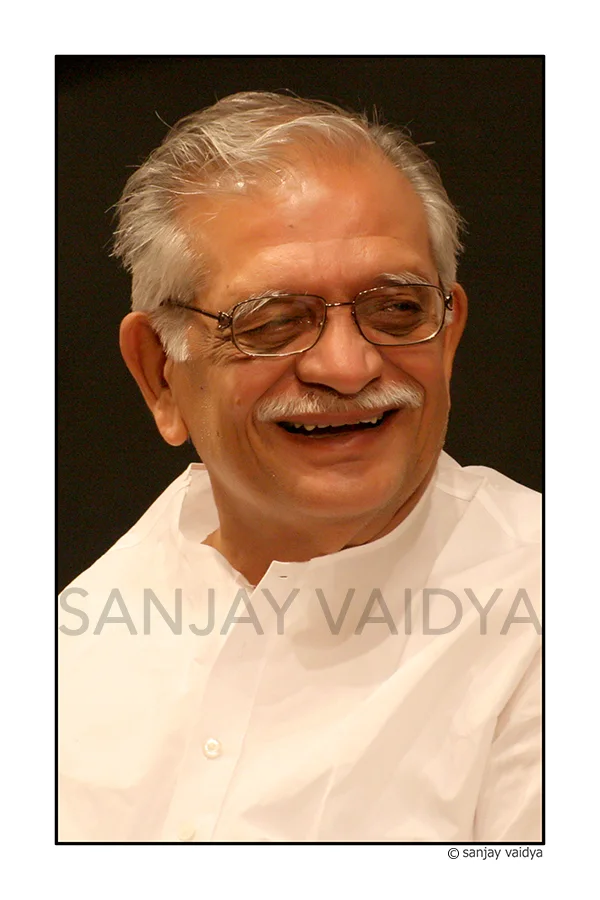
- 9. Wikimedia Commons / Sanjay VaidyaGulzar: exact photograph, history and CC BY-SA grant
Uses initial 13 March 2018 upload, archived as 20200626111810!Gulzar.jpg; later crop and watermark-removal versions rejected.