In this biography
Quick facts
- Born
- 1931-07-10
- Died
- 2024-05-13
- Birthplace
- Wingham, Ontario, Canada
- Country
- Canada
- Nationality
- Canadian
- Known for
- Short fiction, Dear Life and the 2013 Nobel Prize in Literature
- Birth name
- Alice Ann Laidlaw
- First collection
- Dance of the Happy Shades (1968)
- Nobel Prize
- Literature, 2013
- Final collection
- Dear Life (2012)
Why this life matters
Munro expanded the short story’s treatment of time, memory and women’s lives. A responsible account must distinguish that achievement from the family history disclosed by Andrea Robin Skinner after her death.
Timeline
Key moments
Born near rural Ontario settings
Born in Wingham on 10 July.
University and early publication
Studies at the University of Western Ontario before moving into marriage and working life.
First story collection
Dance of the Happy Shades appears after years of writing and magazine or broadcast publication.
Dear Life and Nobel recognition
A final collection is followed by the Nobel Prize in Literature.
Death and subsequent disclosures
Dies on 13 May; in July Andrea Robin Skinner publicly describes abuse by Gerald Fremlin and her mother’s response.
Wingham, reading and an unfinished degree
Alice Ann Laidlaw was born in Wingham, Ontario, on 10 July 1931. Her childhood combined rural family work with reading and school. She attended the University of Western Ontario from 1949 to 1951; the record does not justify turning those studies into an earned degree.
The Ontario communities that later recur in her fiction were neither decorative scenery nor an exhaustive map of her life. She also lived in British Columbia. These different settings complicate the assumption that every fictional household is simply her own family with changed names.
Writing around work and family responsibilities
After marrying James Munro in 1951, she moved west. The couple opened Munro’s Books in Victoria in 1963. Stories had already reached audiences through magazines and broadcasting before Dance of the Happy Shades appeared in 1968.
A first collection was therefore not the beginning of writing but the result of a long apprenticeship. Lives of Girls and Women, published in 1971, used connected stories to follow a developing life. The distinction matters because connected short fiction is not merely an unsuccessful attempt at a conventional novel.
The short story as an expansive form
Munro returned to Ontario in the 1970s, and her work reached a growing international readership. Rather than following every event in sequence, her stories move across years, revisit earlier judgments and withhold information that changes the meaning of an encounter.
The Nobel presentation speech highlighted this command of narrative time. A reader may initially think a story concerns one crisis, only to discover that its consequences have spread across decades. The rural setting does not make the formal construction simple or the characters’ motives transparent.
Dear Life and Nobel recognition
Dear Life appeared in 2012. Its final four pieces turn more directly towards childhood memory than the earlier stories in the collection, without promising a complete factual record. In a contemporary interview Munro described the difficulty of separating remembered feeling from exact reconstruction.
She received the Nobel Prize in Literature in 2013. The Foundation’s In Her Own Words is a recorded interview, not a lecture she delivered in Stockholm. It provides an account of revision and story-making from the writer herself, alongside the institution’s formal assessment.
Andrea Robin Skinner’s disclosures and the legal record
Munro died in Port Hope, Ontario, on 13 May 2024. That July, her daughter Andrea Robin Skinner published an account of sexual abuse by Munro’s second husband, Gerald Fremlin, beginning in 1976 when Skinner was nine. Skinner said she told her mother in 1992 and described Munro’s subsequent decision to remain in the relationship as a profound betrayal. These statements about Munro’s knowledge and response are attributed to Skinner, not presented as criminal findings against Munro.
There is a separate established legal event. Canadian Press reporting from the court transcript records Fremlin’s guilty plea to indecent assault on 11 March 2005 and a suspended sentence with two years’ probation. That conviction should not be blurred into either an unproven allegation or a ruling on every later account. Associated Press reporting also documented support for Skinner and the reassessment of Munro’s reputation.
Reading the work without erasing the person harmed
Earlier institutional biographies explain the growth of Munro’s literary career but predate the public disclosures. They cannot be treated as complete accounts of her family history. Nor does a fictional story, however perceptive about secrecy, establish what the author knew on a particular date.
A useful legacy discussion keeps two tasks visible: examining how the fiction works and acknowledging the survivor’s account and documented court history. Literary influence is not evidence of moral innocence. Readers need accurate context rather than either a celebratory biography that omits the disclosures or unsupported claims that every story confesses them.
Quick answers
Frequently asked questions about Alice Munro
- Why did Alice Munro win the Nobel Prize?
- The 2013 literature prize recognized her mastery of the contemporary short story, especially its ability to contain complex lives and shifts in time.
- Is Dear Life a memoir?
- It is a 2012 story collection. Its final four pieces draw more directly on childhood memory, but the collection as a whole is not a comprehensive factual autobiography.
- What did Andrea Robin Skinner disclose in 2024?
- She described sexual abuse by Gerald Fremlin and said Munro learned about it in 1992 but continued the relationship. These statements about Munro are Skinner’s account; Fremlin’s 2005 guilty plea and conviction are separately documented.
- Did Alice Munro deliver a Nobel lecture in Stockholm?
- No. The Nobel site presents a recorded interview under In Her Own Words; it should not be described as a lecture delivered by her at the ceremony.
Keep exploring
Lives connected to this story
- Lucy Maud Montgomery
Read about an earlier Canadian author named among Munro’s formative reading in her Nobel biography.
- Margaret Atwood
Compare a Canadian contemporary working across novels, poetry, criticism and literary institutions.
- Virginia Woolf
Explore a different writer’s experiments with memory and narrative time, without implying identical methods.
Sources and further reading
Explore the evidence
These references support the biography and offer further reading. Official records, first-person accounts and independent reporting provide different perspectives; image records document attribution and licensing.
- 1. Nobel FoundationAlice Munro: birth, death and 2013 literature prize
- 2. Robert Thacker / Nobel Foundation2013 biographical account, read as a historical account
Historical 2013 biography, not a post-2024 assessment of the disclosures.
- 3. Nobel Foundation2013 biobibliographical note and editions
- 4. Deborah Treisman / The New Yorker20 November 2012 interview on Dear Life and writing
- 5. Nobel Foundation2013 recorded interview: In Her Own Words
- 6. Nobel Foundation2013 presentation speech: narrative time and form
- 7. Andrea Robin Skinner / Toronto Star7 July 2024 first-person essay, reproduced by its author
First-person survivor account; no graphic details reproduced or unproved criminal findings attributed to Munro.
- 8. Rob Gillies and Hillel Italie / Associated Press8 July 2024: daughter’s account and responses
- 9. Sonja Puzic / The Canadian Press30 July 2024: reporting from the 2005 court transcript
Reporter consulted the court transcript; this page does not claim independent inspection of the original case file.
- 10. Knopf / Penguin Random HouseDear Life: collection and edition information
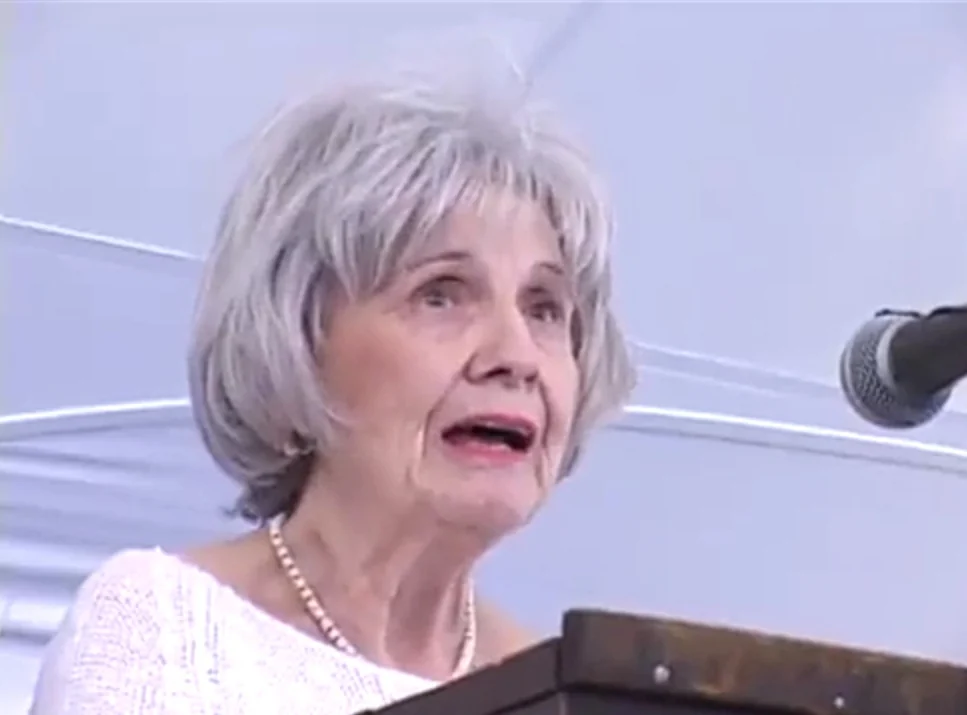
- 11. MacDowell / Wikimedia Commons2006 video still and independently reviewed historical source licence
Specific 2006 source-video CC BY-SA grant was independently reviewed in 2024. Current source playback was unavailable; no full-video viewing is claimed.