In this biography
Quick facts
- Born
- 21 July 1899
- Died
- 2 July 1961
- Birthplace
- Oak Park, Illinois, United States
- Country
- United States
- Nationality
- American
- Known for
- The Sun Also Rises, A Farewell to Arms, For Whom the Bell Tolls and The Old Man and the Sea
- Early profession
- Newspaper reporter before literary fame
- First book
- Three Stories & Ten Poems, Paris, 1923
- Pulitzer Prize
- Fiction, 1953, for The Old Man and the Sea
- Nobel Prize
- Literature, 1954
Why this life matters
His career connects modernist experimentation, international reporting and literary celebrity; his manuscripts also reveal the extensive revision behind an apparently direct style.
Timeline
Key moments
Born in Oak Park
Hemingway was born on 21 July in Illinois.
Reporting and wartime service
He worked for the Kansas City Star, then volunteered with the Red Cross in Italy, where he was wounded.
Early books in different forms
Three Stories & Ten Poems preceded the 1924 vignette book in our time and the expanded 1925 story collection In Our Time.
Major early novels
The Sun Also Rises appeared in 1926 and A Farewell to Arms in 1929.
Spain and a new novel
His Spanish Civil War reporting preceded For Whom the Bell Tolls, published in 1940.
The Old Man and the Sea and literary prizes
The 1952 book won the 1953 Pulitzer Prize for Fiction; Hemingway received the Nobel Prize in Literature in 1954.
Death and posthumous publication
He died in Ketchum, Idaho, on 2 July 1961. A Moveable Feast was published after his death in 1964.
A reporter before a celebrated novelist
Ernest Hemingway was born in Oak Park, Illinois, on 21 July 1899. His youth included time in northern Michigan, a landscape that would recur in his fiction. After finishing high school in 1917, he worked for the Kansas City Star. Newspaper employment came before the books that established his reputation: he learned to observe events, select details and write for readers outside an academic setting.
In 1918 he volunteered with the Red Cross in Italy and was wounded. Wartime experience became important material, but a life event and a fictional scene are different kinds of evidence. A Farewell to Arms, published in 1929, concerns an American ambulance officer during the First World War. Its narrator is a character, not an unmediated record of everything Hemingway did or believed. Reading the novel as an autobiography would flatten the choices through which experience became art.
Paris and the making of the early books
Hemingway married Hadley Richardson in 1921 and moved to Paris. His literary acquaintances included Gertrude Stein, Ezra Pound and F. Scott Fitzgerald. This was a working community of advice, criticism and publishing opportunities, rather than a style invented in isolation. Three Stories & Ten Poems, issued by Contact in Paris in 1923, was his first book. Its title matters: poetry belonged to this early publication as well as short fiction.
The small Paris book in our time followed in 1924. It should not be confused with the substantially expanded American In Our Time of 1925. The Sun Also Rises appeared in 1926, bringing his treatment of expatriate life to the novel. The sequence shows a writer testing scale and arrangement, from compressed pieces to sustained narrative. It also explains why a modern omnibus can obscure the way early readers first encountered the work.
Journeys, reporting and the boundaries of genre
Key West, Cuba, Spain and Africa became important settings in Hemingway’s life and writing. His books nevertheless require different reading expectations. Death in the Afternoon (1932) addresses bullfighting; Green Hills of Africa (1935) is nonfiction associated with an African hunting journey. Neither is simply another installment in a sequence of novels. Sports, travel and danger supplied material, while a deliberately public image increasingly accompanied the books.
In 1937 Hemingway went to Spain as a correspondent for the North American Newspaper Alliance. For Whom the Bell Tolls, published in 1940, transformed that historical setting into fiction about Robert Jordan and an antifascist guerrilla group. The distinction between report and novel is useful here: historical involvement establishes context, but the novel constructs its own characters and action. A later Hemingway Library Edition places drafts and related writings beside the published narrative, making those different documents available for comparison.
War reporting, family changes and a Cuban home
Hemingway’s adult life involved repeated changes of household as well as literary setting. After his marriage to Hadley Richardson ended, he married Pauline Pfeiffer in 1927. Journalist Martha Gellhorn became his third wife in 1940, and both reported from wartime Europe during the Second World War. In 1946 he married journalist Mary Welsh in Havana. These transitions belonged to the working lives of several writers, not simply to the backdrop of one man’s novels.
Cuba was also a home and place of work, rather than only a destination for travel or fishing. The JFK Library’s guide identifies reference copies of Ernest and Mary Hemingway’s papers preserved at the Museo Ernest Hemingway at Finca Vigía. Alongside materials held elsewhere, these records make domestic life and continuing work part of the historical account. His final years brought him to Idaho; he died in Ketchum in 1961.
Understatement, short fiction and international recognition
The Nobel institution’s biographical account emphasizes Hemingway’s spare dialogue and understatement, including in collections such as Men Without Women (1927). Direct phrasing does not necessarily make the emotional situation simple. In this kind of writing, readers must attend to what a conversation leaves unresolved as well as what it explicitly says. The short stories are therefore a substantial part of the achievement, rather than preparatory exercises for the novels.
The Old Man and the Sea was published in 1952 and won the 1953 Pulitzer Prize for Fiction. Hemingway received the Nobel Prize in Literature in 1954. The Nobel citation singled out his narrative art, identified the recent book as an example and recognized his effect on contemporary style. These are different awards with different dates: the Nobel was not the name of the book’s Pulitzer. Its recognition also concerned a literary career broader than a single fishing narrative.
The archive and the books published after his death
Hemingway died in Ketchum, Idaho, on 2 July 1961. His published bibliography continued to grow afterward. A Moveable Feast appeared in 1964 as a memoir of Paris, while Islands in the Stream and The Garden of Eden were published in 1970 and 1986. Their dates describe publication, not a series of newly completed books that he personally approved for release.
The JFK Library’s holdings distinguish manuscripts, drafts and fragments from correspondence, photographs and other materials. That distinction is essential to his continuing reputation: an archive preserves stages of work as well as finished texts. A Moveable Feast’s 2009 Restored Edition represents another editorial presentation of the surviving material. Comparing such editions can deepen a reading, provided that neither a publisher’s label nor an author’s retrospective recollection is treated as an unquestionable final account.
Quick answers
Frequently asked questions about Ernest Hemingway
- Which Hemingway book won the Pulitzer Prize?
- The Old Man and the Sea, published in 1952, won the 1953 Pulitzer Prize for Fiction. Hemingway received the Nobel Prize in Literature the following year.
- Are in our time and In Our Time the same edition?
- No. The 1924 Paris in our time is a short vignette book. The American In Our Time of 1925 substantially expands the material into a story collection. Check the edition rather than relying on the title alone.
- Is A Farewell to Arms an autobiography?
- No. It is a novel. Hemingway’s wartime experience helps explain its context, but the narrator and events must not be treated as a literal account of his own life.
- Was A Moveable Feast published during Hemingway’s lifetime?
- No. It first appeared in 1964, after his death in 1961. Later editions, including the 2009 Restored Edition, present the surviving memoir material differently.
Keep exploring
Lives connected to this story
- James Baldwin
Compare another American writer’s engagement with Paris and the relationship between fiction, essays and public identity; this is a reading comparison, not a claim that their expatriate experiences were alike.
- Mark Twain
Explore a different American tradition in which travel writing and fiction must be distinguished, and a deliberately cultivated public authorial persona accompanies the books.
Sources and further reading
Explore the evidence
These references support the biography and offer further reading. Official records, first-person accounts and independent reporting provide different perspectives; image records document attribution and licensing.
- 1. Nobel PrizeErnest Hemingway: Facts
- 2. Nobel PrizeErnest Hemingway: Biographical
This is an award-era biography later republished in Nobel Lectures, not a complete modern critical biography. The canonical biography and facts pages were read through direct HTML retrieval after browser access returned 403. Their stylistic descriptions are attributed to the institution.
- 3. Harry Ransom Center, University of Texas at AustinErnest Hemingway Collection: finding aid and biographical sketch
Read the biographical sketch and scope of the institutional finding aid. Its assertion that active writing ended in 1952 is not repeated: later memoir manuscripts and posthumous editions require a more careful distinction between writing and publication. Full manuscript files were not consulted.
- 4. Oak Knoll PressErnest Hemingway: A Descriptive Bibliography, excerpt: early first editions
Read the four-page descriptive-bibliography excerpt for the 1923 first book and 1924 Paris edition. The 1924 entry’s printing line contains an inconsistent 1923 date; the explicit publication line and title-page transcription establish 1924, which is corroborated by the Foundation bibliography.
- 5. Ernest Hemingway Foundation of Oak ParkErnest Hemingway bibliography
- 6. The Pulitzer PrizesThe Old Man and the Sea: 1953 Fiction winner
- 7. John F. Kennedy Presidential Library and MuseumErnest Hemingway: Archival Holdings
- 8. Scribner / Simon & SchusterFor Whom the Bell Tolls: The Hemingway Library Edition
- 9. Scribner / Simon & SchusterA Moveable Feast: The Restored Edition
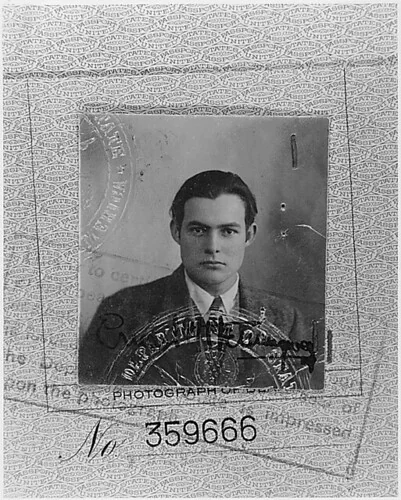
- 10. National Archives Foundation, DocsTeachErnest Hemingway Passport, NAID 192693: item and public-domain statement
Exact NAID 192693 item explicitly identifies public-domain status; the National Archives’ own Flickr item also states unrestricted use. The photographer remains unidentified. Government hosting is not used to infer government authorship, and the complete supplied passport-page rendition is retained.
- 11. U.S. National ArchivesErnest Hemingway 1923 Passport Photograph: unrestricted-use Flickr posting