In this biography
Quick facts
- Born
- 1961
- Birthplace
- Canadian air force base, Baden-Söllingen, West Germany
- Country
- Canada
- Nationality
- Canadian
- Known for
- Generation X, Microserfs, jPod, Player One and a multidisciplinary visual-art practice
- Born
- 1961, Baden-Söllingen, West Germany
- Raised
- West Vancouver, British Columbia
- First novel
- Generation X: Tales for an Accelerated Culture (1991)
- National honour
- Officer of the Order of Canada, appointed 2013
Why this life matters
His writing and visual work examine how consumer objects, information systems and cultural labels shape people’s sense of identity, place and possible futures.
Timeline
Key moments
Germany, Vancouver and art school
A Canadian military-base birthplace precedes a West Vancouver upbringing and art/design study.
Generation X
His first novel brings a fictional trio and an unusual design into public discussion.
Technology, work and stories
Microserfs and jPod extend the fiction beyond the debut’s desert setting.
Player One
A novel in five hours becomes his contribution to the Massey Lectures.
Honours and a major survey
The Order of Canada appointment precedes the Vancouver exhibition and its Toronto presentations.
Short fiction and painting
Binge and The New Ice Age continue a practice across different forms.
An art education before the literary label
Douglas Coupland was born in 1961 on a Canadian air force base at Baden-Söllingen in West Germany. His family moved to West Vancouver in 1965. His Canadian background therefore includes a birthplace abroad, rather than beginning with an inferred nationality based only on where he later worked.
He studied at Vancouver’s Emily Carr Institute of Art and Design, graduating in 1984, and also pursued art and design in Japan and Italy. In a 1991 interview with The Harvard Crimson, he recalled varied jobs and an accidental route into magazine writing. The novelist who became associated with a generation had already been learning to make things and earn a living.
Generation X made fiction into a public shorthand
Generation X: Tales for an Accelerated Culture appeared in 1991. Andy, Dag and Claire leave conventional careers for service work and storytelling in Palm Springs. The novel’s page margins carry definitions, slogans and images alongside the narrative. Its form makes cultural observation part of the reading experience rather than separating it into an explanatory essay.
The title became a shorthand for a cohort, but the book is not a scientific definition of everyone born within a fixed range. Its central figures are particular fictional people. Contemporary reviews found both emotional force and glibness in its satire, distinctions that remain useful when its cultural reputation threatens to replace the actual novel.
Computer workers and changing forms of belonging
Microserfs in 1995 moved into the lives of programmers whose working routines and company loyalty constrain their ambitions. Coupland’s own book description frames a choice between remaining components of a large software organization and trying to become innovators. Technology is part of the characters’ social world, not merely a collection of fashionable references.
jPod returned to a related technological milieu, explicitly presented on his website as an update for the age of Google. Other novels, including Girlfriend in a Coma and Hey Nostradamus!, widened his settings and emotional concerns. The recurring interest is how people seek attachment and meaning amid systems that offer them ready-made identities.
Commentary can take the shape of a story
Coupland’s cultural writing has ranged beyond novels into essays and a biography of Marshall McLuhan. Player One, published in 2010, became his contribution to the Massey Lectures: he used a novel in five hours rather than a conventional sequence of expository talks. Story remained a method for carrying ideas through time.
The Writers’ Trust recognized Generation A as a 2009 fiction finalist and Kitten Clone: Inside Alcatel-Lucent as a 2015 nonfiction finalist. These are finalist distinctions, not prize wins. The pairing shows a career moving between invented situations and investigations of the contemporary technological world, without requiring either form to supply a neutral prediction of the future.
Objects, screens and public space
Coupland’s visual practice encompasses painting, sculpture, installation, photography and everyday materials. The Vancouver Art Gallery’s 2014 survey, everywhere is anywhere is anything is everything, brought that work into a major institutional presentation curated by Daina Augaitis. QR-code paintings joined visual abstraction to messages that viewers could retrieve through a phone.
Reception was not uniformly celebratory. Canadian Art critic Clint Burnham questioned the familiar Canadian imagery and some of the show’s objects while finding stronger work in its treatment of technologically mediated images. Public recognition and critical resistance can coexist. His 2013 Order of Canada citation also recognized a boundary-crossing writer and artist, including the Terry Fox Memorial in Vancouver.
Continuing across media rather than leaving writing behind
The short-story collection Binge returned to compressed narrative in the 2020s. Coupland’s own account describes brief stories ranging across comic, disturbing and dark registers. Meanwhile, Arsenal Contemporary’s 2024 New York exhibition The New Ice Age presented a new group of paintings in collaboration with Daniel Faria Gallery.
These parallel activities complicate a simple career story in which a novelist stops writing and becomes an artist. In his interview with Brenna Clarke Gray, Coupland described different media as ways of making an idea physically present. That account provides a thread through the books and objects without insisting that they all mean the same thing or succeed equally.
Quick answers
Frequently asked questions about Douglas Coupland
- Was Douglas Coupland born in Canada?
- He was born in 1961 on a Canadian air force base at Baden-Söllingen in West Germany and moved to West Vancouver as a child. He is a Canadian writer and artist.
- Is Generation X a novel or a demographic study?
- It is a 1991 novel about Andy, Dag and Claire in Palm Springs. Its title became a generational label, but its fictional characters do not define every member of a cohort.
- Did Coupland work as an artist before becoming a novelist?
- He trained in art and design before Generation X. His later career has continued across books, painting, sculpture, installation and public commissions.
- Did Kitten Clone win the Writers’ Trust nonfiction prize?
- It was a finalist for the 2015 Hilary Weston Writers’ Trust Prize for Nonfiction. The finalist listing is not a winning result.
Keep exploring
Lives connected to this story
- Margaret Atwood
Compare another Canadian writer’s use of speculative stories to question contemporary social arrangements, while keeping their distinct methods visible.
Sources and further reading
Explore the evidence
These references support the biography and offer further reading. Official records, first-person accounts and independent reporting provide different perspectives; image records document attribution and licensing.
- 1. Vancouver Art GalleryBirth, art education and the actual 2014 survey
Consistent museum and publisher sources support the year 1961; an exact day is not needed here. The museum’s actual exhibition title is used rather than differently ordered title variants in promotional biographies.
- 2. Peter D. Pinch / The Harvard Crimson1991 interview: jobs, writing and the Palm Springs setting
- 3. St. Martin’s Griffin / MacmillanGeneration X: characters, setting and current edition
- 4. Kirkus Reviews1991 review: narrative, design and mixed assessment
- 5. Publishers Weekly18 March 1991 review: stories and emotional undercurrents
- 6. Douglas CouplandMicroserfs: 1995 publication and software-work setting
- 7. Douglas CouplandjPod: technological setting and edition record
The official page displays an August 2007 edition date. No claim is made that this is the novel’s first publication date.
- 8. Brenna Clarke Gray / Studies in Canadian Literature2011 conversation: storytelling, McLuhan, Massey Lectures and media
This 2011 conversation is a primary account of artistic method, not a current bibliography. Its dates for some works differ from other catalogues, so unnecessary exact years are withheld.
- 9. Douglas CouplandPlayer One: 2010 publication record
- 10. Writers’ Trust of Canada2009 and 2015 finalist records
- 11. Clint Burnham / Canadian ArtCritical response to the 2014 survey
- 12. Governor General of Canada2013 Officer appointment and contributions across media
- 13. Douglas CouplandBinge: short-story collection and its form
- 14. Arsenal ContemporaryThe New Ice Age: 6 September–19 October 2024 exhibition
- 15. Douglas CouplandOfficial biography, checked with dated institutional records
The official biography was read, but its changing book totals and undated present-tense employment claims are not treated as verified current counts or roles.
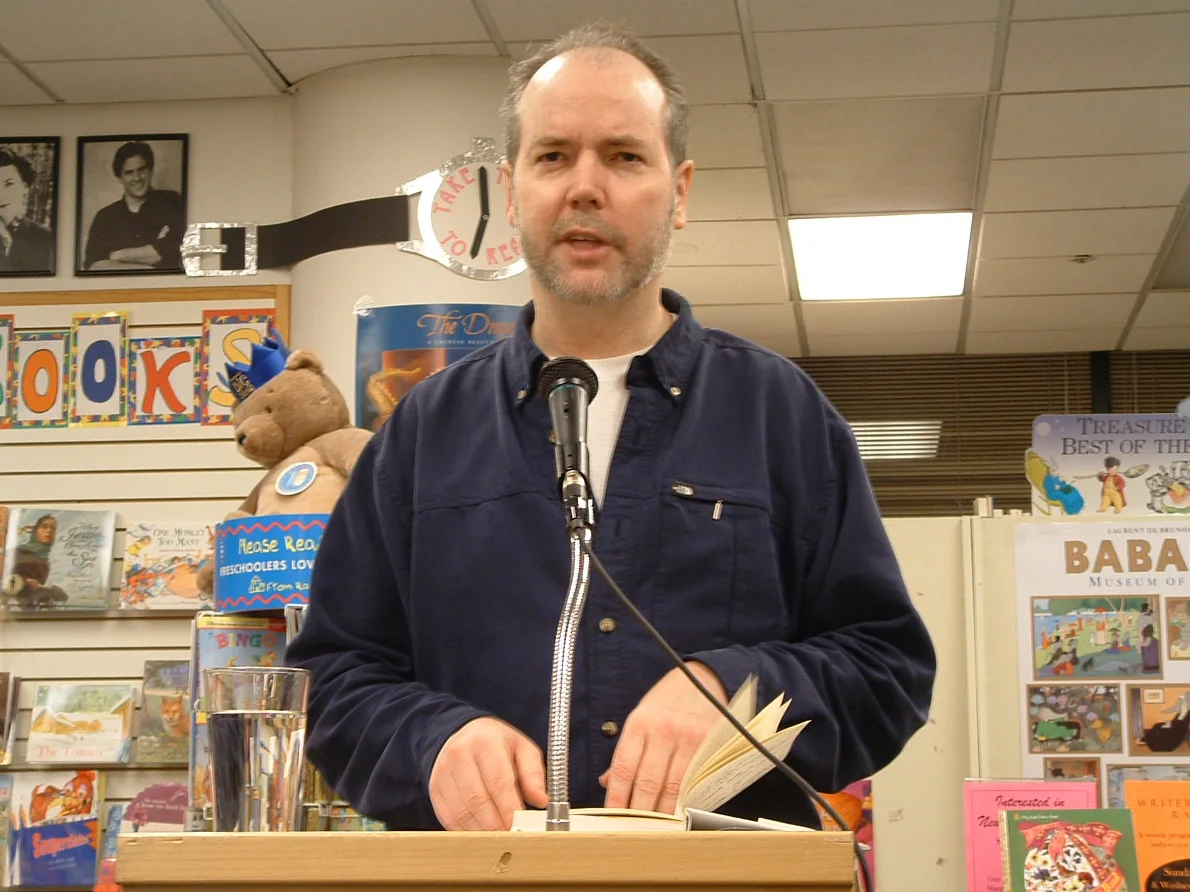
- 16. Interiority / Wikimedia CommonsComplete 2005 reading photograph, self-grant and CC BY-SA 3.0
The exact own-work/self-licence declaration and sole listed original were read through Commons APIs after web cache misses. Full supplied frame and available metadata are retained.