
The short answer
What did the 1961 World Bank loan finance in the Shinkansen project?
Compare the evidence
Shinkansen Finance: Loan and Guarantee
Compare what each inspected record establishes with the claim that remains separate.
| Record or observation | What it supports | What remains separate |
|---|---|---|
| 1961 Guarantee Agreement | Identifies guarantor, borrower and a funding-shortfall undertaking | Is not the separate Loan Agreement or the complete project budget |
| 1967 World Bank retrospective | Connects the loan with construction of the new line | Does not imply the loan financed the whole project |
Identify the three institutional roles
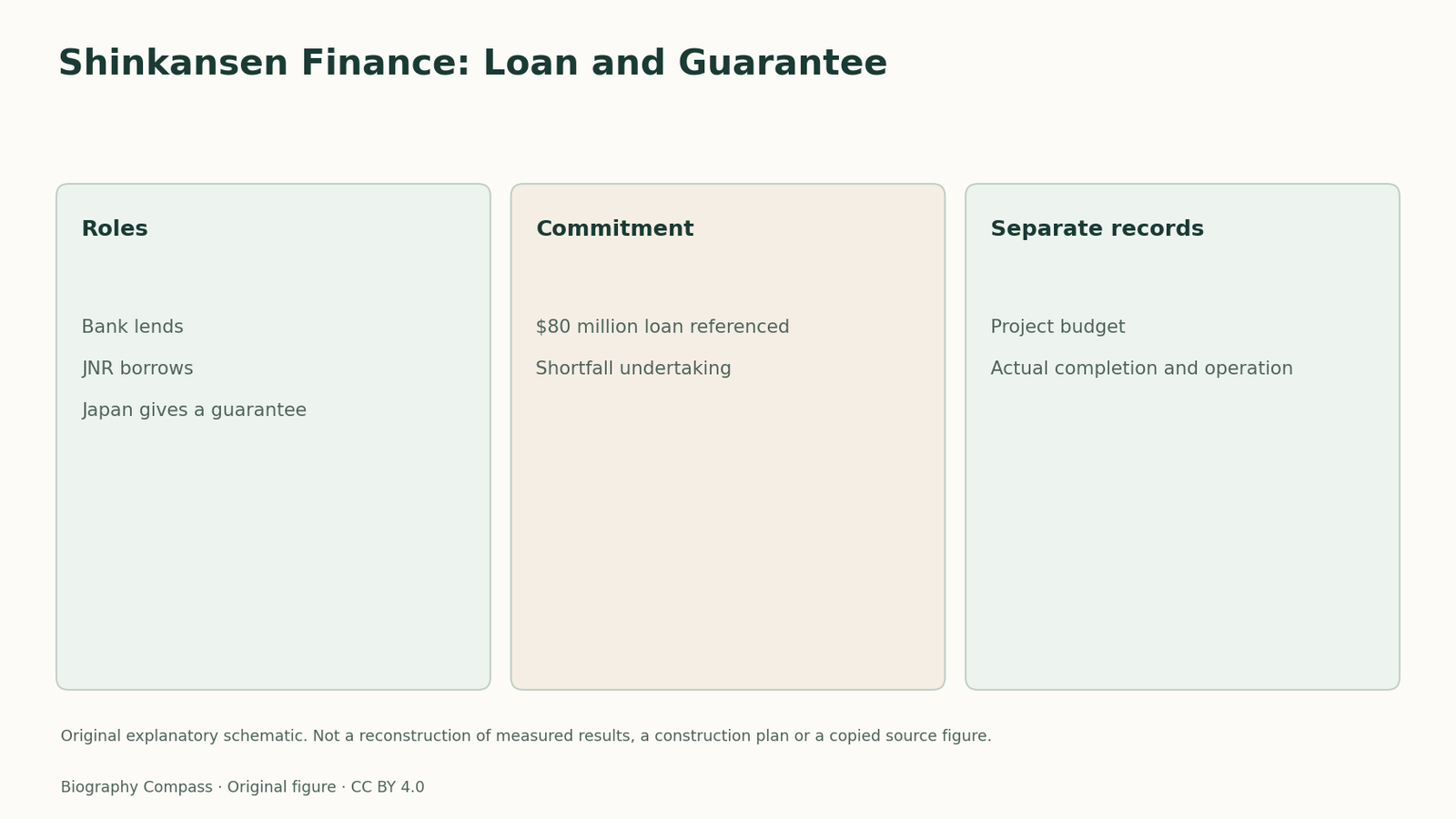
The Guarantee Agreement dated 2 May 1961 names Japan as guarantor and the International Bank for Reconstruction and Development as the Bank. Its opening refers to a separate loan agreement with Japanese National Railways as borrower for the equivalent of eighty million dollars. The documents are connected but not interchangeable. A guarantee agreement explains specified obligations of the guarantor; it should not be cited as though it were the separate loan contract itself.
Sources for this section: [3]
A commitment includes the possibility of a shortfall
Section 2.02 of the guarantee states that, when available funds may be inadequate for estimated project expenditures, Japan is to arrange for the borrower to receive needed funds on reasonable terms. This is evidence of a commitment to address a financing shortfall. The Bank's 1967 retrospective connects its loan with construction of the new line. Neither record implies that eighty million dollars paid for the entire railway or that the initial estimate could not be exceeded.
Sort the records by the claim they support
For an original classroom exercise, label cards lender, borrower, guarantor, project cost and completion. Put the agreed loan amount beside the lender–borrower relationship, and the shortfall undertaking beside the guarantor. Leave project cost and actual completion to their own records. The answer distinguishes a financing contribution from a whole-project budget and a promise from a delivered railway. This is a historical document-reading exercise. It shows why the financing deserves study in its own right beside Sogo's leadership and Shima's engineering.
Continue the chronology
Related history guides
Biography context
Explore Japan through connected lives
Connected biographies
People behind the records
1884–1981
Shinji Sogo
Railway administrator and Japanese National Railways presidentInstitutional leadership and financing of the Tokaido Shinkansen project.Read biography1901–1998
Hideo Shima
Railway engineer and Shinkansen technical leaderTechnical coordination of the first Shinkansen and advocacy of distributed traction.Read biography1883–1959
Edith Clarke
Electrical engineer and power-system analystGraphical calculation methods for long transmission lines and power-system analysis.Read biographyQuick answers
Common questions
- What did the 1961 World Bank loan finance in the Shinkansen project?
- The Bank’s financing contributed to the new Tokaido line. The read Guarantee Agreement identifies JNR as borrower and Japan as guarantor, with a funding-shortfall undertaking; it does not make the loan amount the railway’s total cost.
Primary and institutional sources
How this history was checked
Sources distinguish individual patent or technical records from biographical and retrospective accounts. Their actual reading scope is retained in the biography source notes. This article was reviewed on 7 November 2026.