
The short answer
Why did the first Shinkansen use distributed traction?
Compare the evidence
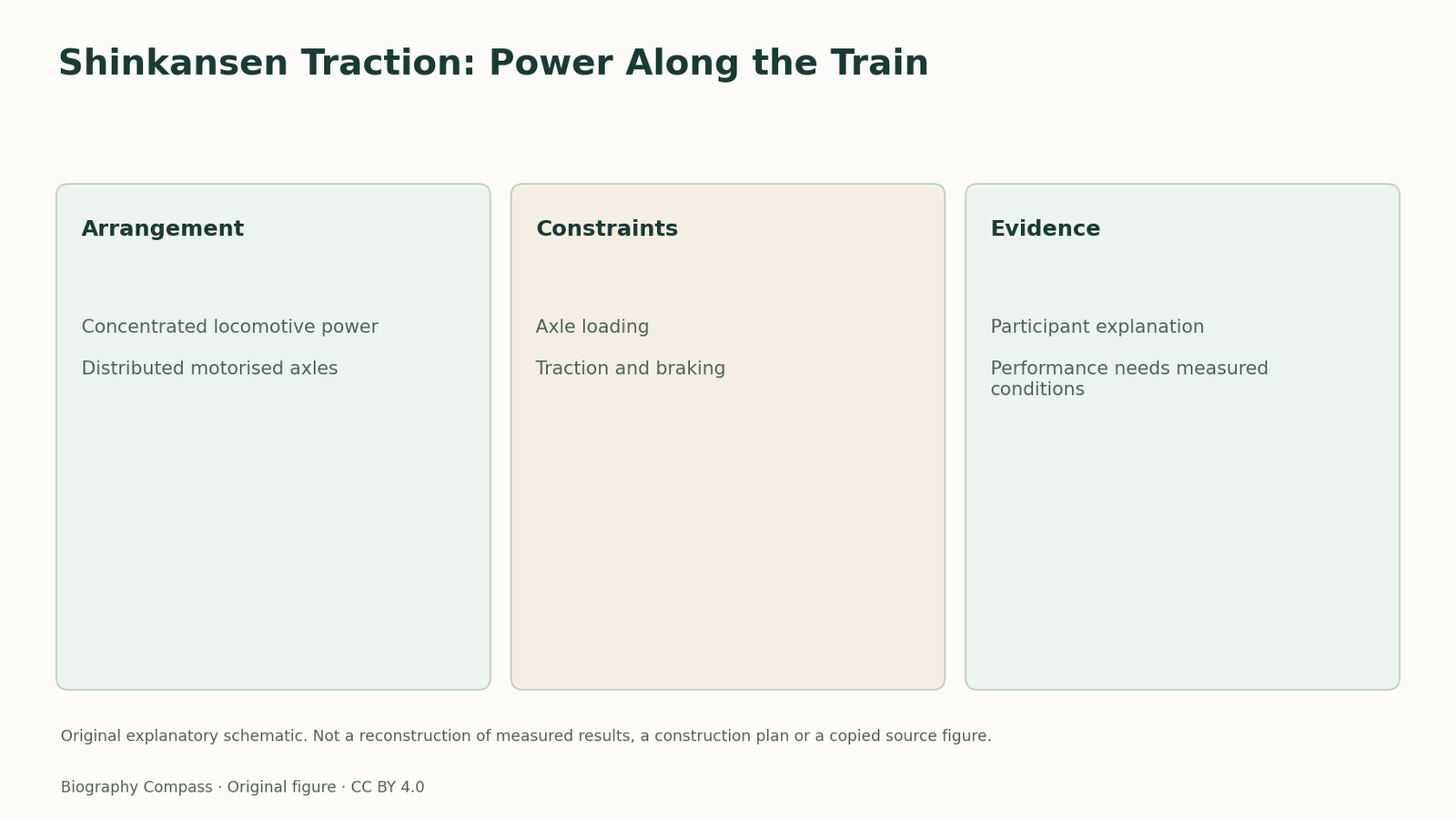
Shinkansen Traction: Power Along the Train
Compare what each inspected record establishes with the claim that remains separate.
| Record or observation | What it supports | What remains separate |
|---|---|---|
| Shima’s participant memoir | Explains distributed traction in relation to axle load and braking | Does not turn a schematic into measured performance |
| Professional obituary | Places the technical choice within a longer railway career | Does not make one engineer the entire development team |
Power need not be concentrated in one vehicle
In his memoir, Shima contrasts locomotive haulage with a multiple-unit arrangement in which motive power is distributed along the train. His earlier experience with electric railcars helped inform the Shinkansen choice. The comparison concerns where traction is produced and how it is transmitted through the train. It is not simply a distinction between a train using electricity and one using steam, since an electrically powered train can also be hauled by a locomotive.
Sources for this section: [2]
Connect the arrangement with constraints
Shima explains that motorised axles can provide the output needed for high-speed operation without concentrating excessive load on a few axles. He also connects them with electric braking. These are system relationships, not a promise that adding motors always improves every measure. His discussion of further improvement through regenerative braking should not be relabelled as proof that every original Shinkansen arrangement already returned braking energy to the supply. The memoir and obituary document a developmental argument with stages.
A distribution exercise without invented performance
Draw an original classroom train with eight identical empty vehicle boxes. In one version place a traction symbol in the front box; in another distribute symbols among several boxes. Ask what the drawing demonstrates. It shows the location of traction equipment, but not acceleration, axle load or energy consumption. To calculate those, masses, power ratings and operating conditions would be needed. This is a conceptual comparison rather than a scale drawing of the first Shinkansen. The supported answer connects distribution with possible constraints while refusing to invent a performance result from the picture alone.
Continue the chronology
Related history guides
Biography context
Explore Japan through connected lives
Connected biographies
People behind the records
1901–1998
Hideo Shima
Railway engineer and Shinkansen technical leaderTechnical coordination of the first Shinkansen and advocacy of distributed traction.Read biography1884–1981
Shinji Sogo
Railway administrator and Japanese National Railways presidentInstitutional leadership and financing of the Tokaido Shinkansen project.Read biography
1886–1976
Hidetsugu Yagi
Telecommunications engineer and university leaderJoint directional-antenna work with Shintaro Uda and international communication of that research.Read biographyQuick answers
Common questions
- Why did the first Shinkansen use distributed traction?
- Shima connected distributed traction with obtaining high output across motorised axles without concentrating axle loads, and with electric braking. The advantages depend on a system design and operating conditions.
Primary and institutional sources
How this history was checked
Sources distinguish individual patent or technical records from biographical and retrospective accounts. Their actual reading scope is retained in the biography source notes. This article was reviewed on 7 November 2026.