
The short answer
Why must a targeted gene change be distinguished from random insertion?
Evidence comparison
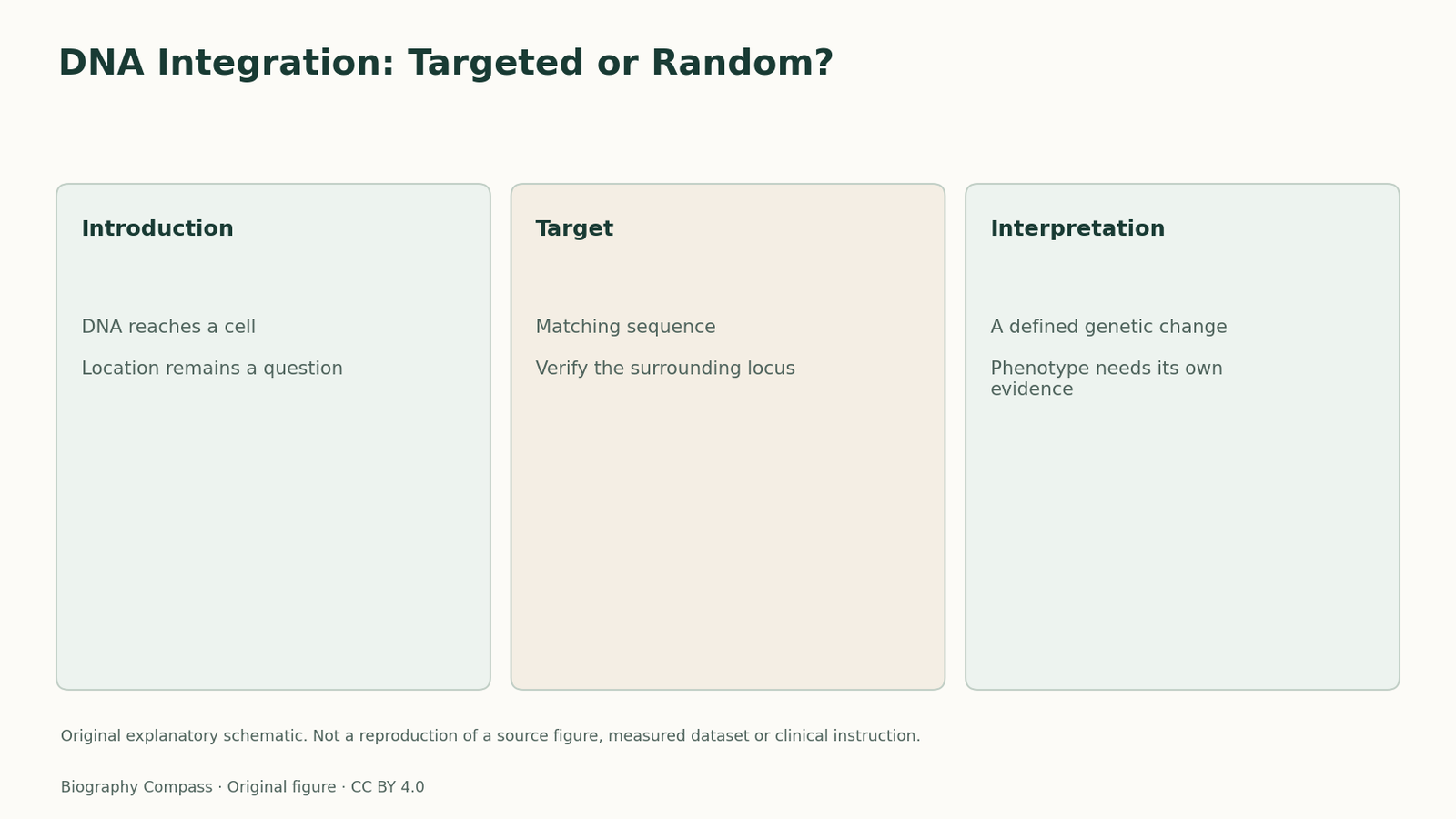
DNA Integration: Targeted or Random?
Compare the observations with the narrower conclusions they support.
| Record or observation | What it supports | What remains separate |
|---|---|---|
| Foreign DNA detected in a cell | Shows introduction or integration somewhere | Does not identify the intended locus |
| Marker linked to the target’s sequence context | Supports a planned genomic modification | Does not by itself establish the later phenotype |
Integration is a location question
Introducing DNA into a cell does not determine where it becomes incorporated. Smithies and colleagues'1985 paper addressed insertion at the human beta-globin locus through homologous recombination. The matching sequence supplied a way to pursue a planned genomic event. The resulting experimental question was more exact than whether a cell had taken up DNA or survived a selection condition: did the intended locus contain the intended modification?
A rare planned event needs an identifying test
The paper's abstract describes producing, scoring and cloning cells with integration at the target locus. Those operations distinguish recovery of a candidate from confirmation of its genetic arrangement. A targeted event can be uncommon among transformed cells without becoming less informative once its identity is established. Conversely, many surviving transformants do not automatically show that targeting worked efficiently or at the correct location.
Sources for this section: [4]
A map-based classroom test
Draw a hypothetical chromosome with a labelled target T and three other sites. Put an identical coloured DNA marker at T in one drawing and at another site in a second. Ask whether detecting the colour somewhere in the cell distinguishes the drawings. The answer is no. A test connecting the marker with the target's surrounding sequence would be needed. The invented chromosome is a location model, not a reconstruction of the beta-globin experiment or an instruction for performing gene targeting.
Sources for this section: [4]
Separate precision from later biological interpretation
Verifying the site establishes the genetic intervention. It does not determine in advance what the modified cell or animal will do. Comparing Smithies's locus question with Capecchi's cell-to-mouse guide keeps the method's genetic specificity separate from the later stages required to investigate gene function.
Continue the chronology
Related history guides
Biography context
Explore United Kingdom through connected lives
Connected biographies
Researchers and related questions

1925–2017
Oliver Smithies
Geneticist and gene-targeting researcherA 1985 paper by Smithies, Richard Gregg, Stephen Boggs, Michael Koralewski and Raju Kucherlapati reported insertion into the human beta-globin locus through homologous recombination.Read biography
1937–
Mario R. Capecchi
Molecular geneticist and gene-targeting researcherIn 1987 Kirk Thomas and Capecchi reported gene targeting in mouse embryo-derived stem cells.Read biography
1943–
Richard J. Roberts
Biochemist and molecular-biology researcherRoberts shared the 1993 medicine prize with Phillip Sharp for the discovery of split genes.Read biographyQuick answers
Common questions
- Why must a targeted gene change be distinguished from random insertion?
- Shows introduction or integration somewhere. Does not identify the intended locus.
- Are the classroom examples historical measurements?
- No. Invented examples are labelled as classroom models; the source-based discussion identifies the historical evidence separately.
Primary and institutional sources
How this history was checked
Official biographical and award records are read alongside the researcher’s technical account. Source scope and hypothetical examples remain distinct. This article was reviewed on 7 November 2026.