
The short answer
How can an enzyme modify a base buried inside a DNA double helix?
Evidence comparison
DNA Base Flipping: Access to a Buried Site
Compare the observations with the narrower conclusions they support.
| Record or observation | What it supports | What remains separate |
|---|---|---|
| Protein binds DNA | Establishes an association or complex | Does not alone show access to a buried target group |
| Target base flips into an enzyme pocket | Provides a local catalytic-access arrangement | Does not imply global unwinding or universal base flipping |
A chemical target lies inside a paired structure
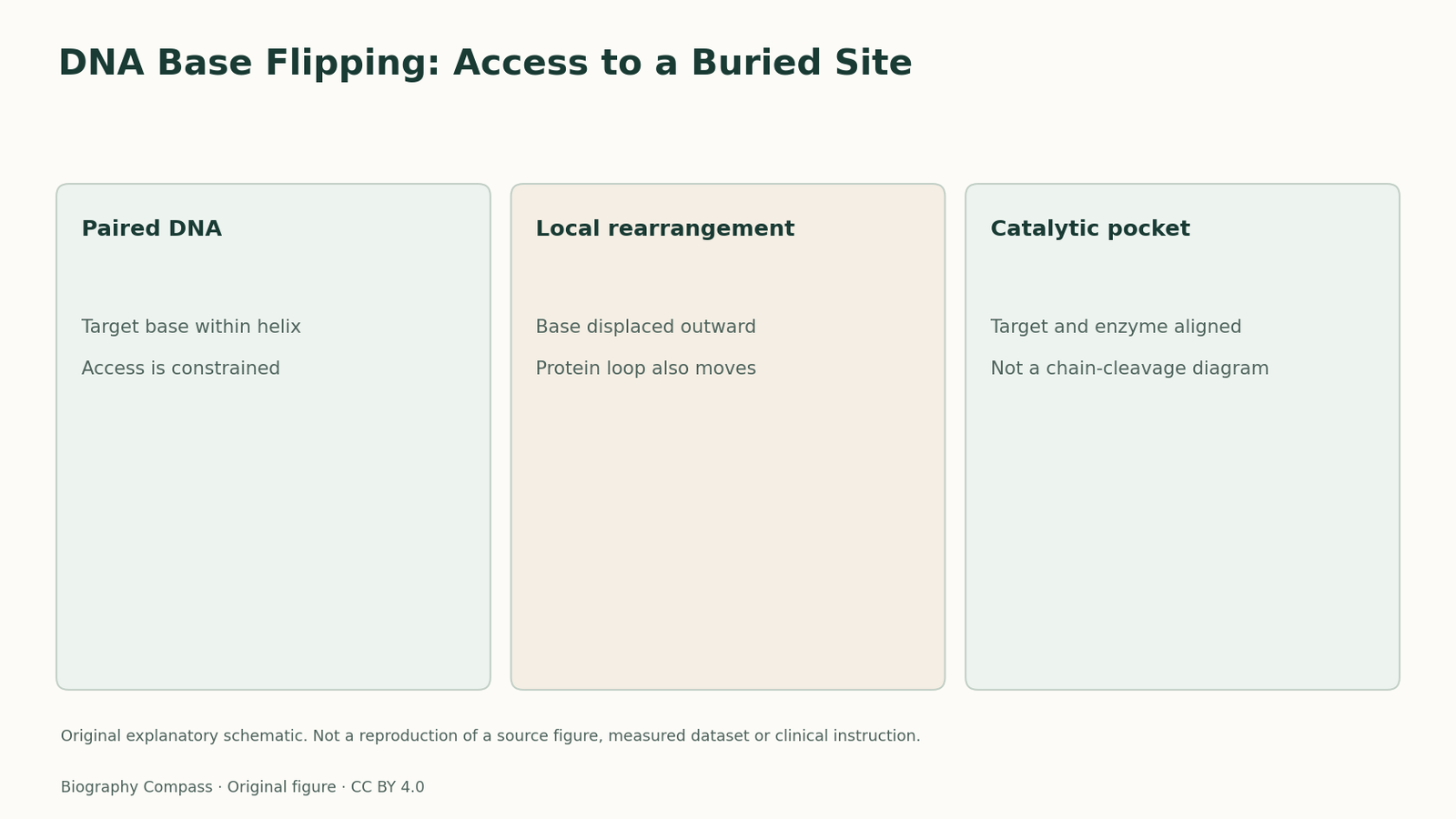
A DNA-modifying enzyme must reach the chemical group it acts upon. In paired DNA, a base is normally organised within the double helix, so access is a structural problem. Roberts's 1993 lecture describes a methyltransferase–DNA complex in which the target cytosine is displaced from the helix into an enzyme pocket. The resulting explanation is more specific than saying that the protein binds DNA somewhere nearby.
Compare binding with the catalytic arrangement
Roberts compares structures with and without DNA and describes both base extrusion and movement of an active-site loop. These observations distinguish a general protein–DNA association from an arrangement that brings the target and catalytic residues together. The lecture reports the rest of the helix as relatively undistorted around the local displacement. This is a particular structural account, not evidence that every DNA-binding protein flips every base it encounters.
Sources for this section: [3]
A page model of access
Draw two parallel lines with paired letter cards between them. Move one card sideways into a labelled pocket while leaving its position in the chain marked. Ask whether the model represents cutting the entire DNA chain, removing a nucleotide permanently or exposing a base to an enzyme. The intended answer is exposure within a local structural rearrangement. The cards do not reproduce atomic coordinates or demonstrate the reaction's speed; they clarify what the proposed movement changes geometrically.
Sources for this section: [3]
Keep the two discoveries separate
Roberts's prize recognised split genes, whereas this lecture-based guide examines access to a base during DNA modification. Comparing them shows why an award citation cannot substitute for reading the later technical record. A discontinuity between DNA and mature RNA is a sequence-organisation question; base flipping is a local molecular-geometry question.
Continue the chronology
Related history guides
Biography context
Explore United Kingdom through connected lives
Connected biographies
Researchers and related questions

1943–
Richard J. Roberts
Biochemist and molecular-biology researcherRoberts shared the 1993 medicine prize with Phillip Sharp for the discovery of split genes.Read biography
1931–2025
Hamilton O. Smith
Molecular biologist and restriction-enzyme researcherAt Johns Hopkins, Smith and graduate student Kent Wilcox investigated the bacterium Haemophilus influenzae.Read biography
1928–1999
Daniel Nathans
Molecular biologist and restriction-mapping researcherNathans became interested in tumour viruses and spent part of 1969 at the Weizmann Institute.Read biographyQuick answers
Common questions
- How can an enzyme modify a base buried inside a DNA double helix?
- Establishes an association or complex. Does not alone show access to a buried target group.
- Are the classroom examples historical measurements?
- No. Invented examples are labelled as classroom models; the source-based discussion identifies the historical evidence separately.
Primary and institutional sources
How this history was checked
Official biographical and award records are read alongside the researcher’s technical account. Source scope and hypothetical examples remain distinct. This article was reviewed on 7 November 2026.