
The short answer
How did gene targeting turn a chosen DNA change into a mouse experiment?
Evidence comparison
Gene Targeting: A Cell Is Not Yet a Mouse
Compare the observations with the narrower conclusions they support.
| Record or observation | What it supports | What remains separate |
|---|---|---|
| Selected altered cell | Provides a candidate for further genetic analysis | Survival does not prove modification at the intended locus |
| Verified targeted locus in a cell | Establishes a specific genetic intervention | Does not alone establish an organismal phenotype |
Choose the genetic site before interpreting the animal
Gene targeting aims to place a defined change at a specified genomic locus. Thomas and Capecchi's 1987 paper examined this in mouse embryo-derived stem cells, including a construct directed at Hprt. The distinction is between obtaining an altered cell and obtaining the intended alteration at the intended place. Selection can help find candidate cells, but the nature of the recovered genetic event still needs to be established.
The cell and mouse stages ask different questions
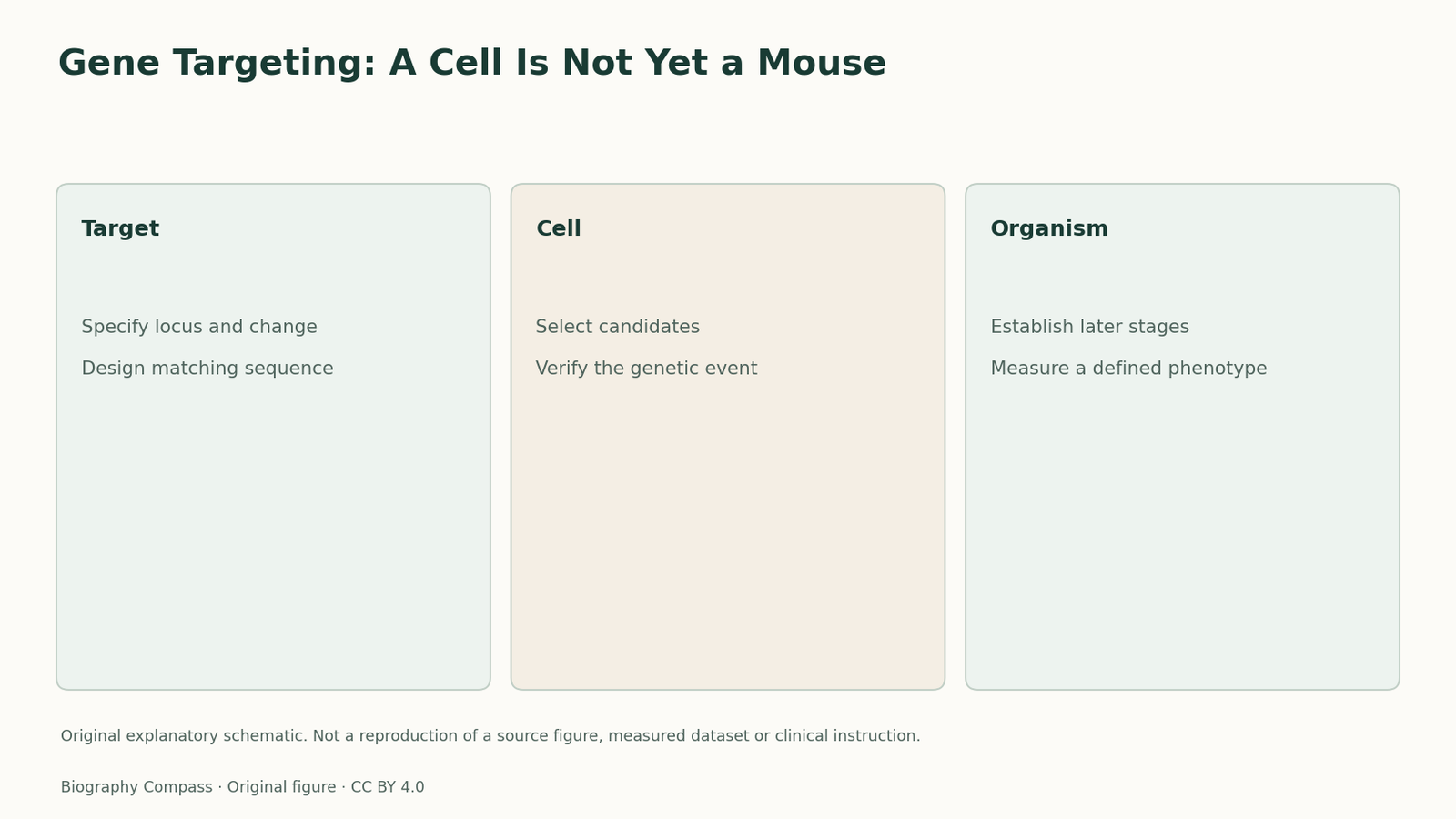
The 2007 Nobel account connects targeted modification with embryonic stem cells and mice. A successfully modified cultured cell is a stage in that programme. It does not by itself establish contribution to a developing animal, transmission or a particular phenotype. Keeping these stages separate prevents a shortened pathway diagram from turning a laboratory intermediate into an organismal conclusion that has not yet been observed.
A staged claim-checking exercise
Create an original ledger with four entries: candidate cell survives selection, intended locus is verified, modified cells contribute to an animal, and the animal's phenotype is measured. Ask which entries can be filled after only the first observation. The answer is just the first. Then add a verified locus and explain the progress: the change is now genetically identified, while the organismal stages remain untested. No invented selection rate or outcome is assigned to the historical work.
Sources for this section: [4]
A model is a defined intervention
Even a completed mouse experiment examines a particular genetic change in a particular context. It need not reproduce every feature of a human disease. The guide's purpose is to make the sequence of evidential claims visible, so that targeting precision and biological interpretation can both be evaluated without treating them as interchangeable achievements.
Continue the chronology
Related history guides
Biography context
Explore United States through connected lives
Connected biographies
Researchers and related questions

1937–
Mario R. Capecchi
Molecular geneticist and gene-targeting researcherIn 1987 Kirk Thomas and Capecchi reported gene targeting in mouse embryo-derived stem cells.Read biography
1925–2017
Oliver Smithies
Geneticist and gene-targeting researcherA 1985 paper by Smithies, Richard Gregg, Stephen Boggs, Michael Koralewski and Raju Kucherlapati reported insertion into the human beta-globin locus through homologous recombination.Read biography1933–2025
John B. Gurdon
Developmental biologist and nuclear-reprogramming researcherGurdon's 1962 study transplanted nuclei from differentiated intestinal epithelium of feeding tadpoles into eggs whose own nuclei had been removed.Read biographyQuick answers
Common questions
- How did gene targeting turn a chosen DNA change into a mouse experiment?
- Provides a candidate for further genetic analysis. Survival does not prove modification at the intended locus.
- Are the classroom examples historical measurements?
- No. Invented examples are labelled as classroom models; the source-based discussion identifies the historical evidence separately.
Primary and institutional sources
How this history was checked
Official biographical and award records are read alongside the researcher’s technical account. Source scope and hypothetical examples remain distinct. This article was reviewed on 7 November 2026.