
The short answer
Why did a carburettor need Shilling’s restrictor during negative-g flight?
Compare the evidence
Shilling’s Restrictor: Flow and Negative G
Compare what each inspected record establishes with the claim that remains separate.
| Record or observation | What it supports | What remains separate |
|---|---|---|
| University’s failure description | Links negative-g conditions with flooding and engine interruption | Does not mean fuel should be reduced in every condition |
| Museum’s object and testing record | Documents a sized restriction, sample tests and later development | Does not make an arbitrary washer a validated fuel-system design |
Name the operating condition and the failure
Negative-g manoeuvres created a fuel-system problem in the carburettor arrangements discussed in the institutional accounts. Excess fuel could flood the engine and interrupt its operation. Shilling's restrictor addressed the flow under those conditions. The important relationship is between the manoeuvre, the behaviour of fuel metering and the operating result. Describing the invention only as a washer leaves out why a specified restriction could be useful.
A restrictor is a controlled modification
The Science Museum record describes an orifice plate sized with tools and gauges, with sample flow testing rather than every plate being individually tested. It also records later methods and pressure-injection development. These details distinguish a calibrated modification from a complete redesign of the carburettor. They provide a better explanation than saying the engine simply needed less fuel in every circumstance. The required flow still had to be compatible with the engine's demand and the conditions being addressed.
Sources for this section: [3]
Compare a change with its validation
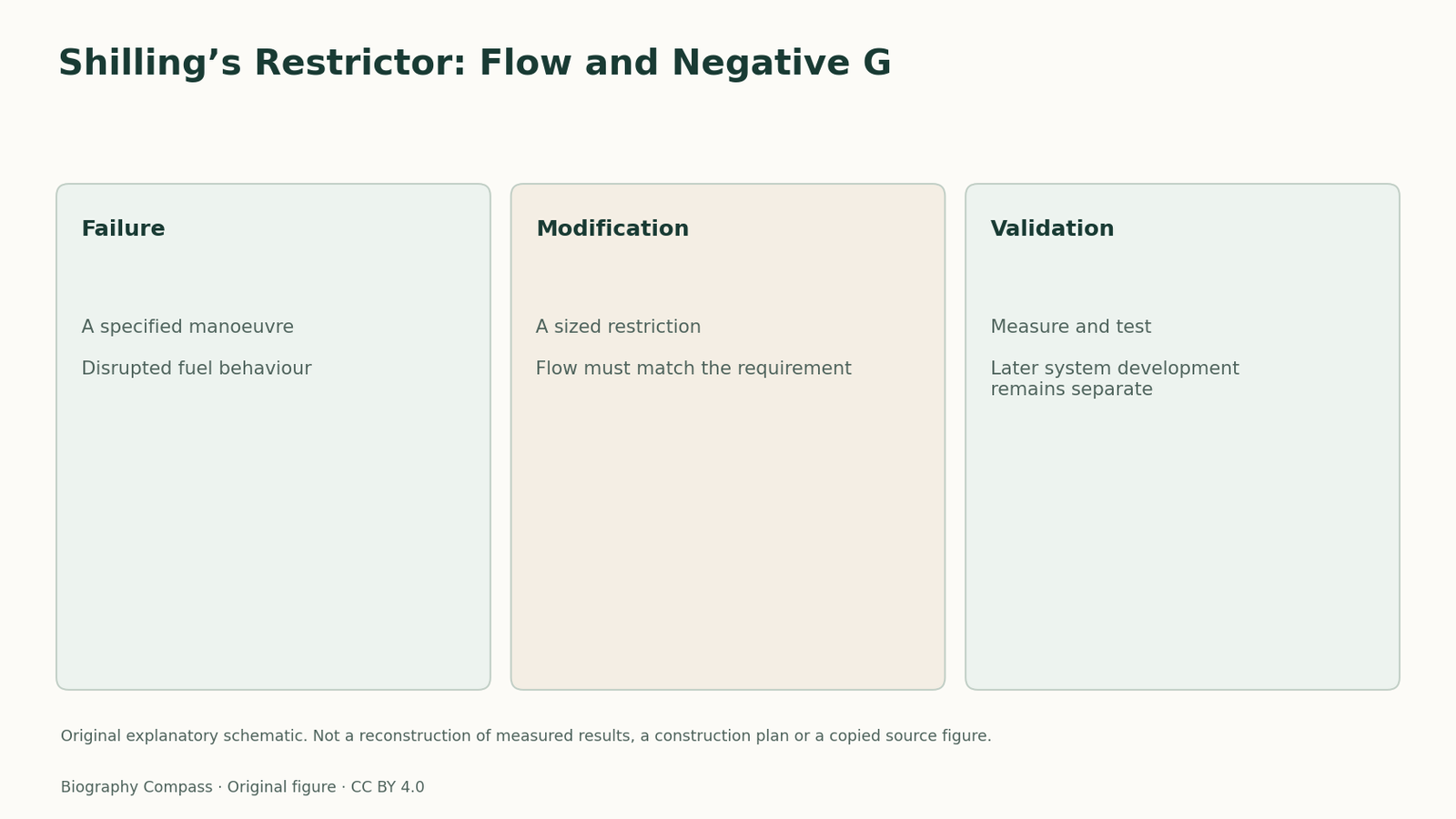
For an original classroom exercise, draw boxes labelled failure condition, proposed restriction, measured flow and engine response. Ask which box is missing if a report says only that a smaller opening was installed. The answer is that the modification alone does not demonstrate its tested behaviour or suitability. This schematic is not an instruction to alter an aircraft or other fuel system. It separates diagnosis, design and validation in the historical record, while leaving actual dimensions and operating limits to the engineering sources rather than inventing them for the diagram.
Continue the chronology
Related history guides
Biography context
Explore United Kingdom through connected lives
Connected biographies
People behind the records
1909–1990
Beatrice Shilling
Aeronautical engineer and carburettor researcherThe RAE restrictor and research on aircraft fuel-metering systems.Read biography1883–1959
Edith Clarke
Electrical engineer and power-system analystGraphical calculation methods for long transmission lines and power-system analysis.Read biography1901–1998
Hideo Shima
Railway engineer and Shinkansen technical leaderTechnical coordination of the first Shinkansen and advocacy of distributed traction.Read biographyQuick answers
Common questions
- Why did a carburettor need Shilling’s restrictor during negative-g flight?
- The restrictor limited excessive fuel flow under the specified negative-g problem. It was a calibrated modification within continuing carburettor development, rather than a claim that every engine always needed less fuel.
Primary and institutional sources
How this history was checked
Sources distinguish individual patent or technical records from biographical and retrospective accounts. Their actual reading scope is retained in the biography source notes. This article was reviewed on 7 November 2026.
- University of Manchester,2015Beatrice Shilling—Engineer and Battle of Britain heroine
- Royal Air Force Museum, Women and Girls in ScienceBeatrice Shilling
- Science Museum GroupPressure injection fuel metering carburettor,1993-2450
- Science Museum, Flight gallery large-print guidePeople story: Beatrice Shilling 1909–1990