
The short answer
What did yeast secretion mutants reveal about transport order?
Evidence comparison
Secretion Mutants: Ordering a Pathway
Compare the observations with the narrower conclusions they support.
| Record or observation | What it supports | What remains separate |
|---|---|---|
| Accumulation followed by release | Supports an intermediate that can continue through the pathway | Does not make every accumulation a normal intermediate |
| An upstream-like double-mutant phenotype | Can support an order under a specified pathway model | Needs complete blocks and interpretable readouts |
A block can reveal an intermediate
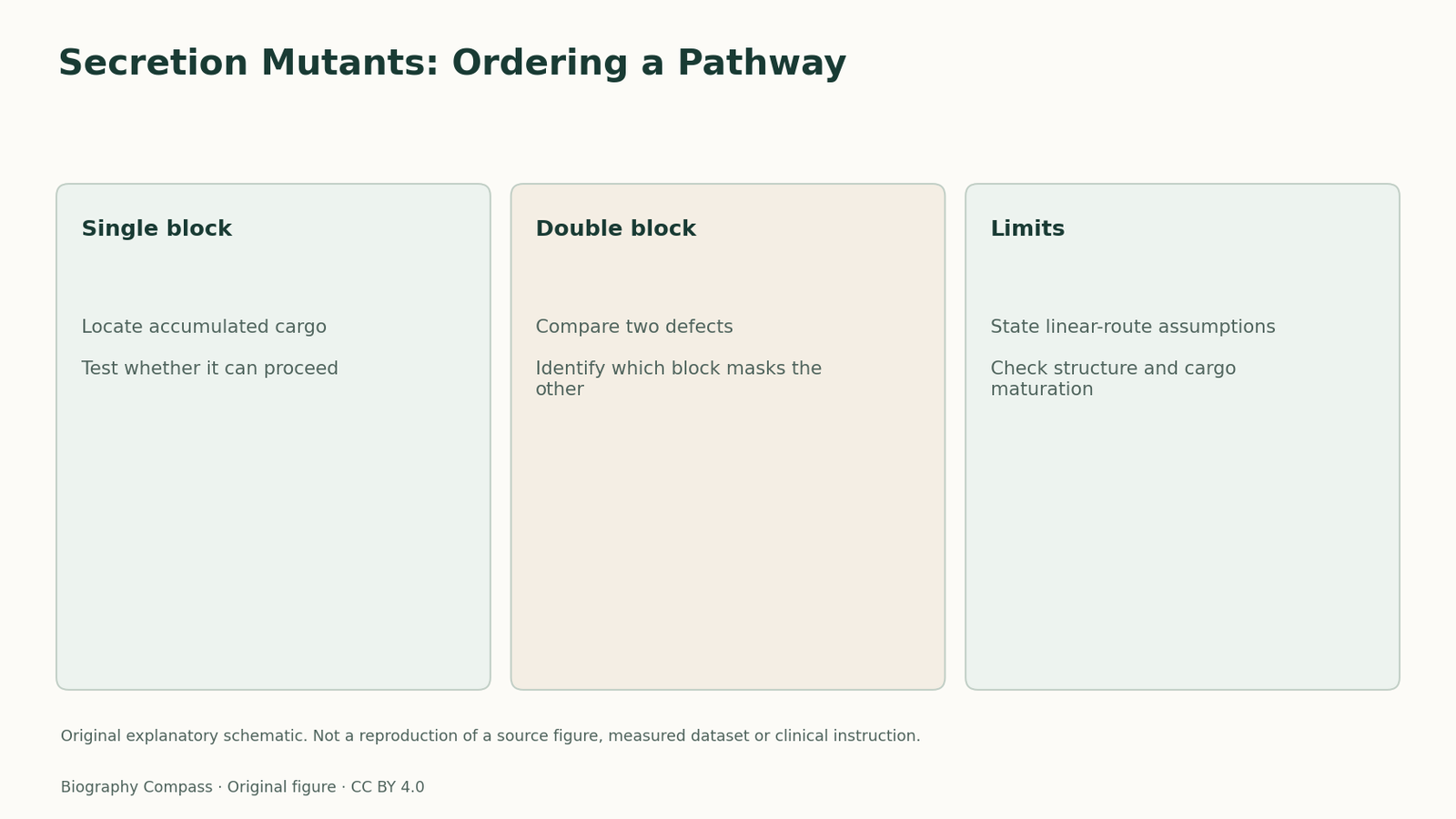
In the 1979 secretion-mutant study, a restrictive temperature blocked secretion while proteins and vesicles accumulated. A return to permissive conditions allowed secretion of accumulated material, including under conditions that inhibited new protein synthesis. This supported the idea that material already present could proceed through the pathway. An accumulation therefore became evidence about an intermediate, rather than simply a general sign that a cell was unhealthy.
Sources for this section: [4]
Compare double blocks to infer order
Novick, Ferro and Schekman's 1981 study used double mutants, cargo maturation and organelle morphology to investigate ordering. If an upstream block prevents material from reaching a downstream stage, the double mutant can resemble the upstream block. That inference requires a pathway model and suitable readouts; it is not a universal rule for every pair of mutations. Parallel branches, incomplete blocks or effects on the readout itself could complicate the interpretation.
A conditional ordering exercise
Draw an invented linear route from compartment A to B to C. Mark one defect that prevents departure from A and another that prevents departure from B. If both defects are complete and neither changes cargo detection, ask where cargo should first accumulate. The answer is A because the earlier block prevents access to B. Now remove the assumption of a single linear route and explain why the answer becomes less secure. This is an original logic exercise, not a claim about a particular historical mutant pair.
Sources for this section: [4]
Use structure and processing together
A cargo's chemical maturation and the appearance of accumulated compartments provide different evidence. Reading them together is more informative than assigning pathway order from a single image. The historical papers show why genetic interpretation depends on the design of the comparison.
Continue the chronology
Related history guides
Biography context
Explore United States through connected lives
Connected biographies
Researchers and related questions
1948–
Randy W. Schekman
Cell biologist and yeast membrane-traffic researcherPeter Novick and Schekman's 1979 paper described a temperature-sensitive secretion mutant in which proteins and vesicles accumulated under restrictive conditions.Read biography1950–
James E. Rothman
Cell biochemist and intracellular membrane-transport researcherRothman and Erik Fries investigated transport of a viral glycoprotein using cell-free preparations.Read biography1918–2007
Arthur Kornberg
Biochemist and DNA-replication researcherKornberg's group isolated DNA polymerase from bacteria in 1956.Read biographyQuick answers
Common questions
- What did yeast secretion mutants reveal about transport order?
- Supports an intermediate that can continue through the pathway. Does not make every accumulation a normal intermediate.
- Are the classroom examples historical measurements?
- No. Invented examples are labelled as classroom models; the source-based discussion identifies the historical evidence separately.
Primary and institutional sources
How this history was checked
Official biographical and award records are read alongside the researcher’s technical account. Source scope and hypothetical examples remain distinct. This article was reviewed on 7 November 2026.
- Nobel Prize OutreachRandy W. Schekman — Facts
- Nobel FoundationRandy W. Schekman — Biographical
- Nobel FoundationRandy W. Schekman — Nobel lecture
- Novick and Schekman / PNAS, 1979Secretion and cell-surface growth are blocked in a temperature-sensitive mutant of Saccharomyces cerevisiae
- Novick, Ferro and Schekman / Cell, 1981Order of events in the yeast secretory pathway