
The short answer
DNA synthesis: why does a copied chain need a template?
Evidence comparison
DNA Copying: Template and Building Blocks
Compare the observations with the narrower conclusions they support.
| Record or observation | What it supports | What remains separate |
|---|---|---|
| Pre-existing DNA | Sequence information supplied | Not simply more raw nucleotide material |
| Activated nucleotides | Material incorporated into product | A supply alone does not specify base order |
Separate the instructions from the ingredients
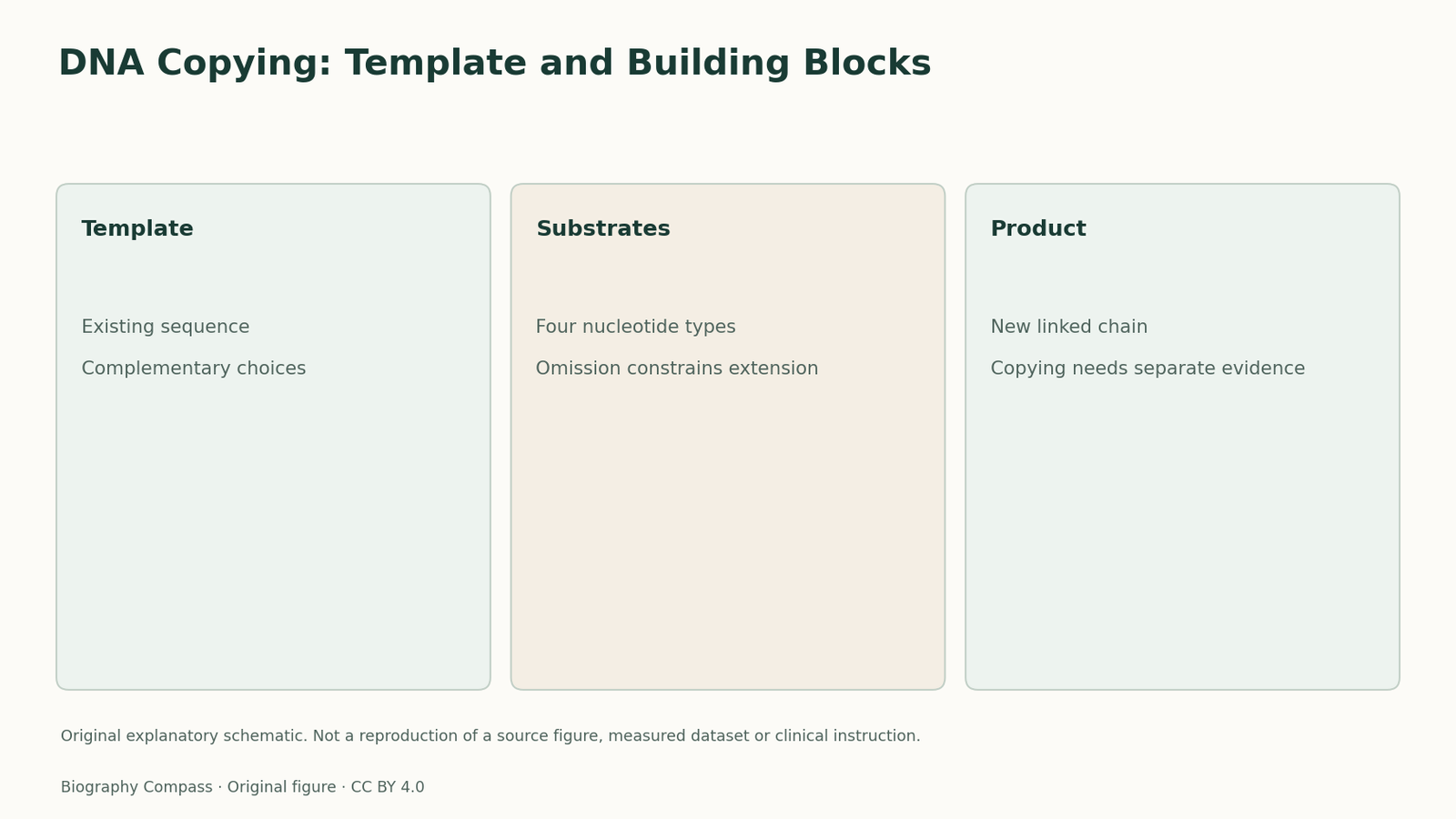
Kornberg's 1959 lecture asks what pre-existing DNA contributes to a synthesis reaction. A supply of nucleotides provides material, but does not by itself specify their order. A template supplies a sequence against which complementary building blocks can be selected. The distinction is useful because a large increase in product demonstrates synthesis, while a claim about copying requires evidence about the relationship between product and template.
Read an omission experiment
The lecture reports that omitting a nucleotide greatly reduced the reaction, and that omitting DNA prevented the complete synthesis system from operating. These comparisons identify requirements of the preparation. They do not, by themselves, show that every DNA molecule inside a living bacterium is copied by this single enzyme. Baldwin's historical account identifies the discovery specifically as DNA polymerase I and connects it with later work on the enzymes of DNA metabolism.
A paper model with a constrained answer
For a classroom model, write the hypothetical template A–C–T–G and offer separate cards marked A, C, G and T. Apply complementary pairing to produce T–G–A–C. Then remove the G card and mark the position that cannot be completed. The answer is a missing substrate requirement, rather than an instruction to substitute any available letter. Label this an original schematic: it supplies neither the molecular geometry nor the reaction conditions of Kornberg's experiments.
Sources for this section: [3]
What the model leaves unresolved
Compare the template, substrate supply and enzyme as three different requirements. A successful card exercise cannot establish fidelity, reaction speed or biological activity. Those are additional experimental questions. The historical achievement was to make such questions approachable with defined components, while leaving the operation of a complete replication system open to further investigation.
Sources for this section: [3]
Continue the chronology
Related history guides
Biography context
Explore United States through connected lives
Connected biographies
Researchers and related questions
1918–2007
Arthur Kornberg
Biochemist and DNA-replication researcherKornberg's group isolated DNA polymerase from bacteria in 1956.Read biography1927–2010
Marshall Nirenberg
Biochemist and genetic-code researcherWorking with Heinrich Matthaei, Nirenberg developed a cell-free system in which added RNA could guide amino-acid incorporation.Read biography1905–1993
Severo Ochoa
Biochemist and enzymatic nucleic-acid synthesis researcherOchoa and Marianne Grunberg-Manago discovered polynucleotide phosphorylase through experiments involving phosphate exchange.Read biographyQuick answers
Common questions
- DNA synthesis: why does a copied chain need a template?
- Sequence information supplied. Not simply more raw nucleotide material.
- Are the classroom examples historical measurements?
- No. Invented examples are labelled as classroom models; the source-based discussion identifies the historical evidence separately.
Primary and institutional sources
How this history was checked
Official biographical and award records are read alongside the researcher’s technical account. Source scope and hypothetical examples remain distinct. This article was reviewed on 7 November 2026.