
The short answer
How did a cell-free assay separate vesicle targeting from membrane fusion?
Evidence comparison
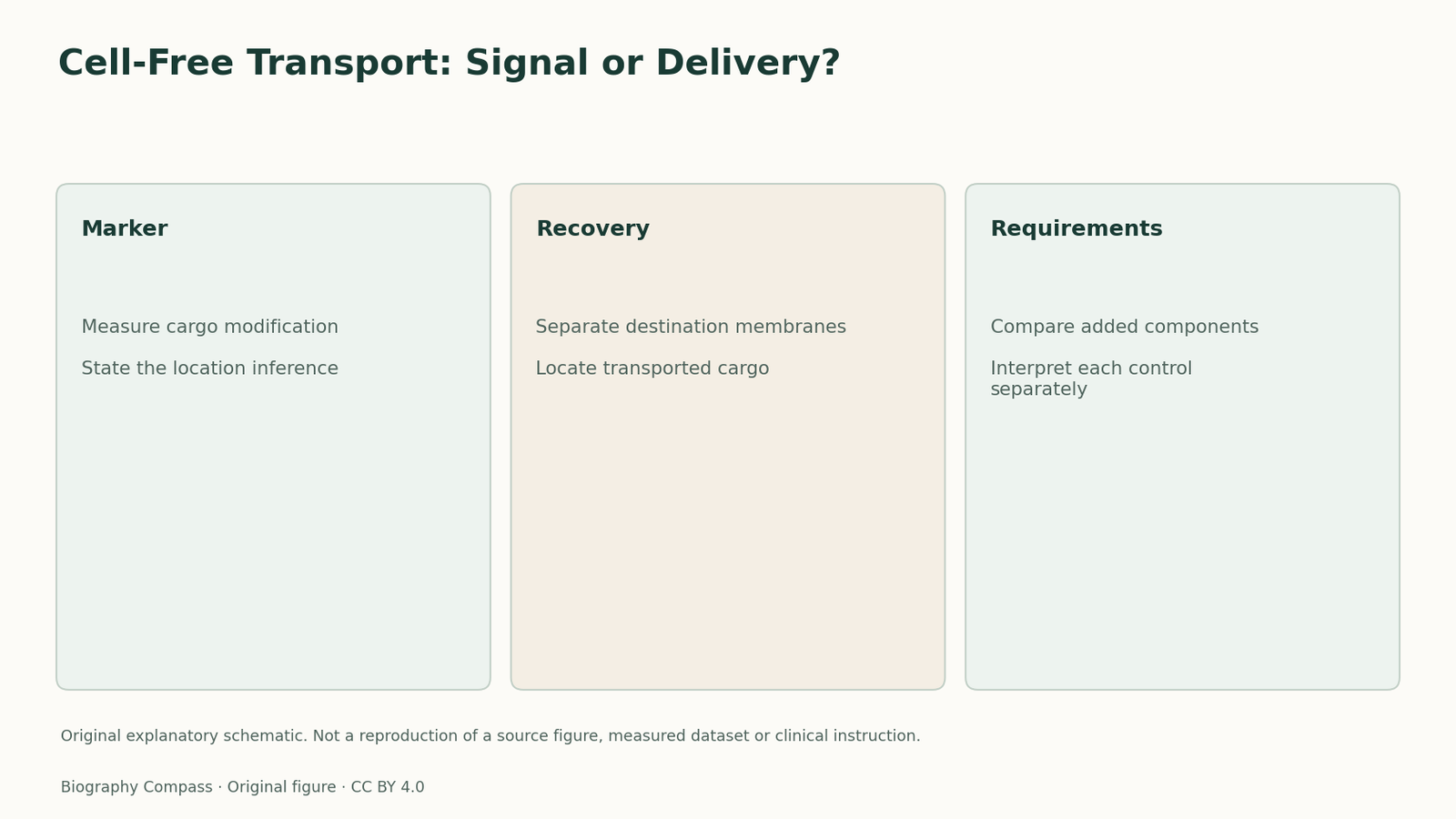
Cell-Free Transport: Signal or Delivery?
Compare the observations with the narrower conclusions they support.
| Record or observation | What it supports | What remains separate |
|---|---|---|
| A destination-associated modification | Provides an indirect arrival marker | Depends on assumptions about where processing occurs |
| Recovery with purified Golgi membranes | Adds more direct cargo-location evidence | Does not reproduce every transport event in a whole cell |
A chemical change can be an arrival marker
Rothman and Fries used modification of a viral glycoprotein as a way to study movement towards Golgi membranes. Their 1981 paper described an earlier conclusion as indirect because it depended on a Golgi-associated glycosylation reaction. The logic was that a cargo acquiring a destination-associated modification had encountered the relevant processing machinery. That is useful evidence, but it is not the same observation as locating the transported cargo in a recoverable destination fraction.
Add a second kind of evidence
The later assay used highly purified Golgi membranes that could be recovered after incubation, permitting a more direct demonstration of net cargo transport. The paper also reported requirements for ATP and a soluble cytosolic fraction, and a membrane-substitution control. These comparisons asked whether the signal reflected a specific transport process rather than an arbitrary mixture of enzymes and membranes. No single control should be treated as a complete account of all vesicle movement.
Sources for this section: [4]
A marker-versus-location exercise
Imagine a parcel that acquires a blue stamp associated with a depot. In one classroom record only the stamp is observed; in another the parcel is also recovered inside the designated depot collection. The second record supplies location evidence in addition to the processing marker. The answer is not that the first record has no value, but that its inference depends more strongly on where the stamping machinery operates. This invented analogy is not a model of membrane geometry or a substitute for the historical assay.
Sources for this section: [4]
Match the conclusion to the readout
A biochemical change, a recovered membrane association and a requirement for an added component support different parts of an explanation. Keeping them separate helps readers follow why reconstitution became a powerful strategy for investigating cellular transport.
Continue the chronology
Related history guides
Biography context
Explore United States through connected lives
Connected biographies
Researchers and related questions
1950–
James E. Rothman
Cell biochemist and intracellular membrane-transport researcherRothman and Erik Fries investigated transport of a viral glycoprotein using cell-free preparations.Read biography1948–
Randy W. Schekman
Cell biologist and yeast membrane-traffic researcherPeter Novick and Schekman's 1979 paper described a temperature-sensitive secretion mutant in which proteins and vesicles accumulated under restrictive conditions.Read biography1918–2007
Arthur Kornberg
Biochemist and DNA-replication researcherKornberg's group isolated DNA polymerase from bacteria in 1956.Read biographyQuick answers
Common questions
- How did a cell-free assay separate vesicle targeting from membrane fusion?
- Provides an indirect arrival marker. Depends on assumptions about where processing occurs.
- Are the classroom examples historical measurements?
- No. Invented examples are labelled as classroom models; the source-based discussion identifies the historical evidence separately.
Primary and institutional sources
How this history was checked
Official biographical and award records are read alongside the researcher’s technical account. Source scope and hypothetical examples remain distinct. This article was reviewed on 7 November 2026.