
The short answer
Malaysia’s Weights and Measures Act 1972 set a framework for measuring goods in commerce. A trader could express a price per kilogram and still need an instrument checked for use in trade. The Act distinguishes the unit used in a sale, the verification of the equipment and actions that can mislead or defraud a buyer.
What an inspector or customer can check
Three parts of a sale by weight
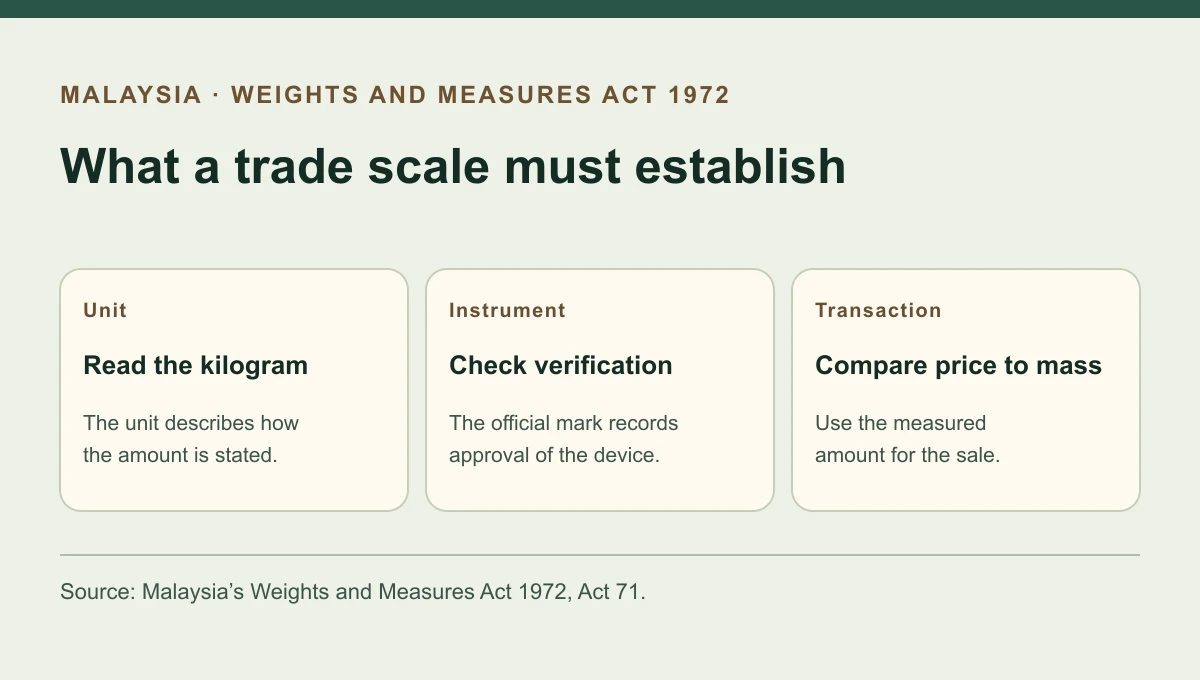
A correct unit and a verified instrument address different parts of the same transaction.
| Part of sale | Example | Question it answers |
|---|---|---|
| Lawful unit | Price quoted per kilogram | Which unit is the basis of the price? |
| Verified instrument | An approved trade scale has the required evidence of verification | Has the equipment been checked for use in trade? |
| Measured quantity | Goods are measured for the sale | What quantity is the charge actually based on? |
Chronology
A timeline of the turning points
The Act receives assent
The statute establishes a national framework for trade weights and measures.
The law provides for appointment of dates
Its commencement clause allows different dates for different provisions or places.
Verification rules can be read together
Sections 12 to 14 cover lawful units, denominations and verification of trade equipment.
Read the date on the first page with the commencement clause
The reprinted Act lists royal assent and publication in March 1972. The commencement clause is separate. It provides for a date appointed by notification and allows different dates for parts of the law or areas within Malaysia. That matters if a reader is comparing the date in the Act’s title with a local change in trading practice.
The Foreign Ministry’s catalogue also records an earlier Metric Weights and Measures Act as repealed by Act 71. The 1972 statute was part of a longer legislative transition.
Why a kilogram label is only one part of the check
In a sale at five ringgit per kilogram, the unit explains how the seller will calculate the bill. If the scale is incorrect, the well-labelled price leaves a measurement problem. The Act’s trade provisions separately address the units in which goods are sold and the checking of the equipment.
Section 14 in the published consolidation describes an inspector verifying and stamping weights, measures or instruments and issuing a certificate. It provides for a certificate in cases where a weight is too small to stamp. The visible mark, the record of verification and the instrument’s actual reading answer related questions.
Where a local check fits in the wider measurement system
An inspector’s reference needs a known relationship to wider standards. The later National Measurement System Act describes traceability for measurements made under written law. Together the statutes let a reader work backwards from a retail reading to a documented comparison, while keeping the retail verification rules separate from the national laboratory’s role.
Continue the chronology
Related history guides
How Malaysia’s 2011 Law Regulated Trade Descriptions
Compare a verified measurement with the commercial claim it might be used to test.
Read the timeline1956–1962How India Introduced Metric Weights and Measures
Compare the local enforcement questions behind India’s change to metric weights.
Read the timeline1972–1981How Singapore’s Market Traders Switched to Metric Scales
Compare Singapore’s market-scale designs and consumer education.
Read the timeline2007How Malaysia Made Measurements Traceable to Standards
Read how Malaysia’s later national measurement law describes traceability.
Read the timelineConnected biographies
People connected to this history
Quick answers
Common questions
- What does a verification mark on a trade instrument signify?
- The consolidated Act describes the mark as evidence that the trade equipment was approved through verification.
- Did royal assent itself specify the date every provision began?
- The Act provides for commencement by gazetted notification, with scope for different dates.
Primary and institutional sources
How this history was checked
Dates, legal milestones and historical claims are checked against the official and institutional records below. This article was reviewed on 19 November 2026.