
The short answer
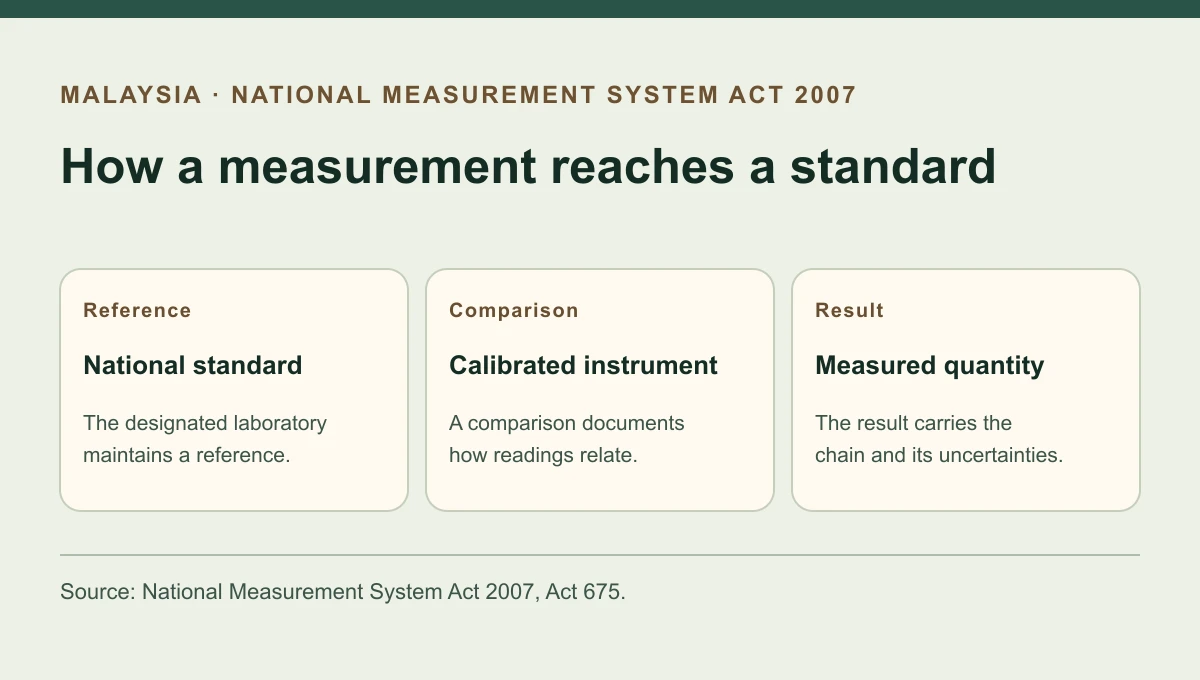
Malaysia’s National Measurement System Act 2007 gives measurements made for the purposes of written law a common reference. A local laboratory can establish a chain of comparisons to a national standard, or reach a recognised reference abroad in specified circumstances. The chain is what makes independently measured results comparable.
An illustrative chain
How a result reaches a reference
This example follows a calibrated reference mass through successive comparisons.
| Level | Example | Evidence needed |
|---|---|---|
| National reference | National laboratory maintains a mass standard | A maintained reference and its established value. |
| Comparison laboratory | A working mass is compared with a known reference | A result connecting the two, with its measurement uncertainty. |
| Local instrument | A balance is tested using the working mass | A documented connection between the observed reading and the reference. |
Chronology
A timeline of the turning points
National measurement law is enacted
Act 675 defines roles for standards, reference materials and traceability.
The designated laboratory maintains standards
Its role includes maintaining or arranging for necessary standards and certified reference materials.
The traceability provisions can be read together
Sections 6 to 8 explain national standards, chains of comparison and recognition abroad.
What counts as traceability
Section 7 describes direct comparison or an indirect chain involving one or more appropriate standards. A measurement can reach the national reference even if the instrument and the national artefact never meet. Each link needs evidence of the comparison or derivation.
The BIPM’s metrology vocabulary describes traceability as a property of a measurement result. In the example, the scale’s reading is useful across organisations because it is linked through the comparison chain and its uncertainties. The chain lets another laboratory evaluate how closely two reported values agree.
Why the law covers more than physical weights
The designated National Measurement Standards Laboratory maintains or arranges the maintenance of standards and necessary certified reference materials. A reference material can support measurement work in which a quantity, such as a composition or concentration, matters more than the shape of an object.
The BIPM country record shows Malaysia participating internationally through its national measurement institutions. That institutional relationship and the local comparison chain provide two different ways of following a reference.
How the law handles a missing domestic reference
Sections 7 and 8 address situations where a normal domestic chain is unavailable, impossible or irrelevant. The Act permits recognised external laboratories under defined circumstances and calls for other confidence measures where appropriate. Reading these provisions together explains why the chain can be flexible without becoming undocumented.
The older law on trade instruments addresses verification at the point of use. Act 675 deals with the reference relationship that allows measurements made under written law to be compared.
Continue the chronology
Related history guides
How Malaysia’s 1972 Law Regulated Trade Scales
See how the trade-scale law handles an instrument used for a sale.
Read the timeline1966–1996How Malaysia Built SIRIM from Two Industrial Institutions
Read how Malaysia’s industrial standards and research institutions were reorganised.
Read the timeline2018–2019How the Kibble Balance Helped Redefine the Kilogram
Compare a laboratory method for realising an international mass reference.
Read the timelineConnected biographies
People connected to this history
Quick answers
Common questions
- Does a local scale need to be compared directly with a national artefact?
- The Act allows indirect traceability through a continuous chain of appropriate comparisons.
- Can a laboratory outside Malaysia provide a reference?
- Section 8 permits traceability to recognised foreign laboratories under the conditions described in the Act.
Primary and institutional sources
How this history was checked
Dates, legal milestones and historical claims are checked against the official and institutional records below. This article was reviewed on 19 November 2026.
- Laws of MalaysiaNational Measurement System Act 2007 (Act 675), consolidated to 1 November 2017
- Laws of MalaysiaWeights and Measures Act 1972 (Act 71), consolidated text
- International Bureau of Weights and MeasuresMalaysia: metrology institutions and participation
- Joint Committee for Guides in MetrologyInternational Vocabulary of Metrology, section 2.41: metrological traceability