
The short answer
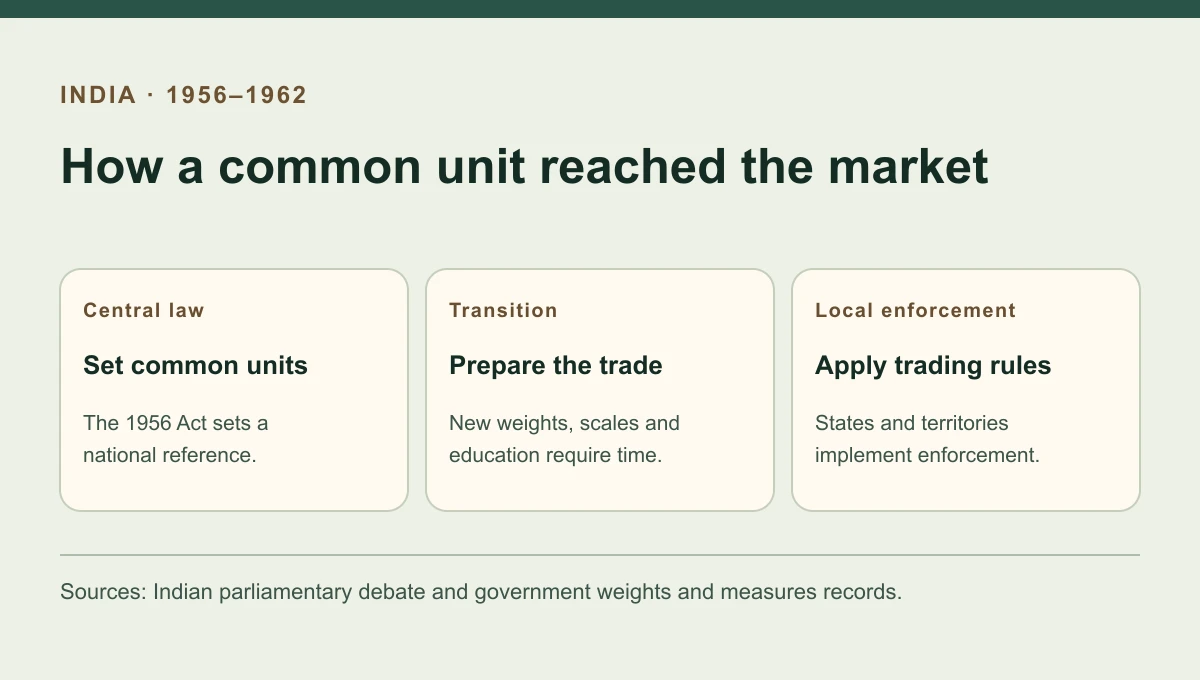
India’s 1956 legislation set common metric weights and measures. The parliamentary record shows why a national standard still required practical work in markets. Pondicherry’s official account illustrates that work through separate dates for weights, capacity and length, beginning with a period when old and new measures could coexist.
One territory’s rollout
Why different measures had different dates
The dates below are for Pondicherry and distinguish quantities measured in different ways.
| Quantity | Initial change | A distinct implementation detail |
|---|---|---|
| Weights | October 1958 | Older units can be used for two more years before metric weights become compulsory. |
| Capacity | April 1961 | A one-year period precedes compulsory usage. |
| Length | April 1962 | A separate period of tolerance allows a changeover. |
Chronology
A timeline of the turning points
Parliament debates common standards
Members discuss existing measures, supplies of reliable weights and ways to verify them.
Metric weights are introduced in Pondicherry
A transition period allows use of older weights.
Metric weights become compulsory there
The elapsed time gave government offices and trade an opportunity to prepare.
Capacity and length follow
Capacity has a separate transition and length measures are introduced from April 1962.
Why the 1956 debate went beyond choosing units
The central legislation established a common framework. Parliament discussed the problems of supplying reliable weights and making them verifiable. Speakers referred to familiar units such as the seer, while contemporary public information explained the new relationship between kilograms and grams. A common unit would simplify comparison, but it would still need a correctly made weight and instrument.
The number on a measure matters only when it can be checked. The debate’s focus on manufacturing weights and keeping standard samples makes that practical dependency visible.
What changed in Pondicherry
The official gazetteer documents the coexistence of British, local and metric measures in trade. It sets different starting dates for weights and capacity, with transition periods during which existing practice could continue. Later steps brought inspection and enforcement into use under locally applicable rules.
The differences depended on the instrument involved. A merchant measuring rice by weight needed different equipment from a trader selling a liquid by volume. Suppliers in neighbouring areas could also affect how quickly an individual trade changed.
Why the dates should stay attached to the territory
The central law supplied common units. State and territory action affected when particular trades could use them in practice and when new requirements became compulsory. Pondicherry explains one route from a national standard to a market transaction. The same local dates should only be applied to other areas when their own records support it.
Continue the chronology
Related history guides
How Malaysia’s 1972 Law Regulated Trade Scales
Compare Malaysia’s distinction between an authorised unit and a verified commercial instrument.
Read the timeline1973–1983Why the Philippines Set a 1983 Deadline for Metrication
Read another country’s records of delays and adjustments to a metric deadline.
Read the timelineConnected biographies
People connected to this history
Quick answers
Common questions
- Did the 1956 Indian law convert all local transactions at once?
- The law provided common standards. The Pondicherry account shows a staged implementation with distinct dates by kind of measurement.
- Why did different trades require different preparations?
- Weights, capacity measures and rulers are different tools. Each trade also depended on its own supply and inspection arrangements.
Primary and institutional sources
How this history was checked
Dates, legal milestones and historical claims are checked against the official and institutional records below. This article was reviewed on 19 November 2026.
- Lok SabhaDebate on the Standards of Weights and Measures Bill, August 1956
- Government of India Publications DivisionContemporary guide to metric weights and measures in Kurukshetra
- Government of Puducherry, Directorate of Economics and StatisticsGazetteer chapter on weights and measures
- India Ministry of Law and Justice, Legislative DepartmentChronological list of central acts, including Act 89 of 1956