
The short answer
Malaysia’s Trade Descriptions Act 2011 replaced its 1972 predecessor and addressed claims made in trade. A statement about a product’s quantity, composition or place of production gives a buyer something to compare. The Act helps identify when a materially false or misleading indication can become a legal issue.
Reading a sales representation
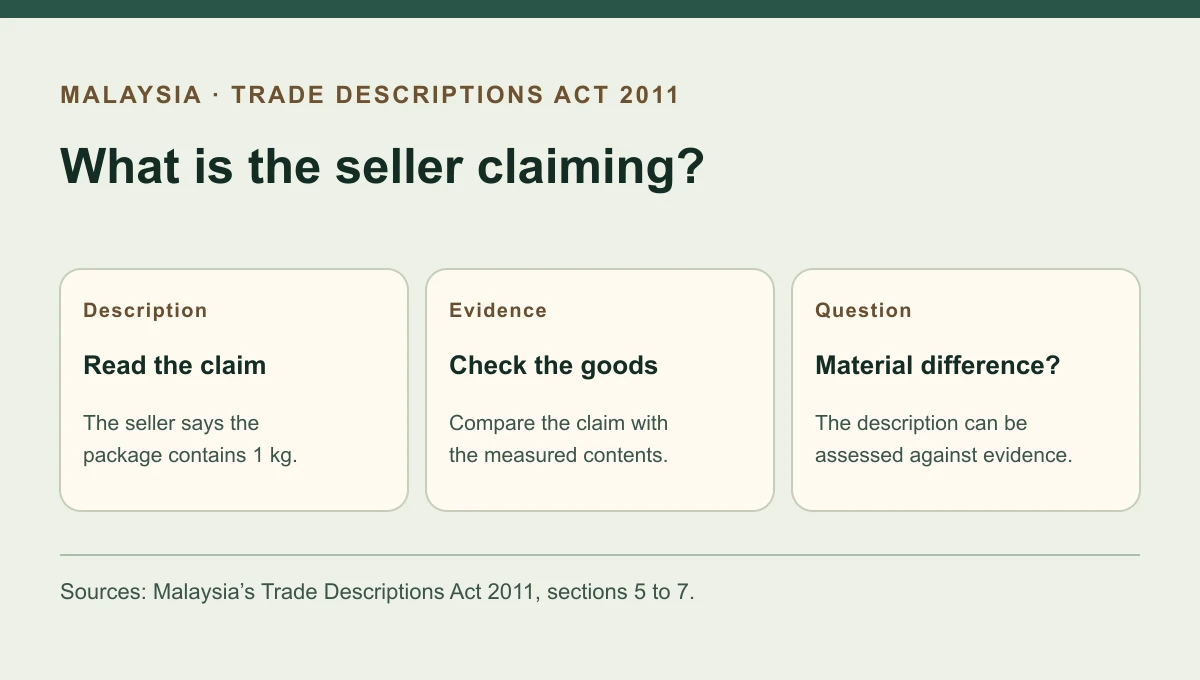
Three parts of the inquiry
An illustrative package is used to show how the claim can be tested.
| Step | Illustration | What still needs to be established |
|---|---|---|
| Identify the claim | A package is described as containing one kilogram | Find the wording or indication applied to the product. |
| Find the evidence | The contents can be weighed using a suitable instrument | Determine what the stated quantity refers to and how it was measured. |
| Assess the description | Compare what was conveyed with the evidence | Consider whether the difference is material or the indication misleading. |
Chronology
A timeline of the turning points
An earlier Trade Description Act is enacted
Act 87 provides the predecessor statute.
Act 730 receives assent and is published
The newer law lays out trade-description and related enforcement provisions.
Act 730 comes into force
Its repeal and saving provisions address the transition from Act 87.
What the law treated as a description
The Act’s list includes matters such as quantity and measurements, method of manufacture, composition and place of production. Such claims can affect a buyer’s choice before the goods are tested or opened. The law distinguishes a description that is false to a material degree from one that is misleading through what it implies.
A label on a package is one way a description can be communicated. Promoted features and statements associated with supply can also matter under the relevant provisions. The evidence begins with what the seller actually conveyed.
Why an accurate scale and an accurate description both matter
Suppose a package is described as containing a kilogram. A suitable instrument can measure the contents, separating packaging from the amount of goods where that is what the label claims. Instrument verification concerns whether the tool can be relied on. The trade description concerns the commercial statement being compared with the measurement.
This example also shows why a numerical difference needs context. The unit, the claim about what is being weighed and the applicable tolerance or rules belong in the analysis.
What changed in 2011
Act 730 came into force on 1 November 2011 and repealed the 1972 Trade Description Act. Its saving provisions preserve specified aspects of the earlier regime during the transition. The date helps a reader decide which historical text to examine when studying how a particular claim was treated.
Continue the chronology
Related history guides
Why Malaysia Created a Tribunal for Consumer Claims
Read how a consumer dispute could reach a dedicated tribunal.
Read the timeline2011How Malaysia Separated Price Controls from Profiteering
Compare a different set of rules governing prices and profit.
Read the timeline1972How Malaysia’s 1972 Law Regulated Trade Scales
See how verification of commercial weighing equipment works in the earlier statute.
Read the timeline1966–1996How Malaysia Built SIRIM from Two Industrial Institutions
Read how Malaysia developed the institutions behind standards and product testing.
Read the timelineConnected biographies
People connected to this history
Quick answers
Common questions
- When did Malaysia’s Trade Descriptions Act 2011 come into force?
- The commencement recorded in the Act is 1 November 2011.
- What is an example of a trade description?
- A claim about quantity, composition or place of production can be a trade description under the Act.
Primary and institutional sources
How this history was checked
Dates, legal milestones and historical claims are checked against the official and institutional records below. This article was reviewed on 19 November 2026.