
The short answer
How did a joint telegraph patent coexist with different commercial and experimental roles?
Read the records together
Contributions,evidence and scope
Different records illuminate different parts of this particular undertaking.
| Record | What the record establishes | What remains distinct |
|---|---|---|
| Joint-patent history | Establishes collaboration and changing rights. | Ownership alone does not rank every technical contribution. |
| 1838 object record | Identifies a particular needle instrument. | A shared name does not make all artefacts identical. |
| Museum scholarly study | Compares needle/dial visions and the dispute. | Its underlying archival sources are not all claimed independently read. |
Joint ownership did not mean one kind of instrument
Cooke and Wheatstone’s partnership produced patents covering more than a single telegraph configuration. The Science Museum’s 1838 four-needle instrument record refers to four- and five-needle arrangements under the 1837 patent and a further patent associated with intermediate-station operation. A patent document could therefore organise claims to related mechanisms without making every surviving instrument identical. This distinction is the starting point for reading the partnership. The label Cooke–Wheatstone describes a documented collaboration, but an object still needs its own date, arrangement and manufacturing history.
Needle and dial devices addressed use differently
The museum journal article contrasts a needle instrument requiring a signalling code with a step-by-step dial approach intended to present characters more directly. The issue was not simply whether electricity could move a pointer. It involved the relationship between apparatus, cost and the person operating it. Different mechanisms could support different ideas about where telegraphy would be used and who would use it. The historical study interprets those visions through the patents and later dispute. This article adopts that bounded comparison rather than claiming to have independently inspected every original drawing or letter cited by the scholar.
Rights agreements were distinct from technical merit
The partners’ disagreement led to arbitration and further agreements concerning control and royalties. Those arrangements affected the commercial use of their work; they did not by themselves establish that one instrument was scientifically worthless or that one partner contributed nothing. The historical biography and museum study give different levels of detail about this changing relationship. Keeping the legal and technical questions distinct makes the outcome easier to assess. An assignment of rights is evidence about permission and payment, while the mechanism and its operation require apparatus records and technical descriptions.
Compare a patent, a device and a service
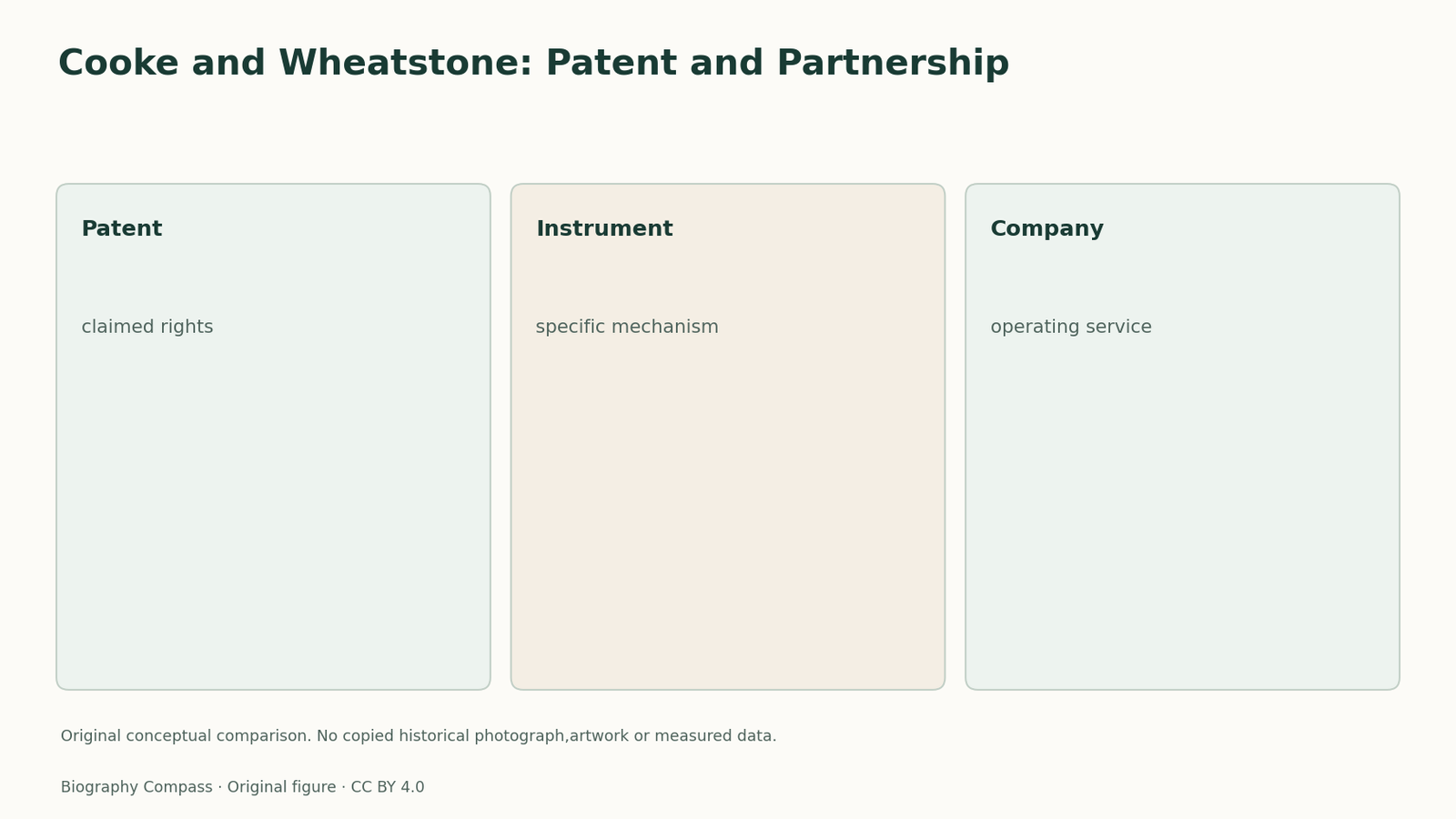
Draw three boxes: joint patent, specific instrument, and company service. Under the instrument box, write 1838 four-needle record. Under the service box, write installation, operators and customers. The checked answer to “does owning a patent prove that every listed device used the same mechanism?” is no. The answer to “does a working mechanism alone establish an operating business?” is also no. This original exercise maps the positive steps between a technical claim, an artefact and practical communication. It explains Cooke’s commercial contribution beside Wheatstone’s work without turning the partnership’s eventual dispute into a simple winner-and-loser invention legend.
Continue the chronology
Related history guides
Bidder and the Electric Telegraph Business
Explore George Parker Bidder’s role in forming the Electric Telegraph Company, separating business organisation from the invention of its instruments.
Read the timeline1850s–1867Atlantic Cable Testing: Fault and Signal
Learn why a submarine cable’s integrity and its signal behaviour required different tests, using Varley’s historical account and an original model exercise.
Read the timelineBiography context
Explore United Kingdom through connected lives
Connected biographies
People behind this work
1806–1879
William Fothergill Cooke
Telegraph developer and entrepreneurWilliam Fothergill Cooke is remembered for commercialising electric telegraphy through partnership and patents with Charles Wheatstone.Read biography1856–1910
Granville Woods
Electrical inventor and railway-communications developerPatented systems for railway telegraphy and electrical transport.Read biography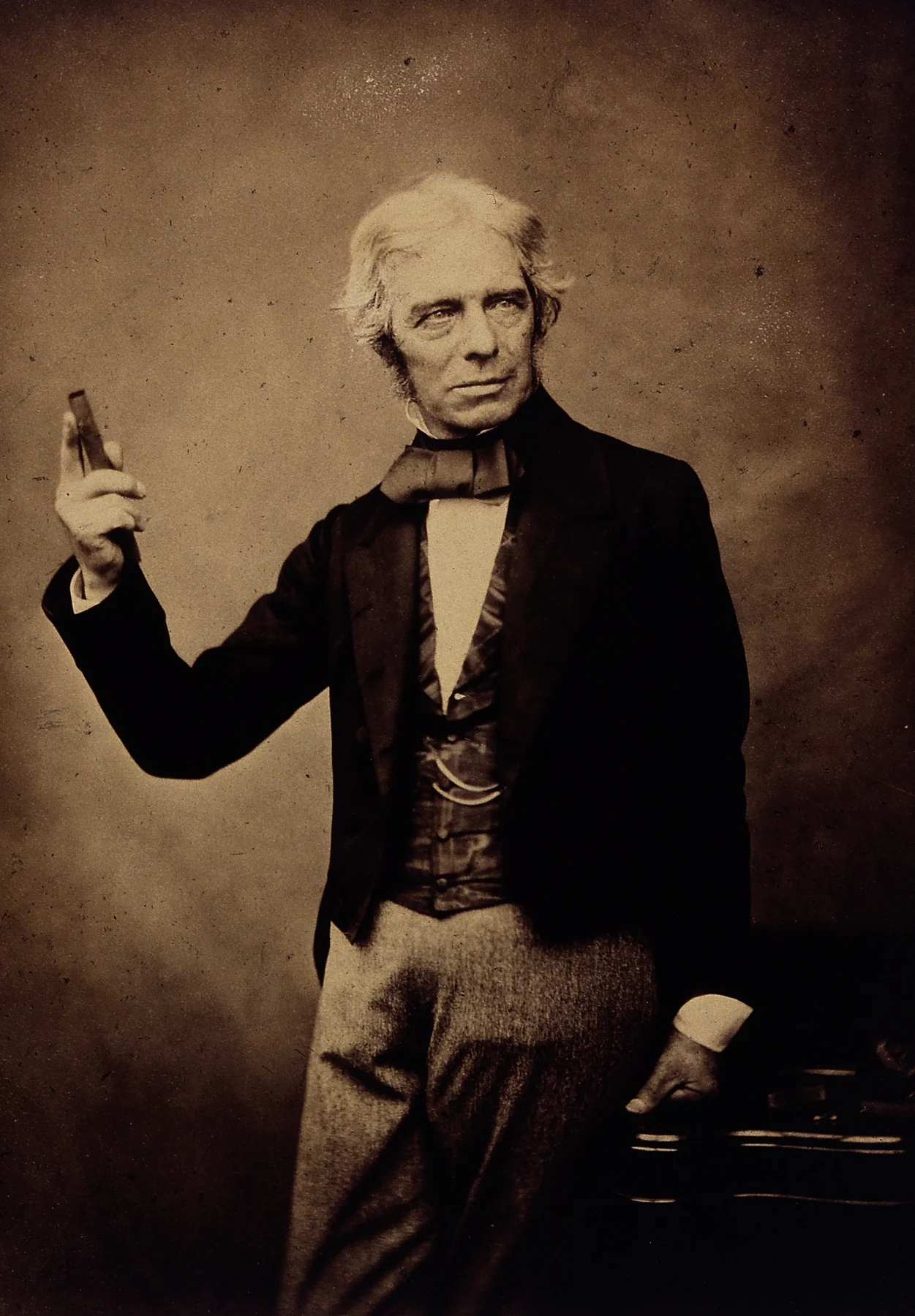
1791–1867
Michael Faraday
Experimental chemist and physicistMichael Faraday built an experimental career at the Royal Institution, investigating electricity, magnetism and chemistry while developing public science lectures.Read biographyQuick answers
Common questions
- Did joint patents cover only one telegraph mechanism?
- No. The partnership covered different instruments; patent rights, physical mechanisms and operating a service remained distinct.
Primary and institutional sources
How this history was checked
The cited records distinguish contemporary accounts,official catalogues and later institutional or scholarly interpretation. The comparison and worked exercise are original editorial material. This article was reviewed on 7 November 2026.
- Dictionary of National Biography, original 1887Cooke, William Fothergill
- Jean-François Fava-Verde, Science Museum Group Journal (2017)A Tale of Two Telegraphs
- Science Museum GroupCooke and Wheatstone’s Four-Needle Telegraph (1838)
- Oxford Dictionary of National Biography, accessible extractCooke, Sir William Fothergill