
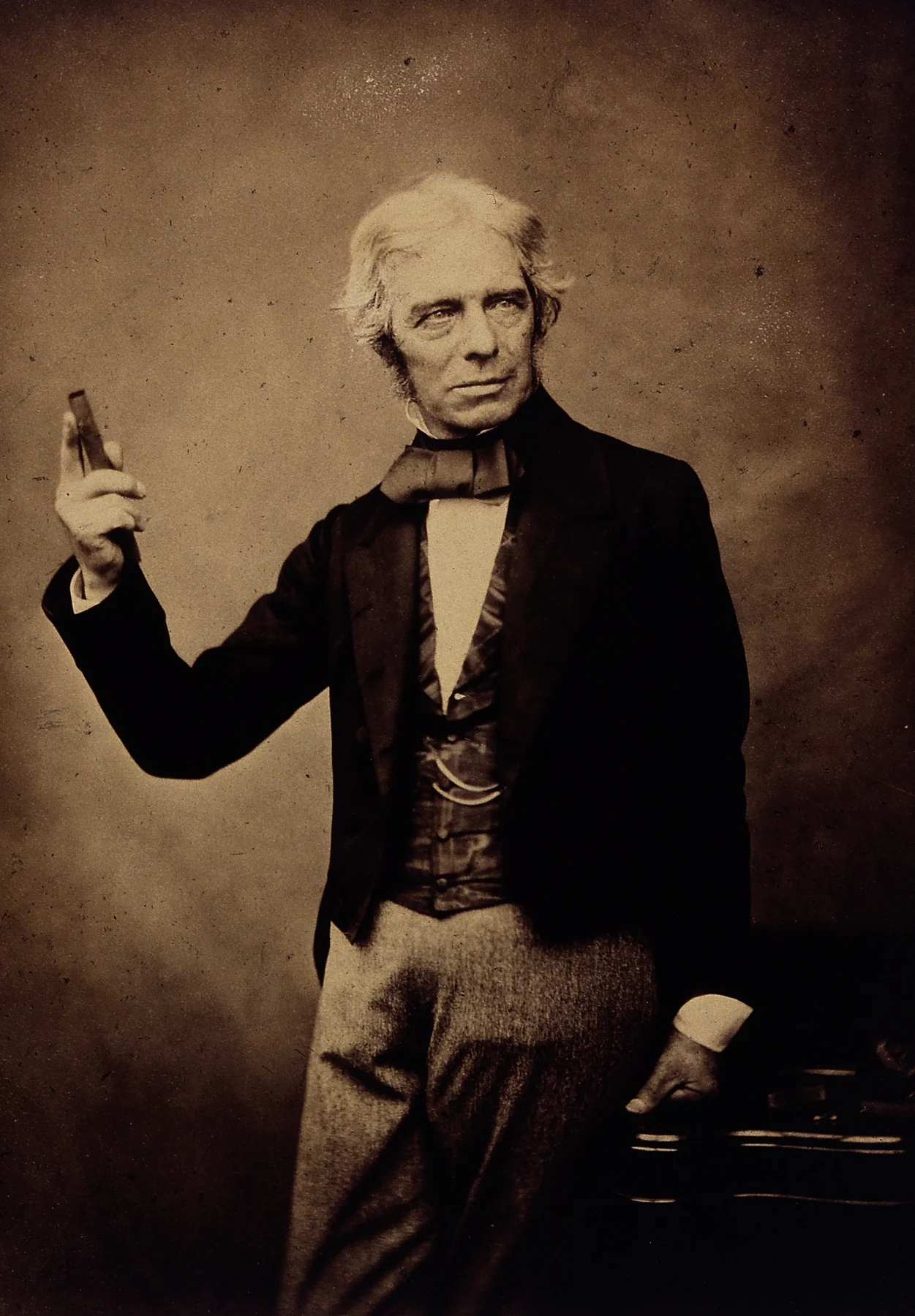
In this biography
Quick facts
- Born
- 1791
- Died
- 1867
- Birthplace
- Newington Butts, Southwark, England
- Country
- United Kingdom
- Nationality
- Not independently established
- Known for
- Electromagnetic induction and experimental science
- Research area
- Experimental chemist and physicist
- Major work
- Electromagnetic induction and experimental science
Why this life matters
By comparing connection, continued contact and disconnection, he made changing conditions central to the evidence for induction. His surviving reports and apparatus preserve an experimental approach that later mathematical accounts could develop.
Timeline
Key moments
Bookbinding
Apprenticed to George Riebau.
Laboratory work
Entered the Royal Institution’s laboratory.
Rotations
Investigated continuous electromagnetic motion.
Laboratory director
Became Director of the Laboratory.
Induction
Built and tested the ring-coil apparatus.
Fullerian chair
Dated institutional table records the chemistry appointment.
A craft apprenticeship and a laboratory career
Faraday was born in Newington Butts in 1791, the son of a Sandemanian blacksmith. His apprenticeship with bookbinder George Riebau ran from 1805 to 1812. He entered the Royal Institution’s laboratory in 1813, and his work with Humphry Davy included a European tour before he resumed laboratory duties.
His career joined skilled practical work with increasingly independent investigations. He became Director of the Laboratory in 1825. The institution’s chronology records him as Fullerian Professor of Chemistry from 1833; its accompanying narrative gives an inconsistent relative interval, so the dated appointment table is followed here.
Sources for this section: [1]
Electricity had to be tested at the right moment
The ring apparatus made in August 1831 used separate windings on an iron core. In the published First Series, paragraphs 27–30 distinguish the response when battery contact was made, continued and broken. A brief deflection appeared at connection; the needle then settled, with a reversed response at disconnection.
This sequence matters. The experiment did not report a second circuit carrying an unchanged continuous current merely because a nearby battery remained connected. Faraday varied arrangements and compared detectors, building an argument from changing conditions rather than from one dramatic demonstration.
A research programme across chemistry and physics
Electromagnetic rotations in 1821, benzene in 1825, and induction in 1831 belonged to different investigations. Faraday also developed electrochemical research and later examined magnetism’s relationship with light. His collected papers preserve how observations, provisional explanations and subsequent tests accumulated.
The First Series begins by crediting earlier induction-related work by Ampère and Arago. Faraday’s achievement can therefore be described without imagining that all prior electricity and magnetism began in his laboratory. His experiments became resources for later mathematical accounts, including Maxwell’s.
Teaching, advice and the surviving record
Faraday helped establish the Royal Institution’s Friday Evening Discourses and Christmas Lectures. He also advised public bodies, including Trinity House, on practical scientific questions. His work combined communication, research and institutional responsibilities.
He died at Hampton Court in 1867. The Royal Institution notes that he rejected accepting a knighthood in public statements, but finds no evidence of a formal offer. That is a useful distinction between his expressed position and a later biographical anecdote. Laboratory notebooks, letters and apparatus leave a stronger record than a collection of heroic stories alone.
Quick answers
Frequently asked questions about Michael Faraday
- What is Michael Faraday known for?
- Michael Faraday built an experimental career at the Royal Institution, investigating electricity, magnetism and chemistry while developing public science lectures.
- Why do the dates and records matter?
- Read First Series paragraphs 1–33, especially 27–30. A short-lived needle response is not a constant induced current; no new measured waveform is asserted.
Keep exploring
Lives connected to this story
- James Clerk Maxwell
Follow the mathematical development of field theory.
- Lord Kelvin
Compare experiment and mathematical work on heat and electricity.
- William Henry Perkin
Compare another career connecting chemical experiments and practical materials.
Sources and further reading
Explore the evidence
These references support the biography and offer further reading. Official records, first-person accounts and independent reporting provide different perspectives; image records document attribution and licensing.
- 1. Royal InstitutionMichael Faraday (1791–1867): biography and archive
The institutional appointment table gives 1833 for the Fullerian chair; its narrative’s relative interval conflicts. Use 1833 and preserve the discrepancy in research notes.
- 2. Royal InstitutionMichael Faraday’s ring-coil apparatus
- 3. Michael Faraday; Instituto Superior Técnico Faraday Museum transcriptionExperimental Researches in Electricity, Volume I: First Series
Read First Series paragraphs 1–33, especially 27–30. A short-lived needle response is not a constant induced current; no new measured waveform is asserted.