
The short answer
How did electrical testing distinguish cable faults from message transmission problems?
Read the records together
Contributions,evidence and scope
Different records illuminate different parts of this particular undertaking.
| Record | What the record establishes | What remains distinct |
|---|---|---|
| Career biography | Connects relays, fault work and artificial lines. | Priority claims beyond the inspected evidence are not adopted. |
| 1867 lecture account | Defines an electrical investigation and model. | Nineteenth-century propagation language is not modern theory. |
| Cambridge role record | Names company offices and patent collaborators. | Office or partnership does not identify every individual experiment. |
A cable could be present yet signals remain difficult
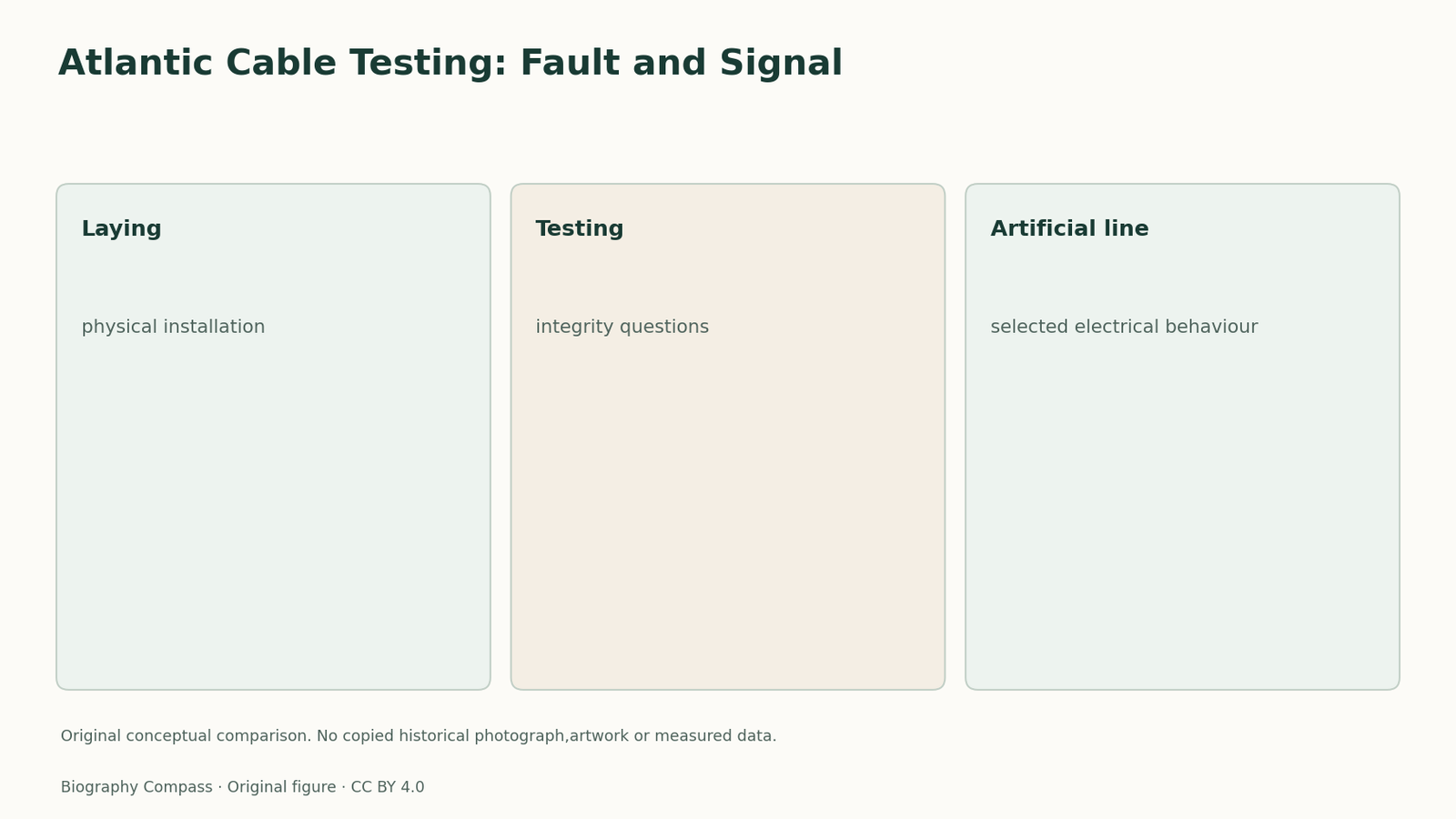
The successful laying of a submarine cable answered a mechanical question about placing a line between shores. It did not automatically answer every electrical question. Varley’s 1867 lecture focused on phenomena encountered when signals passed through long insulated conductors. The reproduced account explicitly sets aside the laying operation. That scope distinguishes his contribution from the shipboard enterprise described in the separate Gooch topic. It also explains why continuity, insulation and the behaviour of a transmitted signal are related tests rather than interchangeable descriptions of success.
An artificial line represented selected properties
Varley used connected resistances and condensers to model the conductor and its electrostatic behaviour. Such a model represented chosen electrical features; it was not a miniature ocean with a physically identical seabed. The biography and lecture account describe how it made otherwise difficult-to-observe behaviour accessible to experiment. A model can be useful precisely because it isolates a question. Its usefulness does not require it to reproduce every condition faced by the real cable. This is an explanation of the historical model’s scope, not a reproduction of its numerical curves or an assertion that all its assumptions remain modern electrical theory.
Signal shape and a fault require different evidence
The lecture describes how a received current rose and subsided over time, affecting the separation of successive messages. A delayed or spread signal therefore cannot, without further testing, be treated as proof that the conductor is physically broken. The same record refers to earlier work on testing insulation and conducting power. This distinction gives a practical meaning to the artificial-line experiment: it helped distinguish ordinary long-line behaviour from other possible causes of a communications problem. The article does not repeat the lecture’s nineteenth-century language about instantaneous propagation as a statement of modern physics.
Classify three test results conceptually
Make three cards: the cable has been laid; an electrical test finds a defect; and a received pulse takes time to rise and fall. Ask whether all three cards describe the same event. The checked answer is no: they concern installation, integrity and signal behaviour. Next, draw a model box containing resistance and charge-storage elements, and list seabed topography outside its represented scope. This original paper exercise introduces no historical voltage, transmission-rate or timing data. It explains why Varley’s laboratory work could contribute to an oceanic enterprise while remaining distinct from the manufacture, financing and laying operations performed by other members of the team.
Continue the chronology
Related history guides
Great Eastern 1866: Ship, Cable and Recovery
Follow Great Eastern’s two Atlantic cable operations in 1866: laying a new line and recovering the 1865 cable, with distinct shipboard responsibilities.
Read the timeline1837–1845Cooke and Wheatstone: Patent and Partnership
Compare Cooke and Wheatstone’s patent partnership, needle and dial instruments and operating service, using museum objects and historical accounts.
Read the timelineBiography context
Explore United Kingdom through connected lives
Connected biographies
People behind this work
1828–1883
Cromwell Fleetwood Varley
Electrical and submarine-cable engineerCromwell Fleetwood Varley is remembered for developing telegraph relays, fault-location methods and artificial cable models for investigating submarine signalling.Read biography1824–1907
Lord Kelvin
Physicist, engineer and university professorWilliam Thomson, Lord Kelvin, combined mathematical physics with instrumentation and communications engineering during a 53-year Glasgow professorship.Read biography1831–1879
James Clerk Maxwell
Physicist and mathematical researcherJames Clerk Maxwell developed an electromagnetic theory of light and helped establish Cambridge’s Cavendish Laboratory, alongside research on gases, colour and mechanics.Read biographyQuick answers
Common questions
- Does a slow signal prove that a cable is broken?
- Not by itself. Installation, integrity and the way a pulse rises and subsides concern different questions.
Primary and institutional sources
How this history was checked
The cited records distinguish contemporary accounts,official catalogues and later institutional or scholarly interpretation. The comparison and worked exercise are original editorial material. This article was reviewed on 7 November 2026.