
The short answer
Why did familial hypercholesterolaemia reveal an LDL receptor?
Evidence comparison
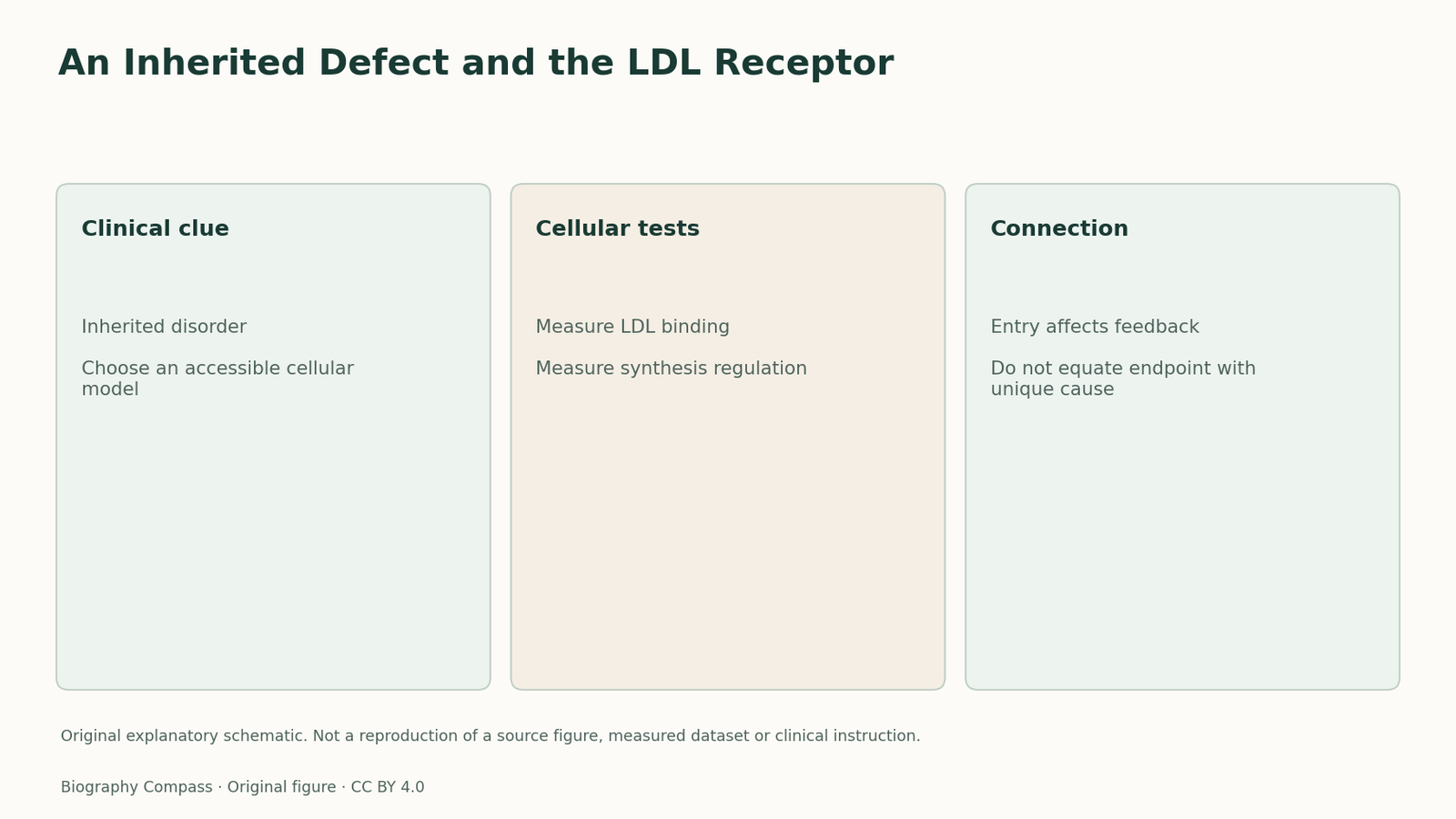
An Inherited Defect and the LDL Receptor
Compare the observations with the narrower conclusions they support.
| Record or observation | What it supports | What remains separate |
|---|---|---|
| High cholesterol-synthesis output | Identifies an altered endpoint in the preparation | Does not uniquely identify the failed pathway step |
| Binding defect linked with feedback defect | Connects cell-surface recognition to intracellular regulation | Does not imply all uptake routes or all cases are identical |
A disease observation becomes a cellular question
Familial hypercholesterolaemia supplied Brown and Goldstein with an inherited pattern to investigate. Their joint lecture explains the practical importance of cultured skin fibroblasts: the researchers could examine a cellular phenotype in an accessible preparation. The question became how cells bind and process LDL and how that influences cholesterol synthesis. This is a more restricted and experimentally useful question than merely restating that cholesterol is high in the blood.
Compare binding with feedback
Their 1974 work linked impaired high-affinity LDL binding with defective regulation of HMG-CoA reductase activity. Binding and biochemical feedback are different measurements. Agreement between them helps connect an entry step at the cell surface with regulation inside the cell. The comparison does not require the assumption that every route of LDL association is absent. Their related work distinguished high-affinity binding from lower-affinity uptake at larger concentrations.
Sources for this section: [4]
Do not infer a mechanism from one high number
Give students two hypothetical cells with the same high cholesterol-synthesis output. State that one lacks normal receptor binding while the other's binding has not been measured. Ask whether the shared output proves an identical defect. The answer is no: similar endpoints can arise through different pathway failures. Ask which additional measurement follows from the historical hypothesis. A binding assay, interpreted with suitable controls, would test the proposed entry defect rather than merely repeat the output measurement.
Sources for this section: [4]
Use the model within its scope
The value of the inherited disorder was its ability to expose a pathway, not a guarantee that the same lesion explains all high-cholesterol states. This guide reads historical experimental evidence and does not interpret a personal lipid result or suggest a treatment.
Sources for this section: [4]
Continue the chronology
Related history guides
Biography context
Explore United States through connected lives
Connected biographies
Researchers and related questions
1941–
Michael S. Brown
Physician and molecular-genetics researcherBrown and Goldstein began their familial-hypercholesterolaemia programme in 1972.Read biography
1940–
Joseph L. Goldstein
Physician and molecular-genetics researcherThe Brown–Goldstein programme connected LDL recognition at the cell surface with uptake and intracellular regulation.Read biography1941–2015
Alfred G. Gilman
Pharmacologist and G-protein researcherGilman's group used S49 lymphoma-cell variants with defective signalling as experimental material.Read biographyQuick answers
Common questions
- Why did familial hypercholesterolaemia reveal an LDL receptor?
- Identifies an altered endpoint in the preparation. Does not uniquely identify the failed pathway step.
- Are the classroom examples historical measurements?
- No. Invented examples are labelled as classroom models; the source-based discussion identifies the historical evidence separately.
Primary and institutional sources
How this history was checked
Official biographical and award records are read alongside the researcher’s technical account. Source scope and hypothetical examples remain distinct. This article was reviewed on 7 November 2026.