
The short answer
How did receptor recycling separate uptake from cholesterol feedback?
Evidence comparison
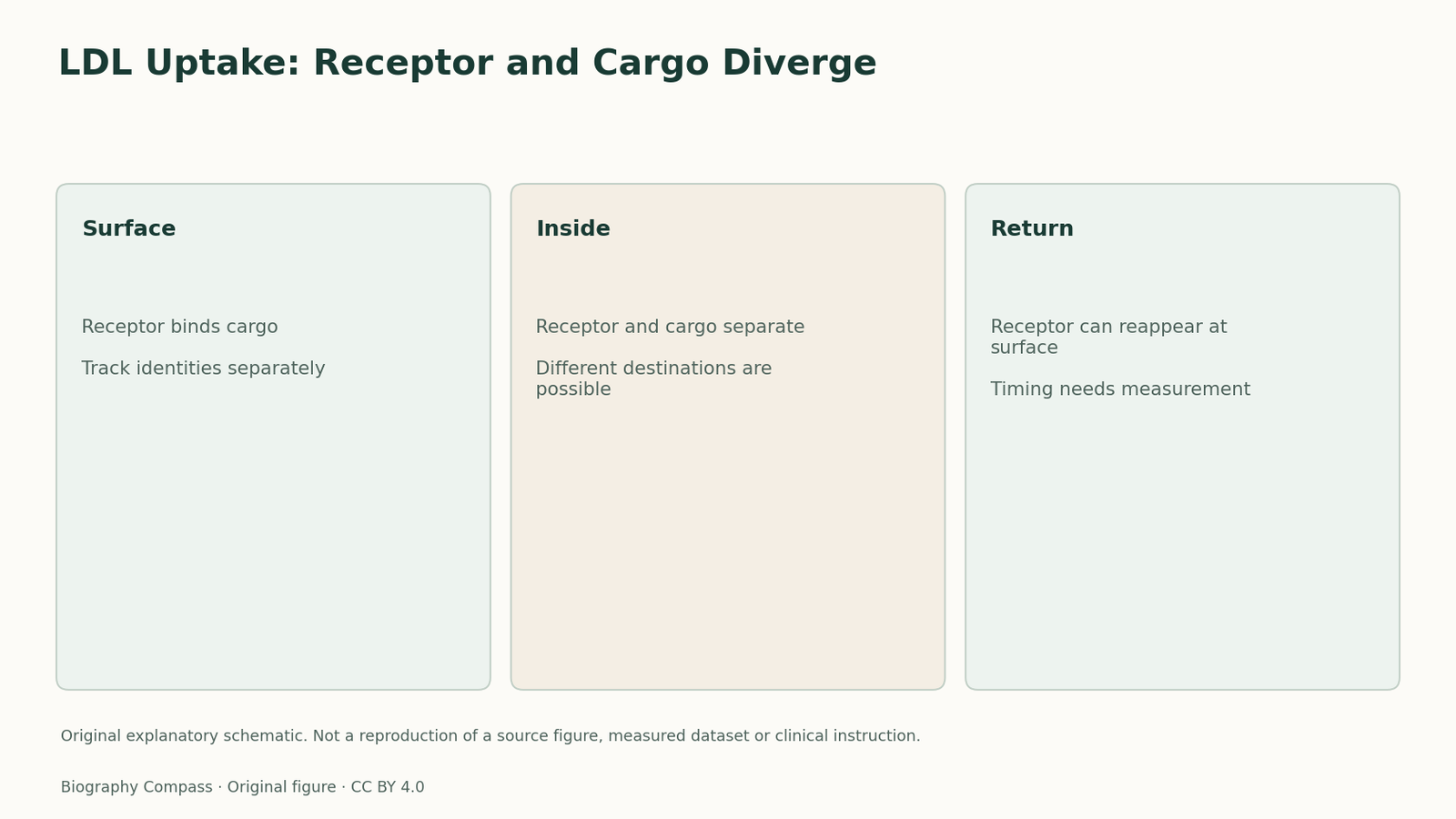
LDL Uptake: Receptor and Cargo Diverge
Compare the observations with the narrower conclusions they support.
| Record or observation | What it supports | What remains separate |
|---|---|---|
| Cargo uptake | Follows material entering the cell | Does not alone reveal the receptor’s later location |
| Receptor recycling | Follows return of recognition machinery | Different from cholesterol feedback or universal receptor survival |
Follow two objects, not one arrow
Receptor-mediated uptake brings LDL into a cell through its interaction with a surface receptor. The receptor is not simply another piece of the incoming cargo. Brown and Goldstein's joint lecture describes separation after internalisation and return of receptor to the cell surface. A pathway that follows only LDL can therefore hide an important economy of the system: the recognising component can be used again.
Movement and regulation are different claims
Receptor recycling concerns where the receptor goes. Cholesterol feedback concerns how the cell changes other activities in response to its supply. The processes are connected, but evidence of one does not substitute for measurements of the other. Anderson, Brown, Beisiegel and Goldstein's account of receptor distribution and recycling uses the receptor itself as an object of study, rather than inferring its fate solely from disappearance of LDL outside the cell.
Trace labels through an original diagram
Give a paper receptor a blue label and its hypothetical cargo a red label. Move both into an internal compartment, then return only the blue label to the surface. Ask what would happen if the observer tracked only the red label. The answer is that receptor return could be missed entirely. Next ask whether the model proves that every receptor always recycles. It does not; it illustrates the need to track component identity and leaves degradation, sorting and timing to actual observations.
Sources for this section: [4]
Do not read the drawing as a measured timetable
The boxes and arrows in this guide identify an itinerary. They are not scaled distances, membrane shapes or kinetic measurements. Comparing the recycling question with Brown's inherited-defect guide shows two ways the same research programme gained explanatory depth: one locates an entry problem, while the other follows repeated use of the entry machinery.
Sources for this section: [3]
Continue the chronology
Related history guides
Biography context
Explore United States through connected lives
Connected biographies
Researchers and related questions

1940–
Joseph L. Goldstein
Physician and molecular-genetics researcherThe Brown–Goldstein programme connected LDL recognition at the cell surface with uptake and intracellular regulation.Read biography
1941–
Michael S. Brown
Physician and molecular-genetics researcherBrown and Goldstein began their familial-hypercholesterolaemia programme in 1972.Read biography1950–
James E. Rothman
Cell biochemist and intracellular membrane-transport researcherRothman and Erik Fries investigated transport of a viral glycoprotein using cell-free preparations.Read biographyQuick answers
Common questions
- How did receptor recycling separate uptake from cholesterol feedback?
- Follows material entering the cell. Does not alone reveal the receptor’s later location.
- Are the classroom examples historical measurements?
- No. Invented examples are labelled as classroom models; the source-based discussion identifies the historical evidence separately.
Primary and institutional sources
How this history was checked
Official biographical and award records are read alongside the researcher’s technical account. Source scope and hypothetical examples remain distinct. This article was reviewed on 7 November 2026.
- Nobel Prize OutreachJoseph L. Goldstein — Facts
- Nobel FoundationJoseph L. Goldstein — Biographical
- Nobel FoundationJoseph L. Goldstein — Nobel lecture
- Anderson, Brown, Beisiegel and Goldstein / Journal of Cell BiologySurface distribution and recycling of the LDL receptor as visualized with antireceptor antibodies