
The short answer
How did deficient cell lines help identify a G protein?
Evidence comparison
G Proteins: Reconstitution as Evidence
Compare the observations with the narrower conclusions they support.
| Record or observation | What it supports | What remains separate |
|---|---|---|
| A deficient preparation | Makes a missing response experimentally visible | Its label is not a complete molecular diagnosis |
| Purified fraction restores response | Connects an isolated component with function | Does not make the rest of the system unnecessary |
A defect can become an assay
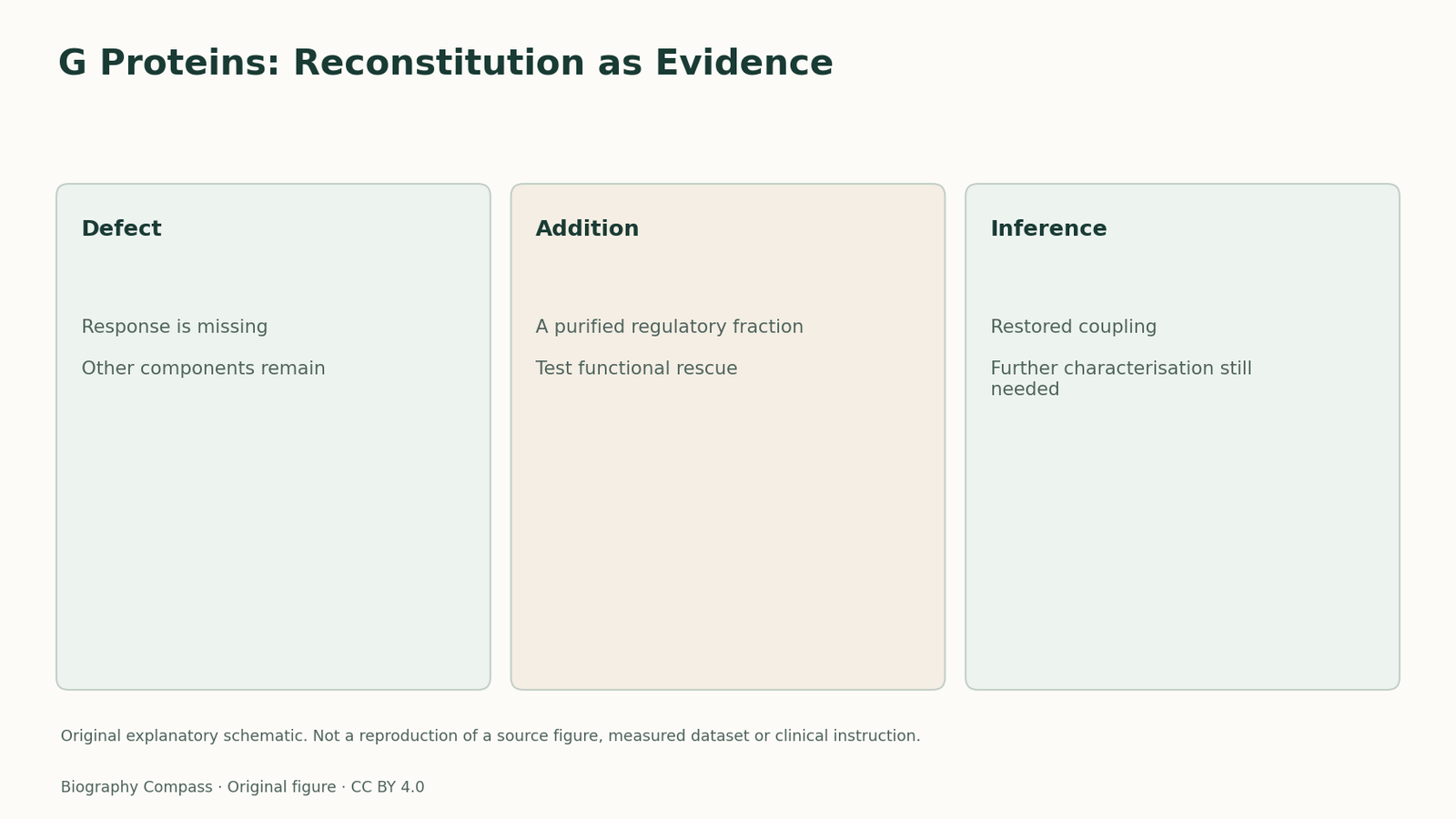
Gilman's group investigated membrane preparations from S49 cell variants that lacked normal stimulated adenylyl-cyclase responses. Such a preparation supplied a sensitive question for purification: could an added fraction restore the missing function? This is reconstitution. The desired result was not simply a visible protein band, but recovery of a biochemical response when a defined component was returned to a deficient system.
Link purification to recovered function
The 1980 paper reports that purified G/F restored guanine-nucleotide-, fluoride- and hormone-stimulated activity in the deficient variant. It also recoupled hormone stimulation in an uncoupled variant. These comparisons connect an isolated regulatory component with several aspects of the response. They do not mean that a single purified component, placed in an otherwise empty tube, independently recognises every hormone and produces the complete cellular outcome.
Sources for this section: [3]
A restoration matrix
Make an original table with three hypothetical preparations: complete, deficient and deficient plus added fraction. Assign response present, absent and present, respectively. Ask what the third result adds. The answer is evidence that the fraction supplies something needed by the remaining system. Ask what remains unknown. The experiment as drawn does not establish purity, direct binding partners or whether several ingredients in the fraction contribute. Those require further separation and characterisation, which is why purification and functional rescue belong together.
Sources for this section: [3]
Compare with Rodbell’s diagram
Rodbell's receptor–transducer–effector framework separates functional roles. Gilman's reconstitution work helps attach molecular identity to the coupling role. Reading the two together explains how an explanatory scheme can generate an assay and how an assay can, in turn, refine the scheme's molecular meaning.
Continue the chronology
Related history guides
Biography context
Explore United States through connected lives
Connected biographies
Researchers and related questions
1941–2015
Alfred G. Gilman
Pharmacologist and G-protein researcherGilman's group used S49 lymphoma-cell variants with defective signalling as experimental material.Read biography1925–1998
Martin Rodbell
Biochemist and cellular-signalling researcherRodbell's work separated reception of a chemical signal from the machinery that carries the influence onward and generates a cellular response.Read biography1918–2009
Edwin G. Krebs
Biochemist and protein-kinase researcherKrebs and Fischer investigated differences between forms of glycogen phosphorylase and discovered that reversible phosphorylation explained their interconversion.Read biographyQuick answers
Common questions
- How did deficient cell lines help identify a G protein?
- Makes a missing response experimentally visible. Its label is not a complete molecular diagnosis.
- Are the classroom examples historical measurements?
- No. Invented examples are labelled as classroom models; the source-based discussion identifies the historical evidence separately.
Primary and institutional sources
How this history was checked
Official biographical and award records are read alongside the researcher’s technical account. Source scope and hypothetical examples remain distinct. This article was reviewed on 7 November 2026.