
The short answer
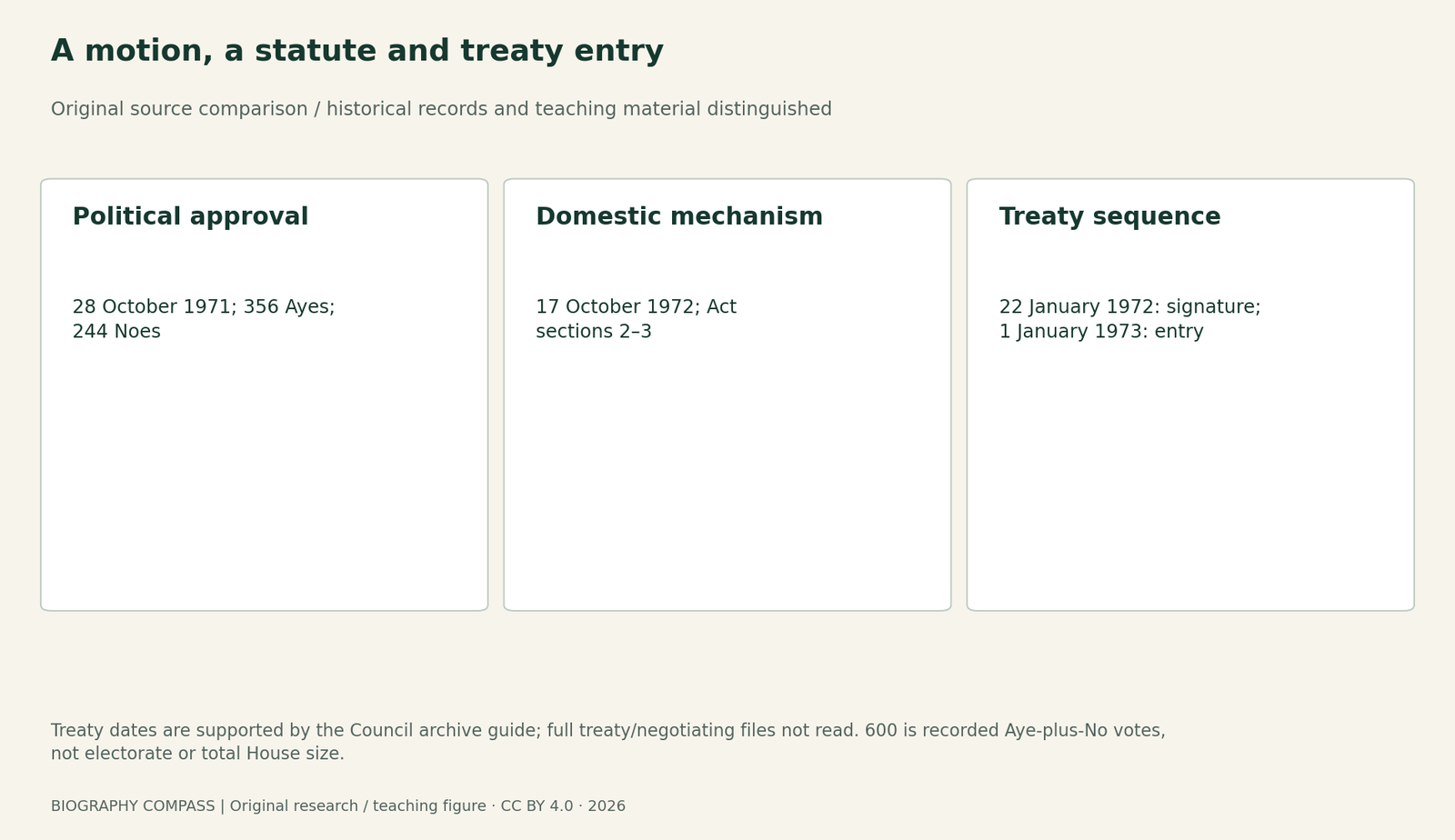
The vote associated with Edward Heath’s European policy was one stage in a longer sequence. A resolution, a statute and treaty entry each answer a different question about Britain’s accession.
Compare the documents
Three documentary functions
Keep the date, institutional function and limit of each document attached to the claim.
| Record | What it establishes | What it does not establish alone |
|---|---|---|
| Commons motion | Approval of a negotiated decision in principle | Domestic operation of each treaty-derived right. |
| European Communities Act | Statutory mechanisms for domestic effect and implementation | Every later court’s application of those mechanisms. |
| Council accession archive guide | Signature and entry dates; description of the treaty process | A full reading of treaty annexes or negotiating files. |
Chronology
A timeline of the turning points
Commons resolution
Approved the government’s negotiated decision in principle, 356–244.
Treaty signature
Council archive guide dates signature in Brussels.
Domestic Act
Royal Assent to the European Communities Act.
Entry into force
Accession took effect in the treaty sequence recorded by the Council archive guide.
Identify exactly what MPs approved
The 28 October 1971 Commons debate resumed a motion approving the government’s decision in principle to join the European Communities on the negotiated arrangements. Its subject was a political decision on negotiated terms. The resolution’s wording is more specific than “Parliament joined Europe”, and it does not present itself as the final domestic implementing statute.
Hansard records 356 Ayes and 244 Noes in division 480, followed by the resolution. The margin was 112 and the two reported totals sum to 600. Those are votes in that division, not a percentage of the electorate, all residents or all MPs entitled to attend. The division lists can also test a claim about a named MP rather than merely supplying a headline total.
Sources for this section: [1]
Separate an argument from an outcome
Heath’s closing speech framed entry in terms of shifting global economic and political power, Europe’s capacity to cooperate and Britain’s place alongside the United States and other powers. It is a primary source for the reasoning he put to MPs. It is not evidence that all of the predicted benefits had already occurred.
The lists record Jenkins among the Ayes and Benn and Healey among the Noes. That supports a narrow statement about their votes on this motion. It does not prove their view on every clause of the later Act, every future European institution or every possible set of negotiated terms. Preserving the question on the order paper prevents a single vote from becoming an all-purpose political label.
Sources for this section: [1]
Read domestic implementation in the original Act
The European Communities Act received Royal Assent on 17 October 1972. Its opening provisions defined the Communities and relevant treaties. Section 2(1) addressed treaty-derived rights, obligations and related matters to be recognised and available in domestic law; section 2(2) provided an implementing power subject to the Act’s limits. These were legal mechanisms, not another expression of opinion.
Section 3 addressed questions of law, Community instruments and the role of European Court decisions in legal proceedings. Reading these provisions explains why passing a political resolution did not perform all the work of legislation. This guide examines selected pages of the original enactment; it does not reconstruct every later judicial interpretation, amendment or constitutional argument.
Sources for this section: [2]
Use the accession archive for a different date
The Council archive guide’s account of the accession instruments dates the treaty signature in Brussels to 22 January 1972 and entry into force to 1 January 1973. It also describes ratification in accordance with the contracting parties’ constitutional requirements. These dates belong to the international process, which should not be collapsed into the 1971 Commons division or the 1972 royal-assent date.
Access matters here. The archive guide’s selected page has been read; the full accession treaty and negotiating files have not. The domestic Act identifies the accession treaty, but neither its existence nor the archive description justifies claiming that every annex and transitional arrangement has been examined. Use “the Council archive guide records” when citing that layer of evidence.
Exercise: assign a source to each caption
A researcher finds four unlabelled cards: A, “356–244 approved the negotiated decision in principle”; B, “section 2 addressed treaty-derived rights in domestic law”; C, “the accession treaty was signed in Brussels”; D, “membership began when the treaty entered into force”. Match each to a date and a document. Then identify which card, by itself, proves the legal treatment of a particular right in a later court case.
Worked answer: A is 28 October 1971, Hansard division 480; B is the 17 October 1972 Act, especially section 2; C is 22 January 1972 and D is 1 January 1973, as recorded in the Council archive guide. None alone proves the outcome of a later case. Card B supplies a legislative framework, but a concrete dispute would require the relevant right, applicable texts and judicial decision. The exercise asks about evidential fit, not just chronological order.
Keep the three kinds of authority visible
A useful timeline can place the Commons motion, treaty signature, domestic Act and treaty entry in one sequence while keeping their functions separate. The political vote preceded signature; the implementing statute followed it; entry into force followed the statute. Different dates can all be correct when the action being dated is made explicit.
The resulting account gives Heath’s European policy a concrete institutional form without treating him as its only contributor. Negotiating governments, MPs, Parliament’s legislative process and the treaty parties each had a role. The question answered here is how the records differ, rather than whether later events vindicated every argument made in 1971.
Continue the chronology
Related history guides
Biography context
Explore United Kingdom through connected lives
Heath’s strategic European commitment
Place the 1971 argument in his wider career.
Explore the biographiesBiographyJenkins across British and European offices
Distinguish a parliamentary vote from his later Commission presidency.
Explore the biographiesBiographyBenn’s different parliamentary position
Keep his recorded vote attached to the specific 1971 motion.
Explore the biographiesConnected biographies
People in these records
1916–2005
Edward Heath
Conservative leader and prime minister, 1970–1974Edward Heath led the Conservatives from 1965 and served as prime minister from 1970 to 1974. European integration was a defining commitment; industrial conflict complicated his domestic programme.Read biography
1903–1995
Alec Douglas-Home
Prime minister, 1963–1964, and foreign secretaryAlec Douglas-Home combined Scottish Unionist and Conservative service with two periods as foreign secretary. His brief premiership crossed an unusual transition from hereditary peer to Commons MP.Read biography
1920–2003
Roy Jenkins
Home secretary, chancellor and European Commission presidentRoy Jenkins moved between Labour government, the European Commission and the SDP. His influence combined ministerial reform, a durable European commitment and a substantial career as a political writer.Read biography
1925–2014
Tony Benn
Labour Cabinet minister, parliamentarian and socialist campaignerTony Benn held Labour ministerial office and represented Bristol South East and Chesterfield. His challenge to inherited disqualification helped make the 1963 peerage reforms a practical constitutional issue.Read biographyQuick answers
Common questions
- Did the 1971 vote make Britain a member that day?
- No. It approved the negotiated decision in principle. The accession sequence includes later signature, domestic legislation and treaty entry into force.
- Were all 600 recorded votes votes by the British electorate?
- No.356 plus 244 is the sum of the recorded Aye and No totals in one Commons division.
Primary and institutional sources
How this history was checked
Read the selected historical records and the stated access limits. The legal texts discussed are their original enactments. This article was reviewed on 27 October 2026.
- UK Parliament, HansardEuropean Communities: Commons debate and division, 28 October 1971
- The National Archives, legislation.gov.ukEuropean Communities Act 1972, original enacted text, chapter 68
- Council of the European Union ArchivesFirst enlargement of the European Communities: archive guide, page 67