
The short answer
Tony Benn’s 1963 disclaimer removed an inherited obstacle to Commons membership. It did not itself give him a parliamentary seat. The original statute and the parliamentary records answer different parts of that story.
Compare the documents
Eligibility and representation are different
Keep the date, institutional function and limit of each document attached to the claim.
| Record | What it establishes | What it does not establish alone |
|---|---|---|
| 1963 Act, section 3 | Prospective removal of peerage disabilities; preserved succession/property | A constituency has elected the person. |
| Benn membership record | Next Commons period begins 20 August 1963 | The 1961 result was retrospectively validated. |
| Douglas-Home biography | Disclaimer followed by a later constituency election | Appointment as prime minister was itself a Commons election. |
Chronology
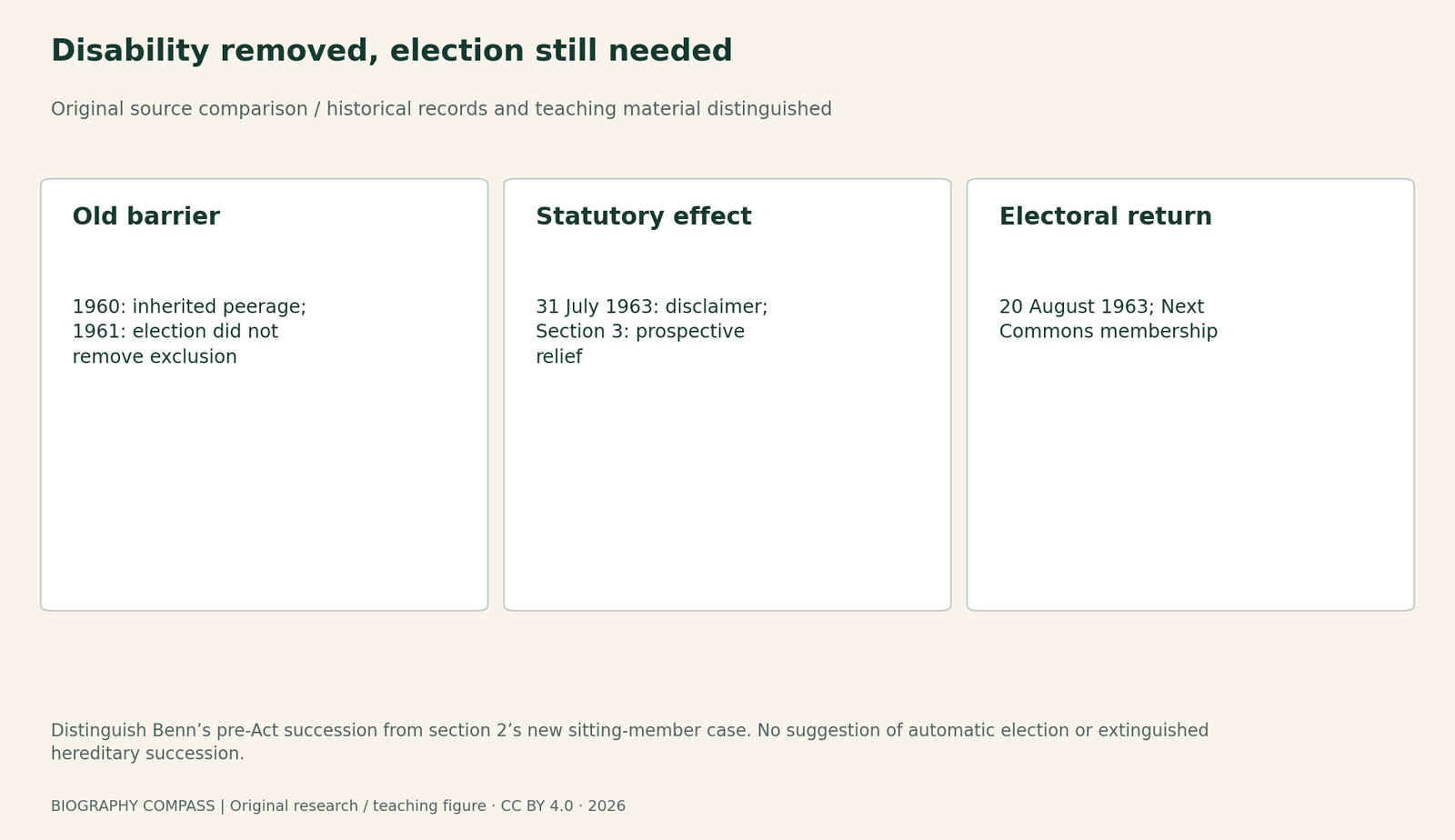
A timeline of the turning points
Inherited status
Benn’s succession produced Commons disqualification.
Electoral success without qualification
The collection account records continued exclusion despite re-election.
Act and disclaimer
Royal Assent and Benn’s disclaimer occurred that day.
Commons return
A new House-membership period began.
Start with the two different questions
An election result can show whom voters chose without resolving whether a candidate is qualified to sit. Parliament’s account of the Stansgate case records that Benn inherited his father’s peerage in 1960 and remained disqualified even after winning the May 1961 contest. That is the constitutional problem to carry into the 1963 legislation.
The collection account is a later interpretation of parliamentary history. It establishes the institution’s explanation of the case, while the original election judgment and the full Privileges Committee evidence have not been read here. It would be too strong to reconstruct every judicial argument from this short account. The narrower question is whether the new Act itself supplied an electoral mandate.
Sources for this section: [1]
Read the Act’s operative date and preserved interests
Section 1 of the Peerage Act 1963 authorised a disclaimer for life for specified hereditary peerages. It included a route for people who had already inherited before commencement. Section 3 made a disclaimer irrevocable and operative from the date of delivery. It relieved disabilities attached to the peerage, including Commons disqualification, without accelerating succession or changing the title’s devolution on death.
The same section preserved interests in associated estates and property. Giving up the parliamentary consequences and use of a title was therefore not the same transaction as surrendering every asset linked to the family. Those distinctions are in the enacted text itself; they do not depend on adopting an admiring or hostile account of Benn’s motives.
Sources for this section: [2]
Do not apply every deadline to every case
Section 1 generally provided twelve months, with specific rules for existing holders and people under twenty-one. Section 2 separately addressed someone who inherited while a Commons member, prescribing one month and restricting sitting or voting during the temporary protection. It also dealt with a candidate’s succession after an election writ had been issued.
Benn’s peerage had been inherited before the Act. Treating his position as identical to a future MP newly inheriting a title would erase the statute’s transitional design. This is a reading of the 1963 text in its historical setting, not advice about present-day eligibility or later Lords reforms. The Act also covered Scottish peers and hereditary peeresses, so its purpose was wider than one individual’s return.
Sources for this section: [2]
Put disclaimer beside the membership record
The Parliamentary Archives interpretation dates Benn’s disclaimer to 31 July 1963, the day of Royal Assent. It describes his Commons return three weeks later. The career record identifies 20 August 1963 as the beginning of the next House-membership period. These dates support a sequence of newly available disclaimer, use of that procedure, and subsequent electoral return.
Use the separate House-membership entries rather than the career page’s aggregated representation line. The latter groups a long constituency association into a broad span and can conceal the interruption. A directory field is useful evidence, but its unit must be understood before it is converted into a sentence about continuous service.
Exercise: repair three misleading captions
A display editor proposes three captions: A, “Benn’s disclaimer retrospectively validated his 1961 election”; B, “disclaimer abolished the peerage and transferred its estates”; C, “any sitting MP inheriting a qualifying peerage had the same twelve-month deadline as an existing holder”. For each, identify the relevant statutory provision or membership record and write a more accurate replacement. Use only the historical sources above.
Worked answer A: section 3 operates from delivery, while the recorded Commons return begins 20 August 1963; write “disclaimer removed the peerage disability before a later election returned Benn”. Answer B: section 3 preserves devolution and property interests; write “the holder gave up the title’s rights and disabilities for life, with succession and property separately preserved”. Answer C: distinguish section 1 from section 2; the latter specifies one month for the defined sitting-member case, with its stated procedural qualifications.
A second person tests the distinction
Alec Douglas-Home offers a useful comparison rather than an identical case. The official biography dates his disclaimer to 23 October 1963 and his election for Kinross and West Perthshire to 7 November. He was already prime minister, and for the interval belonged to neither parliamentary chamber. Appointment, disclaimer and election remained different actions.
The comparison supports a method: ask what each document changes, from what date, and whether another institution must act next. It does not establish that every peer’s circumstances were the same, that an election was unnecessary, or that hereditary titles generally ceased to exist in 1963.
Continue the chronology
Related history guides
Biography context
Explore United Kingdom through connected lives
Connected biographies
People in these records
1925–2014
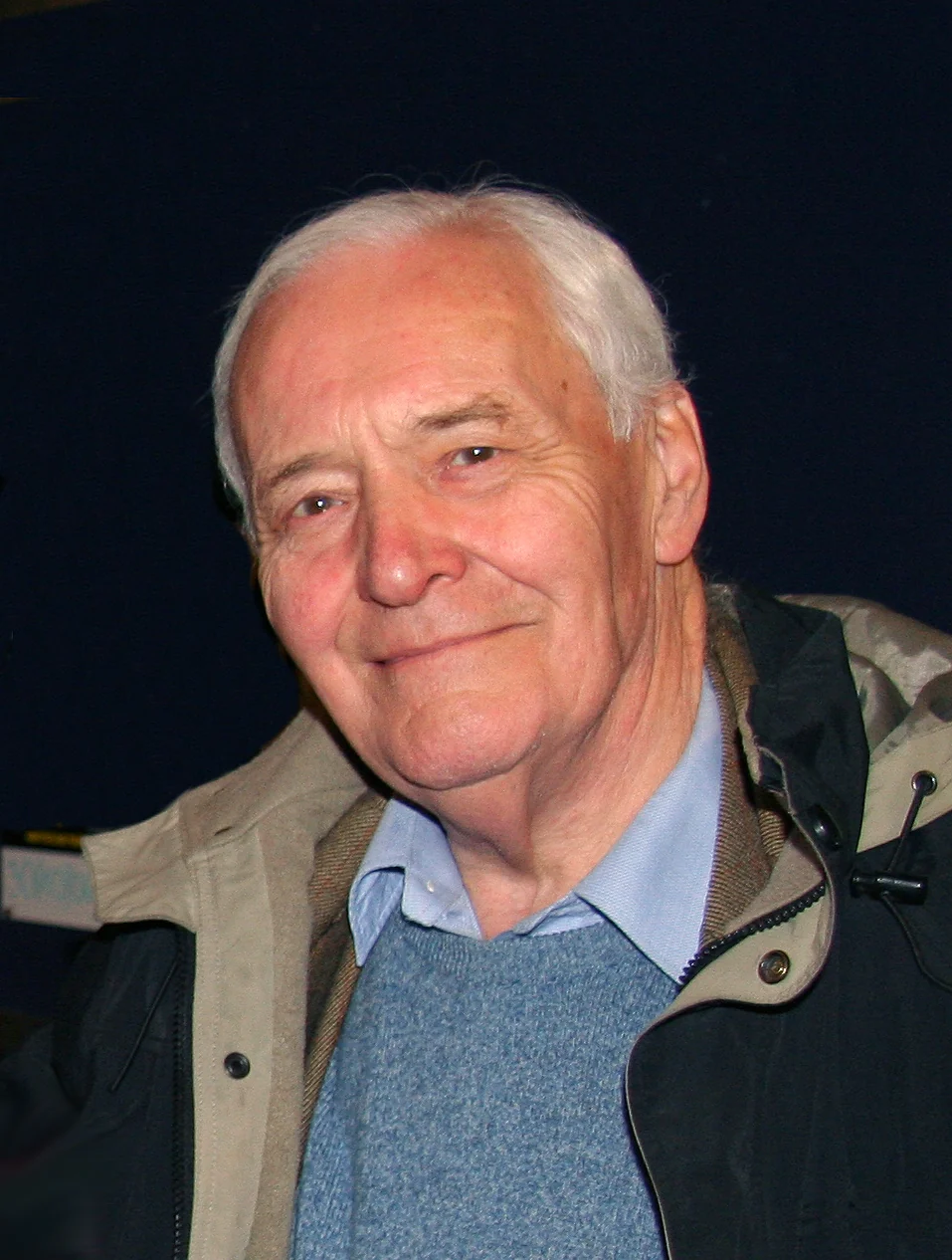
Tony Benn
Labour Cabinet minister, parliamentarian and socialist campaignerTony Benn held Labour ministerial office and represented Bristol South East and Chesterfield. His challenge to inherited disqualification helped make the 1963 peerage reforms a practical constitutional issue.Read biography
1903–1995
Alec Douglas-Home
Prime minister, 1963–1964, and foreign secretaryAlec Douglas-Home combined Scottish Unionist and Conservative service with two periods as foreign secretary. His brief premiership crossed an unusual transition from hereditary peer to Commons MP.Read biographyQuick answers
Common questions
- Did Benn disclaim on 1 August 1963?
- The Parliamentary Archives account gives 31 July 1963, the same day as Royal Assent. A newspaper published on 1 August described the previous evening.
- Did the Act abolish hereditary succession?
- No. Section 3 expressly preserved later devolution of the peerage and did not accelerate succession.
Primary and institutional sources
How this history was checked
Read the selected historical records and the stated access limits. The legal texts discussed are their original enactments. This article was reviewed on 27 October 2026.
- UK Parliament, Parliamentary ArchivesThe Stansgate Case
- The National Archives, legislation.gov.ukPeerage Act 1963, original enacted text, chapter 48
- UK Parliament, Parliamentary ArchivesPeerage Act 1963: collection interpretation
- UK ParliamentTony Benn: parliamentary career
- UK GovernmentPast Prime Ministers: Alec Douglas-Home