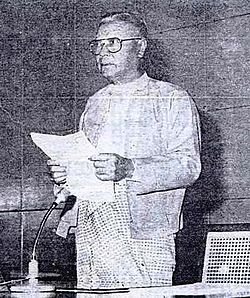
In this biography
Quick facts
- Born
- 2 October 1920
- Died
- 1 May 2020
- Birthplace
- Myitkyina, British Burma
- Country
- Myanmar
- Nationality
- Burmese
- Known for
- Serving as prime minister from July to September 1988 as nationwide protest brought the BSPP system to an end
- Prime minister
- 26 July–18 September 1988
- Finance minister
- 1977–1988
- Military rank
- Brigadier general
- Government ended
- Military takeover · 18 September 1988
Why this life matters
Tun Tin’s short premiership links the BSPP leadership changes of July 1988, the 8888 general strike and the military takeover that abolished his office.
Timeline
Key moments
Born in Myitkyina
Born on 2 October in northern British Burma.
Completed college and joined nationalist politics
Graduated from Mandalay College after involvement in the Dobama and underground student movements.
Served in the independence-era armed forces
Built a military career during the conflict that transformed colonial Burma.
Became finance minister
Managed public finances during the late one-party socialist period.
Appointed prime minister
Replaced Maung Maung Kha during the BSPP leadership crisis.
Removed in the military takeover
The SLORC abolished the existing constitutional institutions after crushing the uprising.
A nationalist who entered the military state
Tun Tin was born in Myitkyina in 1920 and graduated from Mandalay College in 1941. He participated in the Dobama Asiayone and underground student activity against British rule before entering military service. Like several later leaders of socialist Burma, he carried credentials from the independence movement into an armed forces career and eventually reached brigadier-general.
After Ne Win’s 1962 coup, military officers filled political, administrative and economic roles. Tun Tin served in the one-party system and became finance minister in 1977. He also held deputy-prime-minister responsibilities. These offices placed him near the centre of economic management as nationalisation, fixed exchange controls and isolation produced weak growth, shortages and an expanding black market.
Prime minister during eight weeks of crisis
The crisis of 1988 began with student protest and police violence, then expanded into a national movement against one-party rule. At a Burma Socialist Programme Party congress in July, Ne Win stepped down as party chairman. President San Yu and Prime Minister Maung Maung Kha also left office. Tun Tin became prime minister on 26 July, serving first under Sein Lwin, then acting president Aye Ko and finally President Maung Maung.
His appointment did not give the cabinet an independent base of authority. The BSPP still monopolised organised politics, while the armed forces and security apparatus determined the government’s response. On 8 August—the date that gave the 8888 Uprising its name—workers, monks, civil servants and students joined a nationwide strike. Security forces killed demonstrators, and protest continued despite Sein Lwin’s resignation.
The office disappears after the coup
President Maung Maung promised an election and attempted negotiations, but the state was fragmenting and the democracy movement demanded an interim government. On 18 September the military seized power, created the State Law and Order Restoration Council and suspended the 1974 Constitution. Tun Tin’s premiership ended with the constitutional order itself. Saw Maung, the new council chairman, combined military and government leadership outside the institutions Tun Tin had formally headed.
Tun Tin lived until 2020, more than a century after his birth. His eight-week term is easily overlooked, yet it explains why a complete list of Myanmar prime ministers must be read beside the presidential succession and the 8888 timeline. Three presidents and one acting president occupied the head-of-state office during his premiership, illustrating how rapidly the one-party state unravelled before direct military government returned.
Quick answers
Frequently asked questions about Tun Tin
- Who was Tun Tin?
- Tun Tin was a final prime minister of Burma’s one-party socialist state. Tun Tin’s short premiership links the BSPP leadership changes of July 1988, the 8888 general strike and the military takeover that abolished his office.
- What is Tun Tin best known for?
- Tun Tin is best known for serving as prime minister from July to September 1988 as nationwide protest brought the BSPP system to an end.
- When and where was Tun Tin born?
- Tun Tin was born on 2 October 1920 in Myitkyina, British Burma.
- When did Tun Tin die?
- Tun Tin died on 1 May 2020.
Sources and further reading
Explore the evidence
These references support the biography and offer further reading. Official records, first-person accounts and independent reporting provide different perspectives; image records document attribution and licensing.
- 1. Human Rights WatchChronology of political events in Burma, 1962–2008
- 2. Government of Myanmar archiveConstitution of the Socialist Republic of the Union of Burma (1974)
- 3. Scarecrow Press / digital library copyHistorical Dictionary of Burma (Myanmar)
- 4. The New York Times archiveThe military officially takes power in September 1988