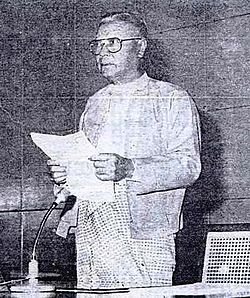
In this biography
Quick facts
- Born
- 7 June 1920
- Died
- 30 April 1995
- Birthplace
- Rangoon, British Burma
- Country
- Myanmar
- Nationality
- Burmese
- Known for
- Leading the Council of Ministers during the long final phase of Ne Win’s one-party socialist system
- Prime minister
- 29 March 1977–26 July 1988
- Ruling party
- Burma Socialist Programme Party
- Earlier office
- Industry and mines minister
- Removed during
- Political crisis preceding the 8888 Uprising
Why this life matters
Maung Maung Kha’s long premiership covers the one-party state’s deepening isolation, 1987 currency demonetisation and the collapse that produced the 8888 Uprising.
Timeline
Key moments
Born in Rangoon
Born on 7 June under British colonial rule.
Joined the independence army
Left engineering studies to enter the Burma Independence Army during the Second World War.
Entered the cabinet
Became industry minister after a career in the armed forces and defence industry administration.
Became prime minister
Succeeded Sein Win as head of the Council of Ministers.
Government demonetised banknotes
The loss of savings intensified anger at the one-party state and its economic management.
Left office amid national crisis
Was replaced by Tun Tin on 26 July as mass protest spread.
Army, industry and the socialist cabinet
Maung Maung Kha was born in Rangoon in 1920 and studied engineering at Rangoon University. He left before completing the course to join the Burma Independence Army in 1941. After the war and independence, he remained in the armed forces, reached the rank of colonel and worked in defence industries. This combination of military service and industrial administration fitted the governing model created after Ne Win’s 1962 coup.
He entered the cabinet in 1972 as the Revolutionary Council prepared to replace open military rule with a one-party constitution. After the Socialist Republic of the Union of Burma was established in 1974, he continued as industry minister and then mines minister. Both portfolios sat at the heart of the “Burmese Way to Socialism,” which transferred major enterprises to the state and sharply restricted the private economy and foreign investment.
Eleven years as prime minister
Maung Maung Kha succeeded Sein Win on 29 March 1977 and remained prime minister for more than eleven years. Under the 1974 Constitution, he chaired the Council of Ministers, but President Ne Win and the Burma Socialist Programme Party controlled the political system. The legislature offered no competitive opposition, the press was censored and the security services suppressed dissent. The length of Maung Maung Kha’s term therefore reflected institutional continuity inside a closed ruling party rather than repeated electoral mandates.
The economy deteriorated through the 1980s. State control, weak productivity, debt and a large informal market contributed to shortages and falling living standards. In September 1987 the government invalidated commonly held banknotes without compensation, destroying household and student savings. The United Nations placed Burma among the least developed countries later that year. Although policy was associated above all with Ne Win, Maung Maung Kha’s cabinet administered the state during this deepening crisis.
The government collapses in 1988
A dispute in Rangoon in March 1988 led to student demonstrations, deaths and new protests over police violence. Universities closed, but mobilisation widened rather than disappeared. At an extraordinary party congress in July, Ne Win resigned as BSPP chairman and warned that the army would shoot to hit. President San Yu and Prime Minister Maung Maung Kha also left office. Tun Tin replaced Maung Maung Kha on 26 July, only weeks before the nationwide general strike remembered as 8888.
The cabinet changes could not restore legitimacy. Sein Lwin resigned as president in August, Maung Maung attempted a civilian-looking transition, and the military seized power again on 18 September. Maung Maung Kha died in 1995. His biography makes clear that the 1988 uprising did not appear suddenly: it followed years of declining living standards, coercive one-party rule and policy decisions made by a government he formally headed.
Quick answers
Frequently asked questions about Maung Maung Kha
- Who was Maung Maung Kha?
- Maung Maung Kha was a prime minister of Burma from 1977 to 1988. Maung Maung Kha’s long premiership covers the one-party state’s deepening isolation, 1987 currency demonetisation and the collapse that produced the 8888 Uprising.
- What is Maung Maung Kha best known for?
- Maung Maung Kha is best known for leading the Council of Ministers during the long final phase of Ne Win’s one-party socialist system.
- When and where was Maung Maung Kha born?
- Maung Maung Kha was born on 7 June 1920 in Rangoon, British Burma.
- When did Maung Maung Kha die?
- Maung Maung Kha died on 30 April 1995.
Sources and further reading
Explore the evidence
These references support the biography and offer further reading. Official records, first-person accounts and independent reporting provide different perspectives; image records document attribution and licensing.
- 1. Government of Myanmar archiveConstitution of the Socialist Republic of the Union of Burma (1974)
- 2. Human Rights WatchChronology of political events in Burma, 1962–2008
- 3. Scarecrow Press / digital library copyHistorical Dictionary of Burma (Myanmar)
- 4. Working People’s Daily archiveBurma Press Summary · contemporary government record, March 1988