In this biography
Quick facts
- Born
- 13 April 1743
- Died
- 4 July 1826
- Birthplace
- Virginia, British America
- Country
- United States
- Nationality
- Not independently established
- Known for
- The Declaration of Independence, religious liberty and the Louisiana Purchase.
- Declaration role
- Principal drafter in 1776
- Secretary of state
- 1790–1793
- Presidency
- 1801–1809
- Louisiana agreement
- Treaty and conventions dated 30 April 1803
Why this life matters
His arguments about rights and limited government must be read alongside territorial expansion, contested executive choices and the enslaved labour supporting his household.
Timeline
Key moments
Birth
Born in Virginia on 13 April.
Legal practice
Entered the Virginia bar after study at William and Mary and legal training.
Declaration
Drafted the text considered and revised by Congress.
French diplomacy
Served in France before returning to national executive office.
Secretary of state
Served in Washington’s administration.
Presidency
Led two administrations amid expansion and international conflict.
Louisiana negotiations
Livingston and Monroe negotiated the cession and financing agreements.
Death
Died on 4 July at the fiftieth anniversary of the Declaration’s adoption.
Law and political writing in Virginia
Thomas Jefferson was born in Virginia on 13 April 1743. Plantation wealth gave him access to education, including study at William and Mary and training in law. He entered the Virginia bar in 1767. His 1774 Summary View of the Rights of British America helped establish him as a forceful writer against parliamentary claims over the colonies.
In 1776 he became the principal drafter of the Declaration of Independence for a congressional committee. Congress debated and revised the text before adopting it on 4 July. Its account of rights and legitimate government became far more influential than a statement of the immediate grievances against George III. Drafting, congressional adoption and the later signatures were separate stages.
A state reformer and a diplomat abroad
Jefferson pursued reforms in inheritance, religion and education in Virginia. He served as wartime governor, a position that exposed him to criticism when British forces invaded the state. His political authority did not spare him the practical difficulties of defending a state during revolution.
After the war he served as minister in France. From Europe he corresponded with James Madison about the proposed federal Constitution and pressed for explicit protections of individual rights. He returned to become Washington’s secretary of state. Disputes with Alexander Hamilton over public finance, the national bank and the direction of foreign policy helped turn competing ideas into organised political opposition.
Sources for this section: [1]
Party conflict and the presidency
Jefferson finished second in the 1796 presidential contest and became John Adams’s vice president under the original electoral system. Four years later, the election produced a tie between Jefferson and Aaron Burr that had to be resolved in the House. He entered the presidency in 1801 after a deeply divisive contest.
He sought lower expenditure and a more restrained federal establishment, but foreign affairs repeatedly tested those commitments. Conflict with Tripoli required naval action. British interference with American shipping and the wider Napoleonic wars eventually brought the 1807 embargo, which badly hurt American commerce. His presidency combined a language of limited government with coercive measures adopted to defend national interests.
Sources for this section: [1]
Louisiana expanded both the nation and constitutional debate
In 1803 Robert Livingston and James Monroe accepted France’s offer of Louisiana. The treaty and two financial conventions were dated 30 April and provided for cession and compensation totalling 15 million dollars. Jefferson had sought a more limited acquisition around New Orleans; his envoys acted on a much larger opportunity.
He worried about constitutional authority to acquire territory but proceeded through the treaty and legislative process. The agreement transferred France’s claimed sovereignty, not every private property right, and it affected lands occupied by Indigenous nations that were not parties to the bargain. Jefferson also authorised the Lewis and Clark expedition, linking territorial ambition with exploration and information gathering.
Monticello, freedom and retirement
Jefferson retired in 1809 and devoted attention to Monticello, correspondence and the creation of the University of Virginia. He died on 4 July 1826, the same day as John Adams. Their renewed correspondence after political estrangement became an important part of both men’s later lives.
The language of liberty did not govern everyone in Jefferson’s household. Enslaved people supplied its agricultural and skilled labour. James Hemings, trained as a chef in France, negotiated a conditional promise of freedom and was legally manumitted on 5 February 1796 after training a replacement. That document disproves the claim that Jefferson never freed anyone; it also shows that one person’s freedom could depend on another remaining enslaved.
Quick answers
Frequently asked questions about Thomas Jefferson
- Was Jefferson the only person responsible for the Declaration?
- He was its principal drafter; a committee and Congress revised and adopted the text.
- Did Jefferson free no enslaved people?
- That blanket statement is false. Monticello reproduces the 5 February 1796 document freeing James Hemings, though most people Jefferson enslaved did not gain freedom from him.
Keep exploring
Lives connected to this story
- James Madison
Madison was a political collaborator, secretary of state and presidential successor.
- James Monroe
Monroe joined Livingston in the 1803 negotiations in Paris.
- John Adams
Their rivalry and later correspondence connect two different founding careers.
- Frederick Douglass
Compare Jefferson’s universal language with Douglass’s later examination of national independence and slavery.
Sources and further reading
Explore the evidence
These references support the biography and offer further reading. Official records, first-person accounts and independent reporting provide different perspectives; image records document attribution and licensing.
- 1. Miller Center, University of VirginiaThomas Jefferson: Life in Brief
Complete Peter Onuf biographical essay read. Its claim that Jefferson never freed anyone is contradicted by the actual 1796 manumission transcript; its 4 July signing shorthand is not adopted.
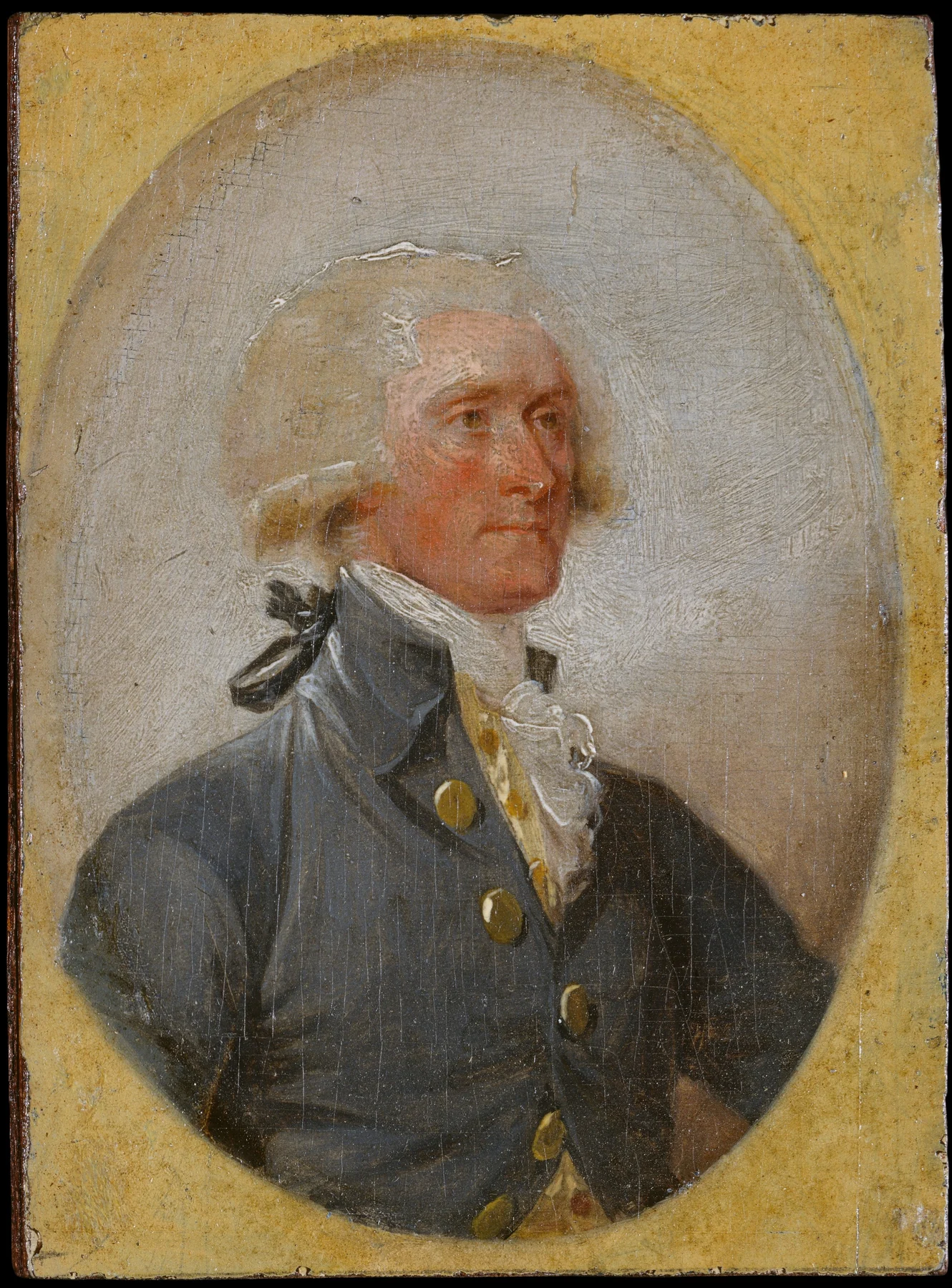
- 2. Smithsonian National Portrait GalleryThomas Jefferson, NPG.99.66
Actual indexed exact artwork record read for sitter 13 April 1743–4 July 1826 and artistMather Brown. Its file not acquired; different Met 1788 artwork selected separately.
- 3. National ArchivesLouisiana Purchase Treaty and two conventions, 30 April 1803
Original transcript: cession articlesI–VI andIX–X, first convention articles 1–2 and second-convention introductory monetary summary read. Whole annex/voucher/claims record not read. Introductory territorial overview also read.
- 4. Wayne T. DeCesar and Susan Page, Prologue / National ArchivesJefferson Buys Louisiana Territory, and the Nation Moves Westward
Selected full article narrative on negotiations, two payment instruments, ratification/exchange, stock implementation and U.S. possession read. Original thirty-document Treasury file not claimed read. Compressed three-flags ceremony description is not repeated.
- 5. Thomas Jefferson’s MonticelloThe Life of James Hemings
Actual web body lines 11–33 and 68–92 read: James Hemings’s role, conditional 1793 agreement and 5 February 1796 manumission transcript. Videos not watched; later-travel sections and all food-history claims not independently assessed.