
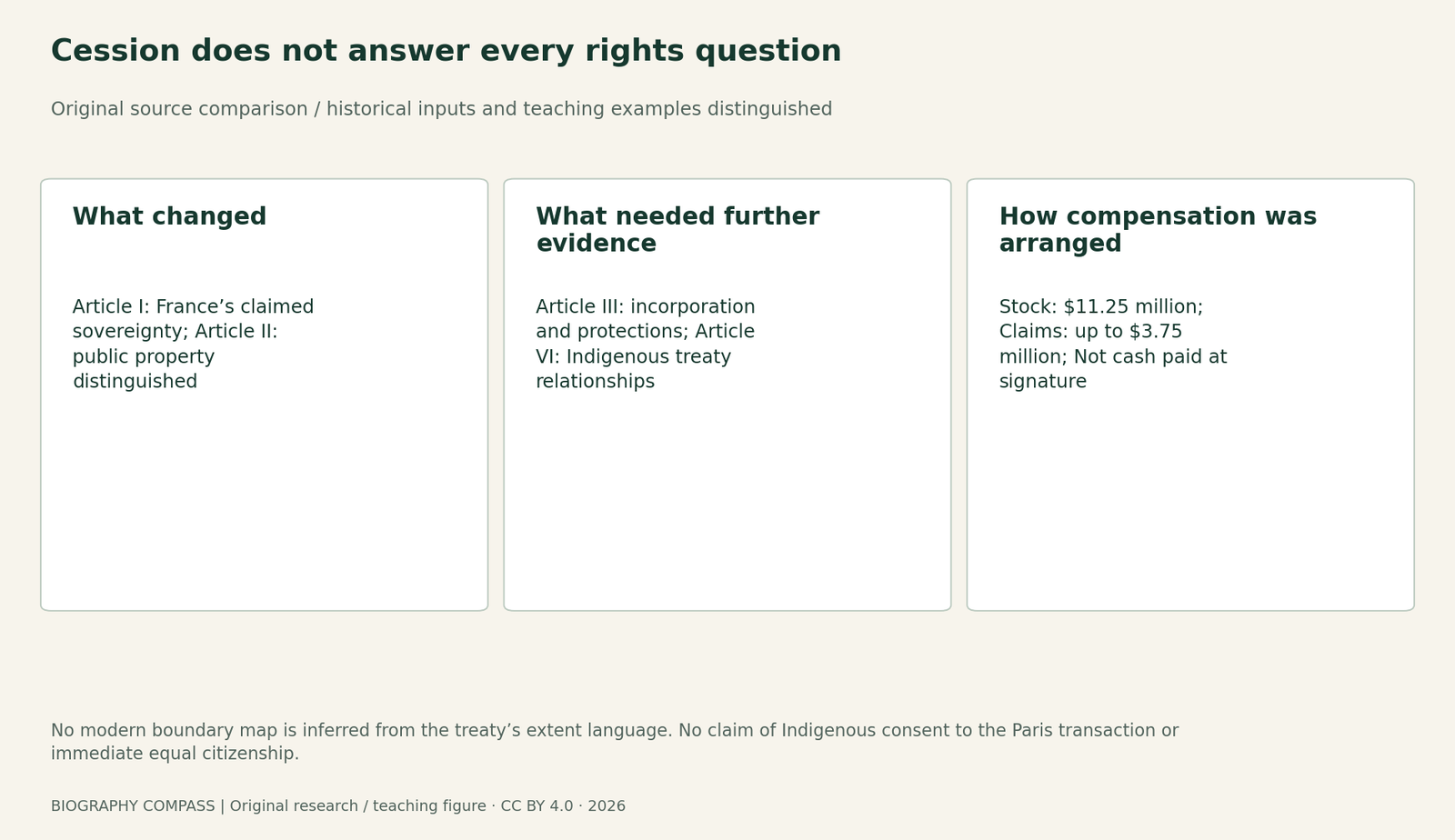
The short answer
“America bought Louisiana” compresses several different transactions and rights questions. The treaty, its financial conventions and the later implementation record show what was ceded, how compensation was arranged and why possession and inhabitants’ rights require separate evidence.
Document comparison
One agreement, several distinct questions
Read each part according to the right or action it addresses.
| Record | What it addresses | Limit |
|---|---|---|
| Articles I–II | Sovereignty and public property | Not ownership of every private holding |
| Article III | Incorporation and inhabitants’ protections | Not proof of immediate equal rights in practice |
| Article VI | Specified Indigenous treaty relationships | Not Indigenous consent to the Paris cession |
| Two conventions | Stock and American claims against France | Not one cash payment at signature |
Chronology
A timeline of the turning points
Instruments dated
Livingston, Monroe and Barbé-Marbois concluded the treaty and conventions.
Senate consent
The Senate agreed to ratification.
Ratifications exchanged
The implementation account records the exchange.
U.S. possession at New Orleans
The United States took possession there; not every regional handover is dated here.
Identify the instruments and the negotiators
The treaty and two conventions were dated 30 April 1803 in Paris. Robert Livingston and James Monroe acted for the United States; François Barbé-Marbois represented France. Jefferson’s importance as president should not erase the envoys who negotiated the documents or collapse their agreement into a personal purchase by him.
Article IX required the two conventions to be ratified jointly with the treaty. The archive’s implementation account then distinguishes the Senate’s consent on 20 October, the exchange of ratifications on 21 October and the United States taking possession at New Orleans on 20 December. These are different institutional and physical actions, not competing dates for one event.
Cession of sovereignty is not a deed to every farm
Article I transferred France’s claimed sovereignty over Louisiana, defining its extent by reference to earlier French and Spanish possession. That wording does not provide a precise modern state map or settle every boundary dispute. It records the European governments’ claims and their agreed transfer.
Article II included public property such as public lots, buildings and fortifications, but distinguished these from private property. The article also addressed archives and records. A caption that says the United States acquired ownership of every privately held house and farm confuses governmental authority with individual title. A researcher investigating one family’s land would need the relevant property records and later proceedings.
Sources for this section: [1]
Read the inhabitants and Indigenous-treaty clauses
Article III promised incorporation of the inhabitants into the Union and admission to citizens’ rights as soon as possible according to the federal Constitution, with interim protection of liberty, property and religion. Those conditions and timing prevent the sentence from proving that every resident immediately exercised equal citizenship in practice. Enslavement and other exclusions cannot be wished away by quoting its promise.
Article VI addressed treaties and articles previously agreed between Spain and Indigenous nations, preserving them until altered by mutual consent between the United States and those nations. Indigenous governments were not signatories selling all their lands through the Paris bargain. The clause itself indicates continuing relationships beyond France’s cession. It does not prove how the United States later honoured each obligation.
Sources for this section: [1]
Compensation had two components
The first convention provided sixty million francs through United States stock, equivalent to 11.25 million dollars, with six per cent interest and specified redemption conditions. The other convention addressed up to twenty million francs, or 3.75 million dollars, in American claims against France. Together those components explain the familiar fifteen-million-dollar total.
It would be inaccurate to depict fifteen million dollars in cash changing hands in Paris on the treaty date. The archive’s Treasury-based article traces later implementation, including the creation and payment of stock. The treaty establishes obligations and procedures; the later records help establish their performance. The selected evidence here is not a complete audit of every claimant’s voucher.
Exercise: repair four exhibition captions
An editor proposes four captions. A: “The United States became owner of every private farm on 30 April.” B: “All Indigenous nations agreed in Paris to sell their land.” C: “Every inhabitant immediately gained identical citizenship rights.” D: “Fifteen million dollars in cash was paid at signature.” For each, identify the relevant article or convention and write a replacement that stays within its evidence.
Worked answer A: articles I–II distinguish cession of sovereignty from private property. B: article VI preserves specified treaty relationships pending mutual change; the Indigenous nations were not the Paris signatories. C: article III describes future incorporation subject to the Constitution and interim protections, not proof of equal rights in practice. D: the conventions distinguish stock of 11.25 million dollars from a claims provision of up to 3.75 million. None of these corrections requires pretending the agreement had no effect; each makes the nature of that effect more exact.
Ask what the next record must show
To investigate actual handover, seek possession records; to trace a claimant’s compensation, seek the relevant stock or claims account; to understand an Indigenous nation’s position, seek its own records and the applicable treaty relationship. A diplomatic agreement cannot answer all those questions simply because it reshaped a continent.
The National Archives article is useful for the federal implementation sequence, but its compressed description of successive flags should not be expanded into a claim that all transfers occurred on the same day. This guide uses its explicit United States possession date at New Orleans and leaves other regional handovers outside the claim. The distinction keeps a readable chronology without inventing uniform possession across the whole territory.
Continue the chronology
Related history guides
Biography context
Explore United States through connected lives
Connected biographies
People in these records
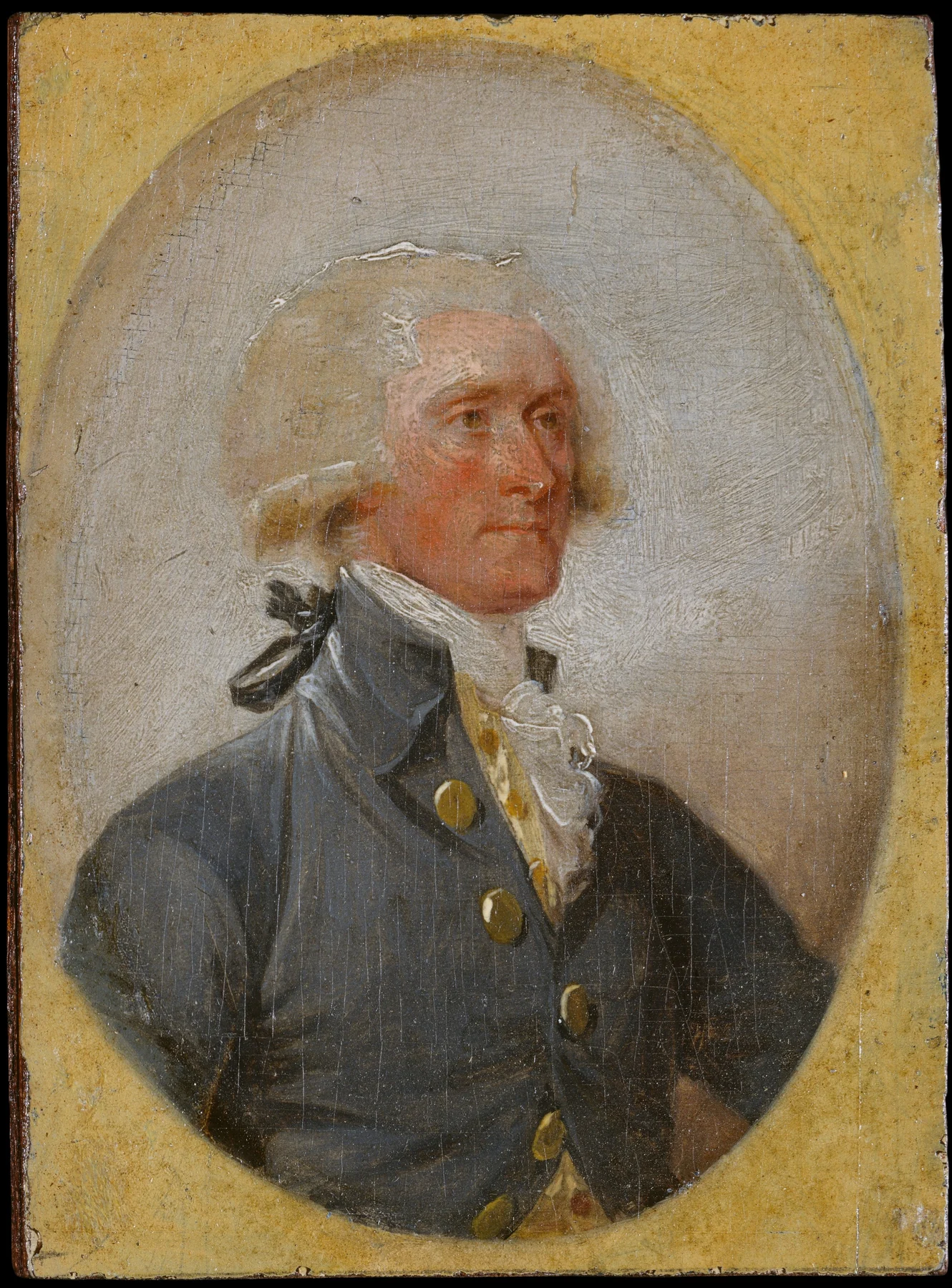
1743–1826
Thomas Jefferson
Declaration drafter, diplomat and third U.S. presidentThomas Jefferson shaped the language of American independence and later led an expanding republic. His career moved through Virginia law and government, diplomacy in France, national party conflict and two presidential terms.Read biography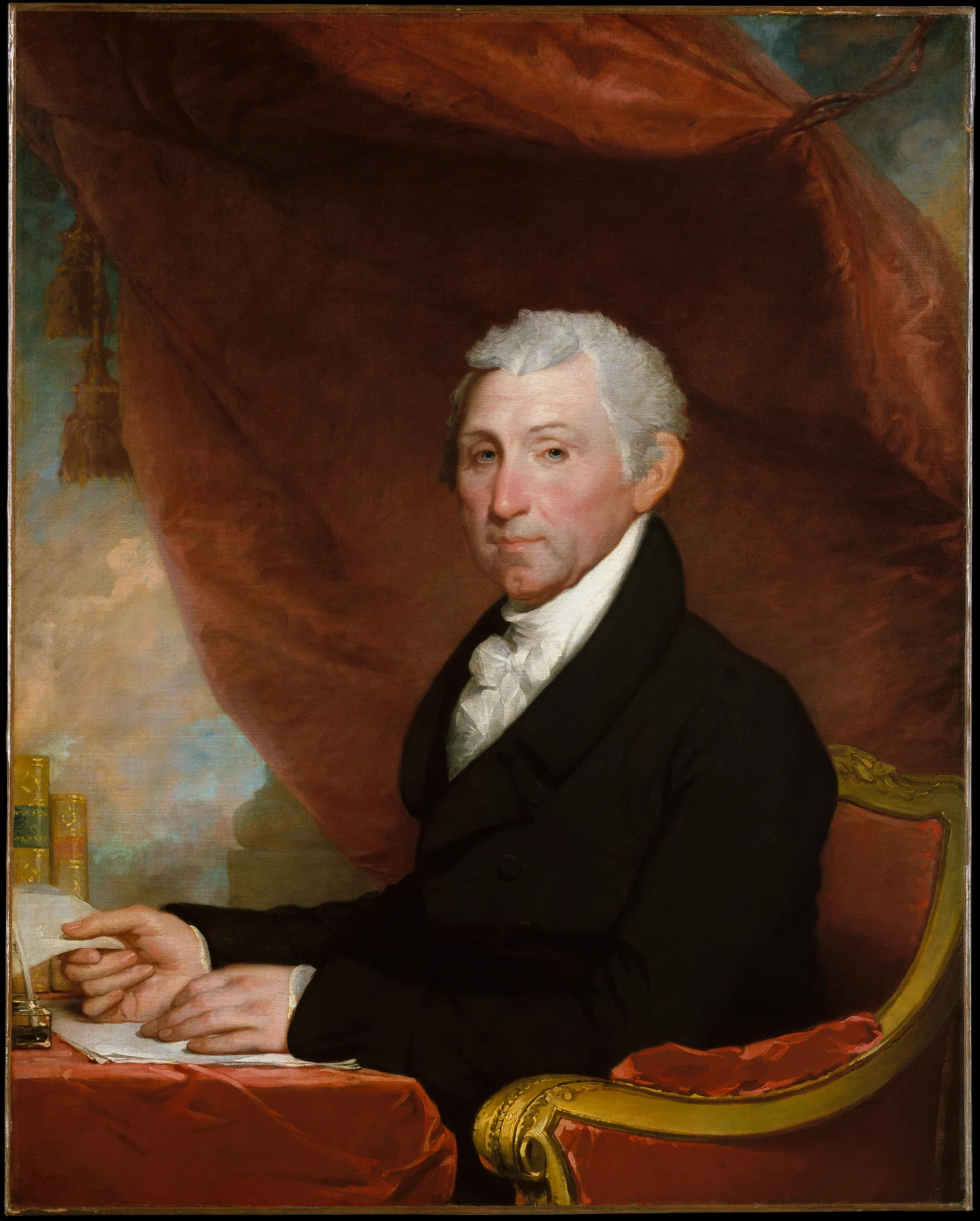
1758–1831
James Monroe
Diplomat, cabinet officer and fifth U.S. presidentJames Monroe moved from revolutionary military service into state government, diplomacy and the presidency. His career followed the republic’s expansion from an Atlantic union into a much larger continental power.Read biographyQuick answers
Common questions
- Were private lands and sovereignty the same thing?
- No. The treaty distinguished public property and sovereignty from private property.
- Did the treaty itself prove later compliance with Indigenous treaties?
- No. It contained an undertaking whose subsequent performance requires separate evidence.
Primary and institutional sources
How this history was checked
Read the historical documents alongside the stated access scopes. Proposals, enacted provisions and later interpretations are distinguished. This article was reviewed on 27 October 2026.