In this biography
Quick facts
- Born
- 28 April 1758
- Died
- 4 July 1831
- Birthplace
- Westmoreland County, Virginia, British America
- Country
- United States
- Nationality
- Not independently established
- Known for
- The Louisiana negotiations and the 1823 foreign-policy message later called the Monroe Doctrine.
- Louisiana mission
- Envoy in the 1803 negotiations
- Secretary of state
- 1811–1817
- Presidency
- 1817–1825
- Annual message
- 2 December 1823
Why this life matters
His diplomacy and presidency connect territorial agreements, slavery’s expansion and the distinction between a policy declaration and the power to enforce it.
Timeline
Key moments
Birth
Born on 28 April in Westmoreland County.
Revolutionary army
Served in the war before turning toward law and politics.
U.S. Senate
Served Virginia in the federal Senate.
Louisiana mission
Joined Robert Livingston in negotiating with France.
Secretary of state
Served under James Madison, also taking wartime duties.
Presidency
Led the government during expansion and sectional conflict.
Annual message
Stated opposition to new European colonisation and intervention.
Death
Died in New York on 4 July.
A soldier enters the republic’s politics
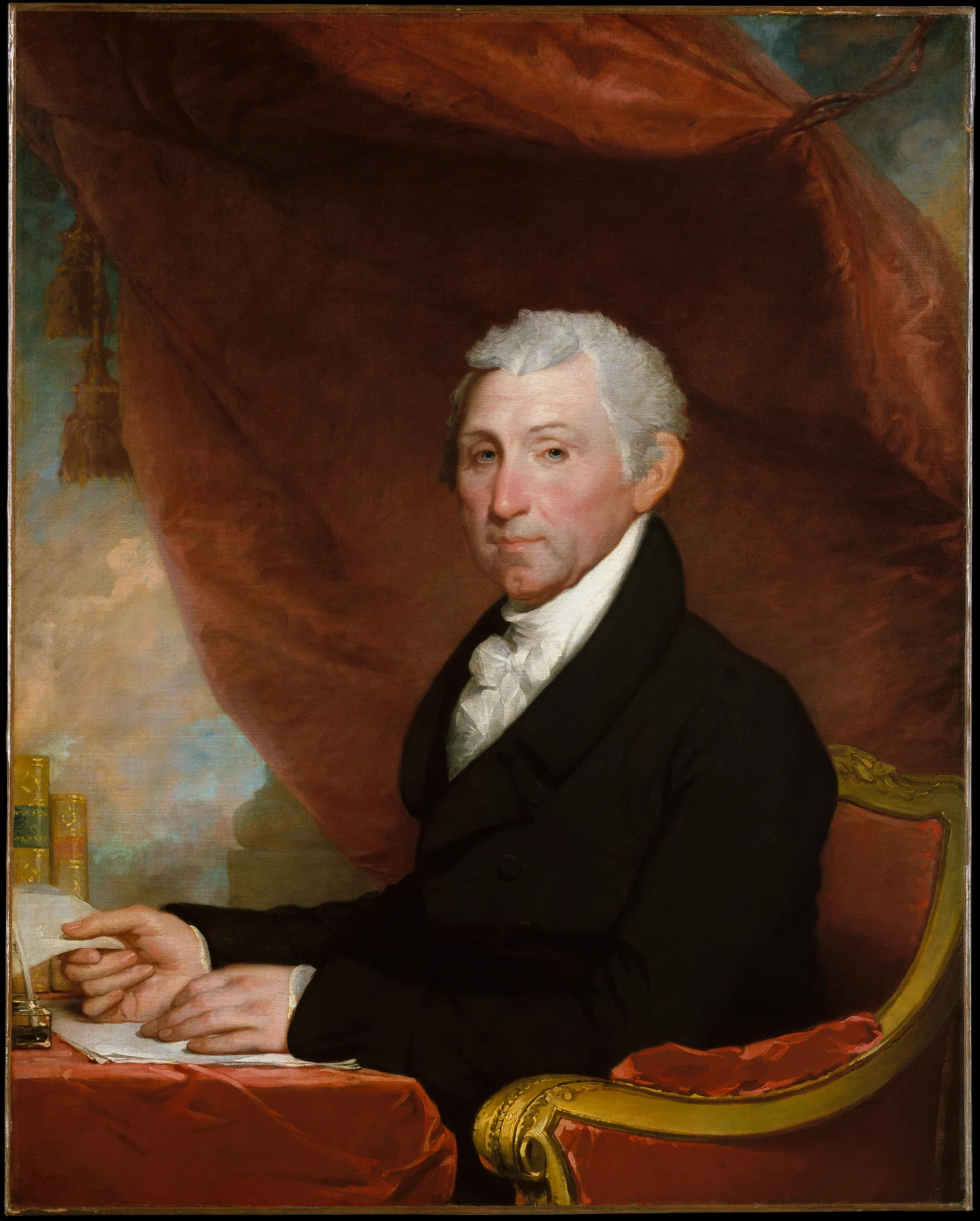
James Monroe was born in Westmoreland County, Virginia, on 28 April 1758. He left college for revolutionary military service and later studied law under Thomas Jefferson. The Revolution gave him both political connections and experience of the new nation’s weak military and financial institutions.
He served in the Confederation Congress and opposed ratification of the proposed Constitution without stronger protections for rights. His objections did not keep him outside the new system: he became a United States senator in 1790. The movement from critic to officeholder shows how the Constitution’s opponents also helped shape its operation.
French diplomacy and the Louisiana opportunity
Monroe served as minister to France during the 1790s and as governor of Virginia around the turn of the century. His French sympathies and disagreements with Federalist policy made diplomacy part of domestic party conflict. He later represented the United States in Britain as well as in special negotiations.
In 1803 Jefferson sent him to join Robert Livingston in seeking an arrangement over New Orleans and access to the Mississippi. Napoleon’s government offered the much larger Louisiana territory. Livingston, Monroe and François Barbé-Marbois signed a treaty and two conventions dated 30 April. The instruments combined France’s cession of its claimed sovereignty with stock and claims arrangements totalling fifteen million dollars.
Cabinet experience and a growing nation
Monroe became Madison’s secretary of state in 1811 and also undertook war-department responsibilities during the final part of the War of 1812. Those offices placed him close to the military and diplomatic weaknesses that had become evident during the conflict. He succeeded Madison as president in 1817.
His administration negotiated the Adams–Onís settlement with Spain, including the acquisition of Florida, and confronted the economic distress of the Panic of 1819. The decline of the Federalist Party did not eliminate political conflict. Disagreement over Missouri’s admission exposed how territorial growth reopened the question of slavery and the balance of power between sections.
The message later called a doctrine
Monroe’s annual message of 2 December 1823 opposed further European colonisation in the Americas and warned against intervention in the newly independent American states. The same message distinguished those claims from existing European colonies and stated a policy of non-interference in Europe’s internal affairs.
Secretary of State John Quincy Adams was central to the administration’s diplomacy. The message was a presidential statement of policy, not a treaty binding European powers or an assurance that the United States could immediately enforce every part of it. Later governments gave the Monroe Doctrine new meanings that should not be read backwards into the original paragraphs.
Highland, debt and the people he enslaved
Monroe’s household at Highland depended on enslaved workers with family ties, skilled occupations and ambitions of their own. The museum’s documentary reconstructions identify, among others, Billy the carpenter, Betsy Sanders’s family, and Dudley and Eve McGuire. Financial pressure on the owner could mean forced movement for these families rather than an ordinary change of employer.
In 1828 several Highland families were sold to Joseph White and taken to his Casa Bianca plantation in Florida. Monroe himself struggled with debt after leaving office and eventually moved to New York, where he died on 4 July 1831. His financial troubles and expanding national reputation must be understood alongside the much more severe consequences of sale and separation for the people he enslaved.
Quick answers
Frequently asked questions about James Monroe
- Did Monroe negotiate Louisiana by himself?
- No. He joined Robert Livingston, and both negotiated with the French representative François Barbé-Marbois.
- Was the Monroe Doctrine a treaty?
- No. Its original statements formed part of the president’s 2 December 1823 annual message to Congress.
Keep exploring
Lives connected to this story
- Thomas Jefferson
Jefferson sent Monroe to join Livingston’s Louisiana negotiations.
- James Madison
Monroe served in Madison’s cabinet before succeeding him.
- Theodore Roosevelt
Later interpretations of hemispheric policy differed from Monroe’s original message.
Sources and further reading
Explore the evidence
These references support the biography and offer further reading. Official records, first-person accounts and independent reporting provide different perspectives; image records document attribution and licensing.
- 1. Miller Center, University of VirginiaJames Monroe: Life in Brief
Complete Daniel Preston biographical essay read; 1780s–1820s career and policy. Its war/territorial narrative is not treated as an Indigenous viewpoint; diplomatic-recall day/year not relied on.
- 2. U.S. Congress / GovInfoBiographical Directory of Congress, 1774–2005: James Monroe entry
Actual indexed Monroe entry read:28 April 1758, Westmoreland County, offices and 4 July 1831 death. Entire directory not acquired/read; its Harlem Heights wound claim conflicts with Miller’s Trenton and is not used.
- 3. National ArchivesLouisiana Purchase Treaty and two conventions, 30 April 1803
Original transcript: cession articlesI–VI andIX–X, first convention articles 1–2 and second-convention introductory monetary summary read. Whole annex/voucher/claims record not read. Introductory territorial overview also read.
- 4. Wayne T. DeCesar and Susan Page, Prologue / National ArchivesJefferson Buys Louisiana Territory, and the Nation Moves Westward
Selected full article narrative on negotiations, two payment instruments, ratification/exchange, stock implementation and U.S. possession read. Original thirty-document Treasury file not claimed read. Compressed three-flags ceremony description is not repeated.
- 5. National ArchivesMonroe Doctrine, 1823: original message excerpts
Full displayed transcript excerpts of 2 December 1823 message read, plus short context. Not the entire annual message; later Roosevelt/Cold War applications distinguished from original words.
- 6. James Monroe’s Highland, William & MaryWho Was Enslaved at Highland?
Saved page introduction and selected Betsy Sanders, Billy, Charles and Dudley/Eve McGuire entries read. Underlying linked legal records/spreadsheet not read in full; these are museum documentary reconstructions.