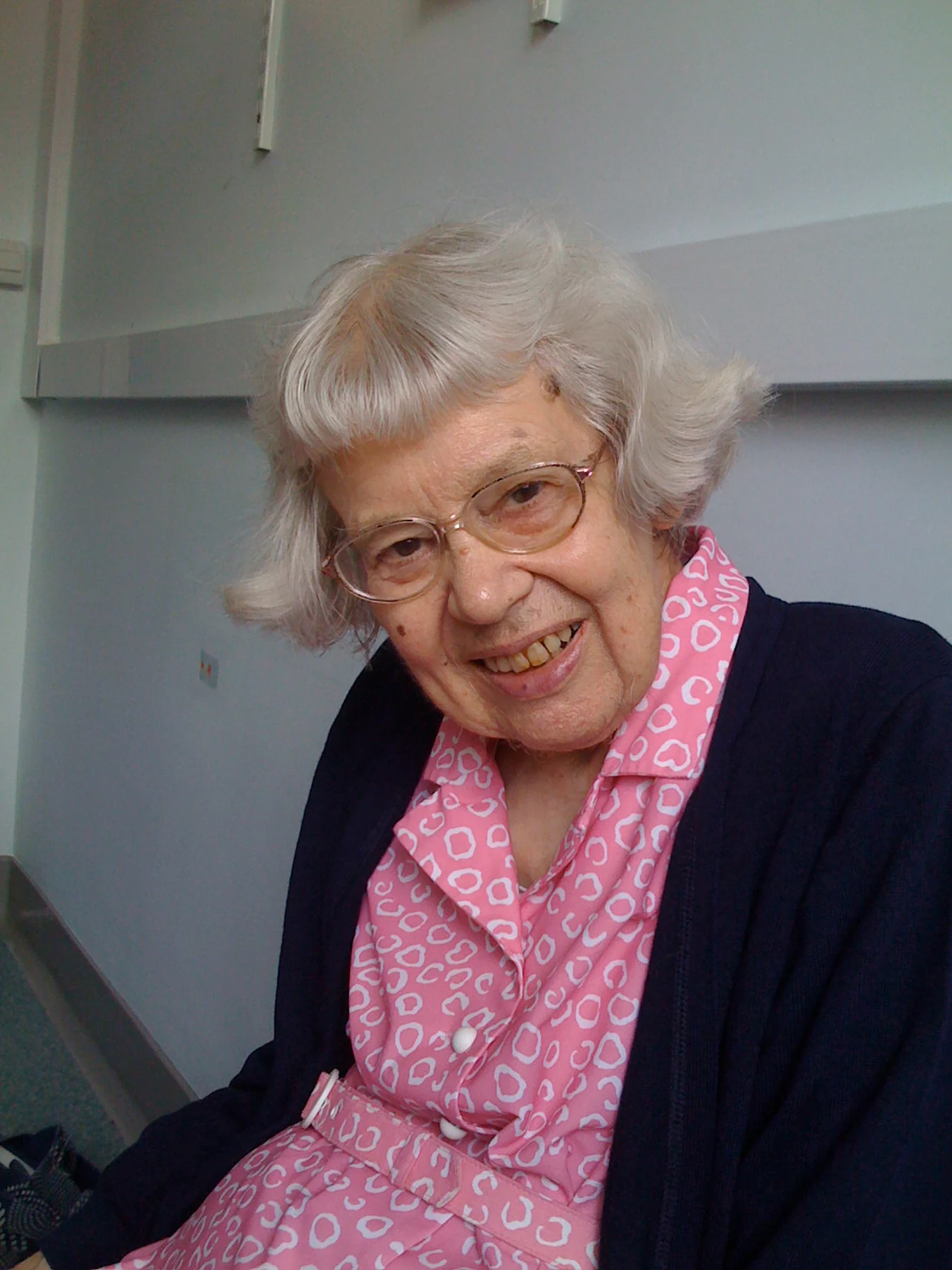
In this biography
Quick facts
- Born
- 1918
- Died
- 1997
- Birthplace
- Chicago, Illinois, United States
- Country
- United States
- Nationality
- Not independently established
- Known for
- Investigating non-Mendelian inheritance in algae and later studying gene expression in cancer
Why this life matters
Her work separates evidence for an inheritance pattern from a complete account of its physical carrier.
Timeline
Key moments
Birth in Chicago
Born on 7 February 1918.
Contrasting inheritance patterns
Published research on two streptomycin-resistant algal strains.
Maspin collaboration
Co-authored research identifying a candidate tumour-suppressing gene.
A geneticist with two research careers
Ruth Sager was born in Chicago in 1918 and trained across several branches of biology. Her studies took her from the University of Chicago to Rutgers and then to doctoral work in maize genetics at Columbia. Arthur Pardee’s National Academy memoir describes a career with two major centres: inheritance outside conventional nuclear-genetic expectations, followed by cancer genetics. This was a change in experimental setting and scale, rather than a simple progression from an early discovery directly to a finished medical application.
Sources for this section: [1]
Asking where inheritance resides
At Rockefeller, Sager investigated the alga Chlamydomonas. Her 1954 paper compared two streptomycin-resistant strains. One followed the segregation and recombination behaviour expected of a Mendelian gene. The other produced a different pattern, even while other markers behaved normally. The contrast mattered because the same observable trait, resistance, did not guarantee the same mode of inheritance. Sager’s conclusion concerned genetic behaviour; the paper explicitly stated that the physical carrier and the mechanism of transmission remained obscure.
Sources for this section: [2]
A later collaboration on gene expression
Sager later investigated cancer through differences in gene expression. A 1994 Science paper, with Sager among a multi-author team with Zhi Zou as first author, described maspin as a candidate tumour-suppressing gene. The reported experiments distinguished several outcomes: introducing the gene did not change growth properties in the tested cell culture, but changed invasion and tumour-related behaviour in other experimental settings. That distinction makes the collaboration more informative than a claim that the team had simply found a universal switch that stopped cancer cells growing.
Sources for this section: [3]
A career read through its questions
Sager’s appointments included Columbia and Hunter College before her later work at Harvard and Dana-Farber. She was elected to the American Academy of Arts and Sciences in 1979 and died in 1997. Her biography links two valuable habits of inquiry: recognising an unexpected pattern and resisting an explanation more complete than the experiments warrant. The algal work asked how a characteristic passed between generations; the cancer work compared expression and behaviour across experimental systems. Neither can be reduced to an award, a single gene or an isolated laboratory hero.
Quick answers
Frequently asked questions about Ruth Sager
- What is Ruth Sager known for?
- Investigating non-Mendelian inheritance in algae and later studying gene expression in cancer.
Keep exploring
Lives connected to this story
- June Almeida
Compare how two research methods assign observations to different categories.
- Elizabeth Blackburn
Read a separate career investigating chromosome-associated biological mechanisms.
Sources and further reading
Explore the evidence
These references support the biography and offer further reading. Official records, first-person accounts and independent reporting provide different perspectives; image records document attribution and licensing.
- 1. National Academy of SciencesRuth Sager — Biographical Memoirs
Arthur Pardee’s participant memoir: Chicago birth, education, Rockefeller and Columbia research, algal genetics and later cancer genetics. Its apparent 1995 Harvard-appointment typo is omitted.
- 2. PNASMendelian and Non-Mendelian Inheritance of Streptomycin Resistance in Chlamydomonas Reinhardi
Actually viewed original scan pp358 and362: nuclear marker segregation, resistant progeny, stability, alternative explanations and summary explicitly leaving physical carrier and transmission mechanism unresolved.
- 3. Science / PubMedMaspin, a serpin with tumor-suppressing activity in human mammary epithelial cells
1994 indexed primary abstract and complete author list: differential expression, transfection observations, mouse and invasion endpoints; no full paper or subsequent validation reviewed.
- 4. American Academy of Arts and SciencesRuth Sager
Official life years, geneticist identification, institutional affiliation and 1979 election metadata only.