
The short answer
Why was HER2 amplification as a prognostic association different from evidence that an antibody treatment worked?
Read the evidence
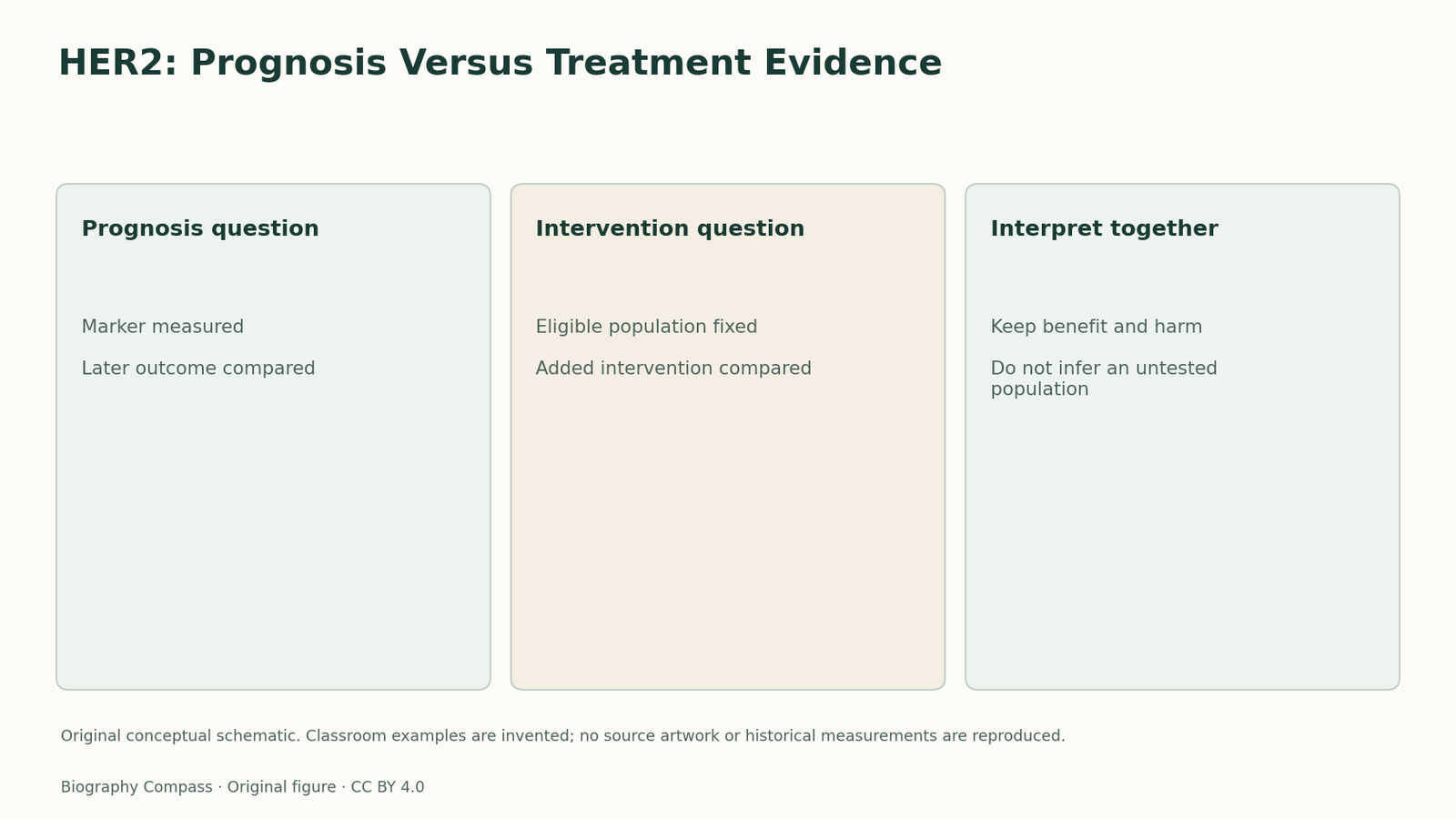
HER2: Prognosis Versus Treatment Evidence
Keep a marker–outcome association distinct from an assigned intervention comparison.
| Record or comparison | What the record supports | What remains separate |
|---|---|---|
| 1987 primary-tumour study | HER2 amplification was associated with relapse and survival in the investigated series | It did not test an assigned antibody intervention |
| 2001 randomised metastatic-disease trial | Adding trastuzumab changed specified outcomes within the eligible group, with harms also reported | It did not directly compare treatment benefit across HER2-positive and HER2-negative populations |
A prognostic question concerns expected outcomes
The 1987 HER2/neu paper investigated189 primary breast tumours and related amplification to outcomes including relapse and survival. Its abstract reports a prognostic association after adjustment for other factors. This asks whether a tumour characteristic helps distinguish subsequent outcomes in the studied population. It does not ask what would happen if otherwise comparable patients were assigned an antibody. A marker associated with aggressive disease may identify an important biological question, but association alone does not demonstrate an effective intervention.
Sources for this section: [4]
A treatment comparison asks what changes
The 2001 trial randomly assigned469 women with HER2-overexpressing metastatic breast cancer to chemotherapy with or without trastuzumab. It compared outcomes such as disease progression, response and survival, while also reporting cardiac harm. The selected population matters. Because the abstract concerns HER2-overexpressing disease, it should not be presented as a direct randomised comparison of benefit between HER2-positive and HER2-negative patients. The trial tests adding the antibody within its eligible group; it does not supply every possible biomarker-by-treatment comparison.
Sources for this section: [5]
An original two-question exercise
Give students two invented research cards. Card A compares a tumour marker with later relapse in a patient series. Card B assigns two groups with that marker to a background treatment, with or without an added intervention. Ask which card can investigate prognosis and which can compare the intervention. The answer is A for prognosis and B for the specified intervention comparison. Next add a third claim: the intervention works equally well in people without the marker. Ask whether either card establishes it. Neither does. A new comparison involving that population would be needed. Finally, ask why a benefit column should not cause readers to hide an adverse-event column. Both are patient outcomes, and a research conclusion must preserve both. These cards are original teaching examples, not recreated trial participants or results.
Why the distinction improves the history
Slamon’s career connects the two questions without collapsing them. The earlier molecular association helped frame a clinical research programme; the later trial tested a particular intervention in a particular disease setting. Dated award records recognise the development work but cannot replace the study design when determining what a publication established. Reading the records in sequence makes the achievement more substantial: it shows the additional work required to move from a plausible target to comparative patient evidence, rather than implying that the first association already contained the answer to every treatment question.
Continue the chronology
Related history guides
How did the evidence change between the 1996 selective-inhibition experiments and the 2001 early clinical trial?
Compare another molecularly directed research programme and its clinical endpoints.
Read the timeline1987–2001How did algal crosses distinguish a nuclear resistance marker from non-Mendelian inheritance?
Compare expression and behavioural observations in a separate laboratory programme.
Read the timelineBiography context
Explore United States through connected lives
Connected biographies
Researchers and related questions
1948–
Dennis Slamon
Oncologist and cancer researcherDennis Slamon connected molecular investigation with oncology through collaborative studies of HER2 and subsequent clinical research.Read biography
1955–
Brian Druker
Physician-scientist and leukaemia researcherBrian Druker connected clinical questions with a collaborative programme testing whether a molecular abnormality could guide the development of a cancer medicine.Read biography1918–1997
Ruth Sager
GeneticistRuth Sager moved between algal genetics and cancer research, investigating how inherited characteristics and gene expression could be studied experimentally.Read biographyQuick answers
Common questions
- Does a prognostic association prove a treatment works?
- No. The 1987 association and the 2001 assigned intervention comparison address different questions.
- Did the 2001 abstract describe every breast-cancer population?
- No. It reports women with HER2-overexpressing metastatic disease and preserves that eligibility boundary.
Primary and institutional sources
How this history was checked
Two complete primary abstracts are read beside dated institutional career, interview and award records. The guide preserves population eligibility and does not infer unreviewed results. This article was reviewed on 7 November 2026.
- UCLA HealthDennis Slamon
- UCLA HealthMedicine in his DNA: a conversation with Dennis Slamon
- Royal Swedish Academy of SciencesTargeted treatment of cancer receives the Sjöberg Prize
- Science / PubMedHuman breast cancer: correlation of relapse and survival with amplification of the HER-2/neu oncogene
- NEJM / PubMedUse of chemotherapy plus a monoclonal antibody against HER2 for metastatic breast cancer that overexpresses HER2
- UCLA HealthUCLA oncologist Dennis Slamon wins2019 Lasker Award