
The short answer
What could the 1967 electron-microscopy comparison establish about three respiratory viruses?
Read the evidence
Almeida’s 1967 Virus Image Comparison
Separate the original specimen comparison from the later record of recognition.
| Record or comparison | What the record supports | What remains separate |
|---|---|---|
| 1967 respiratory-virus summary | Two specimens resemble one reference group; a third resembles another | Morphological resemblance does not establish sequence identity or disease severity |
| 2020 NHS laboratory naming | Almeida’s work retained institutional importance decades later | A commemoration supplies no new test of the 1967 specimens |
Three specimens, two comparisons
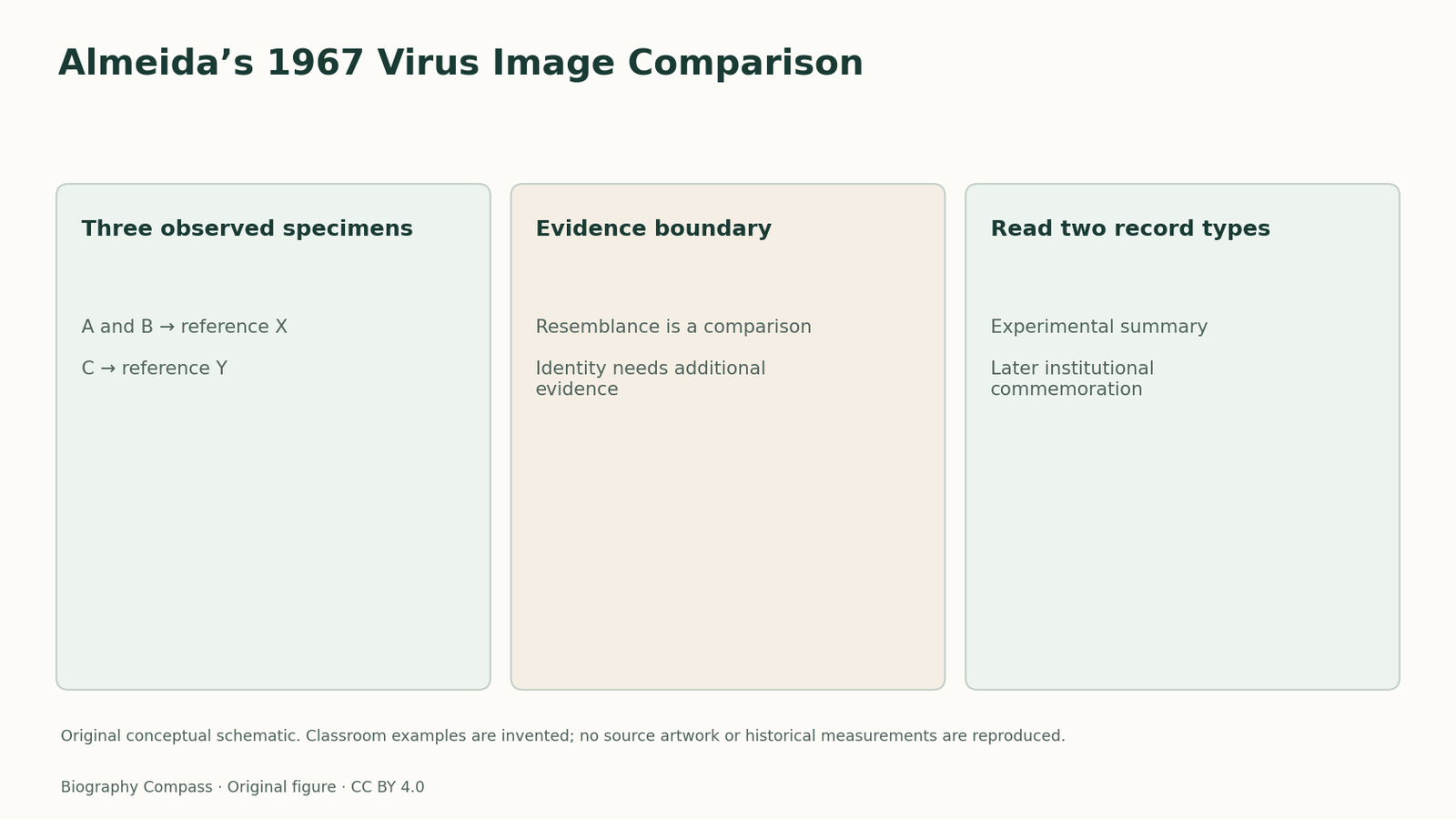
Almeida and Tyrrell’s 1967 article answers a narrower question than its later reputation sometimes suggests. It examines the morphology of three human respiratory viruses grown in organ culture. The publisher’s summary reports resemblance to avian infectious bronchitis virus for two specimens, and resemblance to parainfluenza for the third. Therefore the paper’s own comparison does not support treating all three observations as one morphological category. A careful reading keeps the number of specimens separate from the number of groupings suggested by their appearance.
Sources for this section: [3]
How the image acquired meaning
An electron micrograph becomes evidence through comparison, preparation and interpretation. Almeida’s earlier paper with Cinader and Howatson studied negatively stained virus–antibody aggregates, demonstrating the connection between visual work and immunological questions in her research. Her technical career, documented by Keele and the BMJ obituary, helps explain that expertise without replacing the experiment itself. A retrospective biography can establish where a researcher worked; an experimental publication must carry the more specific claim about what its specimens resembled. Those records perform different jobs.
An original classification exercise
Consider an invented classroom set of three specimen cards, A, B and C. The accompanying observation sheet says that A and B resemble reference X, while C resembles reference Y. Ask students to choose among three statements: all three specimens are identical; two share an observed resemblance; or reference X must cause more severe disease. The defensible answer is the second. Neither identity nor severity follows from that observation sheet. Then remove the reference images and ask which judgment becomes harder to check. The answer is the resemblance judgment itself: without the comparison record, readers cannot evaluate how the category was assigned. These letters represent a learning model, not Almeida’s specimen labels or reconstructed measurements.
Sources for this section: [3]
What a commemorative account cannot add
The NHS laboratory naming in 2020 shows continuing institutional recognition. It supplies no additional molecular evidence for the 1967 specimens. Likewise, the abstract reviewed here contains no genome sequences, and similarity in appearance should not be rewritten as a complete explanation of ancestry, transmission or clinical outcome. The useful conclusion is that visual evidence can suggest a relationship and distinguish an unlike specimen. A stronger identification would require records addressing that stronger question. This reading keeps an important discovery visible without expanding its claims beyond the available source.
Continue the chronology
Related history guides
Biography context
Explore United Kingdom through connected lives
Connected biographies
Researchers and related questions
1930–2007
June Almeida
Electron microscopist and virologistJune Almeida built a research career through laboratory work and electron microscopy, moving between Canada and Britain and developing ways to make viruses visible.Read biography1920–1958
Rosalind Franklin
Physical chemist and X-ray crystallographerRosalind Franklin investigated the structure of matter through careful preparation, diffraction measurements and mathematical analysis. Her DNA research with Raymond Gosling was one part of a career that also made substantial contributions to carbon and virus studies.Read biography1918–1997
Ruth Sager
GeneticistRuth Sager moved between algal genetics and cancer research, investigating how inherited characteristics and gene expression could be studied experimentally.Read biographyQuick answers
Common questions
- Did all three viruses in the 1967 summary resemble coronaviruses?
- No. Two resembled avian infectious bronchitis virus; the third resembled parainfluenza.
- Did Almeida identify SARS-CoV-2?
- No. Her research concerned earlier viruses; she died in 2007.
Primary and institutional sources
How this history was checked
The 1967 summary is read alongside an earlier research abstract and scoped institutional career accounts. The full paid 1967 paper was not reviewed. This article was reviewed on 7 November 2026.
- Keele UniversityJune Almeida — Faces of Science
- Guy’s and St Thomas’ NHS Foundation TrustGuy’s Hospital names COVID lab after pioneer
- Journal of General VirologyThe morphology of three previously uncharacterized human respiratory viruses that grow in organ culture
- Journal of Experimental Medicine / PubMedThe structure of antigen-antibody complexes
- BMJJune Almeida (née Hart)