In this biography
Quick facts
- Born
- 1943-07-05
- Died
- 2023-08-09
- Birthplace
- Toronto, Ontario, Canada
- Country
- Canada
- Nationality
- Canadian
- Known for
- The Band, The Weight, Music from Big Pink, The Last Waltz and music for Martin Scorsese’s films
- Born
- 5 July 1943, Toronto, Ontario
- Died
- 9 August 2023
- Group
- The Band, with Helm, Danko, Manuel and Hudson
- Later recognition
- Posthumous 2024 original-score Oscar nomination
Why this life matters
His career connects a Canadian and Indigenous upbringing to Southern musical experience, collaborative roots-rock performance and the shaping of music for cinema.
Timeline
Key moments
Toronto and Six Nations
Family music-making and radio listening precede his first bands.
Hawkins and Dylan
The Hawks develop through club work before backing Bob Dylan on his electric tours.
Big Pink and the Band
Woodstock-area collaboration precedes Music from Big Pink and the group’s self-titled second album.
The Last Waltz
A farewell concert becomes a film directed by Martin Scorsese.
Solo music and cinema
Solo albums and Indigenous-centred projects develop alongside film-music work.
A final score and later recognition
Robertson dies in 2023; Killers of the Flower Moon receives a posthumous score nomination in 2024.
Toronto, Six Nations and learning to play
Robbie Robertson was born in Toronto on 5 July 1943. His mother’s Cayuga and Mohawk background connected him to Six Nations of the Grand River. The Royal Conservatory’s remembrance describes visits there as an early musical education: relatives played instruments, and his cousin Herb helped introduce him to guitar.
Radio supplied another education through rhythm and blues, blues and country broadcasts from beyond Toronto. He was playing in bands as a teenager. These beginnings place Indigenous family experience within his musical formation without making every later song an expression of a single identity or confusing heritage with citizenship.
An apprenticeship with Hawkins and Dylan
Ronnie Hawkins recruited the young guitarist into the Hawks. Work in Canadian clubs and the American South joined Robertson with drummer Levon Helm, bassist Rick Danko, pianist Richard Manuel and keyboardist Garth Hudson. Their ability to respond to one another came from sustained performance, not simply from assembling prominent individual players.
The musicians subsequently backed Bob Dylan during his controversial electric period, including the 1965–1966 tours. Helm left during that period before returning later. Moving from Hawkins’s forceful stage act to Dylan’s changing songs widened their repertoire and tested how an ensemble could support a singer while retaining its own musical character.
Songs written for a group of different voices
In the Woodstock area, informal work with Dylan and music-making around the house called Big Pink preceded the Band’s 1968 debut. Robertson’s The Weight became one of its enduring songs. The recordings also depended on Manuel, Danko and Helm as distinctive singers, Hudson’s instrumental imagination and producer John Simon’s work with the ensemble.
The Band’s 1969 second album extended its repertoire, including The Night They Drove Old Dixie Down. In a Library of Congress interview about that second record, Robertson described writing as a starting point that the other musicians developed. His Southern experience supplied characters and settings, but arrangements and vocal interpretation helped turn compositions into recognizable Band performances.
A farewell and contested accounts of authorship
The Last Waltz concert in November 1976 brought the Band together with guests including Hawkins, Dylan, Joni Mitchell and Neil Young. Scorsese’s 1978 film turned the event into a carefully constructed account of a group ending a chapter. The Band later reunited without Robertson in 1983, so the concert was not the name’s final appearance.
The apparent fellowship did not settle disputes about money or credit. Helm’s memoir argued that shared contributions were insufficiently recognized in songwriting royalties. Robertson later disputed that account and said he had shared publishing income. Those are competing participants’ claims; neither the film’s prominence nor Robertson’s credited authorship resolves every disagreement about collaborative labour.
Solo records and an Indigenous musical conversation
Robertson’s self-titled solo debut appeared in 1987, with collaborators including Peter Gabriel and members of U2. Storyville followed in 1991. Solo recording placed his own voice more centrally than the Band’s records had done, while maintaining his interest in atmosphere, narrative and working with other musicians.
Music for the Native Americans in 1994 and Contact from the Underworld of Redboy in 1998 brought Indigenous musical and historical concerns into that later work. The American Academy of Arts and Sciences also identifies his mentorship of Indigenous artists. This was a continuing part of his practice, rather than a background detail confined to a childhood biography.
Thinking about music through cinema
The collaboration begun with The Last Waltz continued through Scorsese’s films, with responsibilities ranging across composition, music supervision and soundtrack selection. In a 2020 interview, Robertson linked his songwriting to a long fascination with cinema and described the overlapping work behind his 2019 album Sinematic and The Irishman.
Robertson died on 9 August 2023. His score for Killers of the Flower Moon became his final Scorsese collaboration and earned a posthumous original-score nomination at the 2024 Academy Awards. It was a nomination, not a win. The later recognition extends a career whose different forms all required decisions about how music carries a story.
Quick answers
Frequently asked questions about Robbie Robertson
- Was Robbie Robertson Canadian?
- Yes. He was born in Toronto and is identified as a Canadian musician. His Cayuga and Mohawk heritage is also an important, separately documented part of his background.
- Was Robbie Robertson the Band’s lead singer?
- He was its guitarist and a principal songwriter. Richard Manuel, Rick Danko and Levon Helm supplied the group’s most familiar lead voices.
- Did the Band stop performing forever after The Last Waltz?
- No. The 1976 concert marked the close of Robertson’s main performing period with the group; the Band reunited without him in 1983.
- Did Robbie Robertson win an Oscar?
- He received a posthumous original-score nomination for Killers of the Flower Moon at the 2024 Academy Awards, but did not win.
Keep exploring
Lives connected to this story
- Joni Mitchell
Read about another Canadian songwriter who performed at the Band’s Last Waltz concert.
- Neil Young
Follow the wider career of a fellow Canadian guitarist and songwriter who joined The Last Waltz.
Sources and further reading
Explore the evidence
These references support the biography and offer further reading. Official records, first-person accounts and independent reporting provide different perspectives; image records document attribution and licensing.
- 1. NAMM Oral History2017 interview record, birth, death and songwriting career
- 2. Royal Conservatory of MusicToronto, Six Nations family music and Hawkins apprenticeship
The remembrance gives a broader Dylan touring range. The chronology uses the documented 1965–1966 electric tours rather than implying a 1967 tour.
- 3. American Academy of Arts and SciencesCayuga and Mohawk heritage, Indigenous mentorship and film work
- 4. Robbie Robertson official websiteHawks, solo records and film-music chronology
Promotional descriptions of the 1976 concert as the end of the Band are qualified with the documented 1983 reunion. Heritage does not supply an inferred nationality.
- 5. Universal Music CanadaBand membership, Dylan period and Music from Big Pink
- 6. Qobuz / Universal Music GroupBand performers and selected album credits
- 7. Library of CongressRobertson’s interview about The Band, the 1969 album
This 2017 interview concerns the self-titled 1969 second album. Its production details are not silently transferred to Music from Big Pink.
- 8. American Film InstituteThe Last Waltz: concert and film chronology
- 9. Levon Helm Studios1983 reunion without Robertson
- 10. David Browne / Rolling Stone, reprinted by WoodstockHelm’s memoir objections and Robertson’s account
Helm’s royalty and authorship objections and Robertson’s response are attributed, not adjudicated. Collaborative arrangement is distinguished from formal songwriting credit.
- 11. Ken Sharp / Rock CellarRobertson on publishing, cinema, Sinematic and The Irishman
- 12. Academy of Motion Picture Arts and Sciences2024 original-score nomination
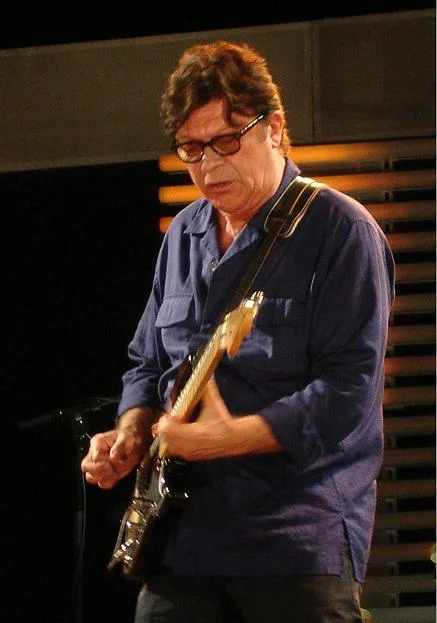
- 13. Truejustice / Wikimedia CommonsComplete 2007 performance photograph, history and CC BY-SA 2.5
The exact own-work grant and history were checked. The earlier complete 437 × 623 original precedes the 2025 border crop; that full frame was inspected and retained.