
The short answer
Music from Big Pink introduced the Band under its own name in 1968. Its history involves a shared house, informal work with Bob Dylan and professional recording studios, but those are related stages rather than interchangeable descriptions of where the album was made.
Chronology
A timeline of the turning points
A house and a working repertoire
Woodstock-area rehearsals and informal Dylan sessions develop a shared musical language.
Professional studio recording
John Simon produces sessions in New York and Los Angeles.
The debut is released
Capitol releases Music from Big Pink.
A distinct second album
The Band follows; it is not another title for the debut.
A new anniversary mix
Bob Clearmountain’s remix and expanded material revisit the original recordings.
The house supplied a name, not every master recording
Big Pink was a house in West Saugerties, near Woodstock in New York State. In 1967, informal music-making there and nearby with Bob Dylan helped the future Band develop songs and an ensemble vocabulary. Those sessions became associated with The Basement Tapes, a related but different recording history.
The debut itself was recorded professionally at A and R Studios in New York and at Capitol and Gold Star in Los Angeles. Its rural house-name can obscure that movement between domestic experimentation and commercial studios. The distinction matters whenever the album is described as a spontaneous basement recording: its finished performances also involved a producer and deliberate recording decisions.
Sources for this section: [1]
Five musicians made a flexible ensemble
The Band comprised Robbie Robertson, Levon Helm, Rick Danko, Richard Manuel and Garth Hudson. Guitar, drums, bass, keyboards and other instruments could be redistributed, while Helm, Danko and Manuel offered contrasting lead and harmony voices. Robertson’s songwriting prominence did not make the record a solo project under a group name.
The credits identify John Simon as producer. In his Goldmine interview, Robertson recalled Simon’s wish to preserve visual contact among players rather than isolating everyone behind studio barriers. Microphone choices helped make that arrangement practical. The remembered process gives a concrete explanation for collaboration: musicians could respond to one another while the engineer still needed a usable recorded balance.
The repertoire combines original songs and other writers
The Weight is Robertson’s composition, but it does not stand for every writing credit on the album. Tears of Rage pairs Bob Dylan with Richard Manuel, and This Wheel’s on Fire pairs Dylan with Rick Danko. Manuel also wrote songs including In a Station. The different credits reveal several routes through which material entered the group.
The repertoire includes Dylan’s I Shall Be Released and Long Black Veil, written by Danny Dill and Marijohn Wilkin. Original writing and interpretation therefore sit together. Songwriter, lead singer and arranger are not interchangeable roles: a performance can become strongly identified with a group even when its members did not compose the underlying song.
Production connects roots to a particular recorded sound
Robertson’s account to Goldmine emphasizes the practical effort behind an apparently informal sound. John Simon’s contribution was not simply to let a rehearsal run unattended. Preserving interaction while controlling the recording conditions allowed ensemble character to become part of the finished album rather than a quality lost in the studio.
That helps explain why the record should not be reduced to an inventory of older genres. Voices, instrumental responses and changes of musical role matter alongside the repertoire. Its relation to gospel, country and blues is a way of making new performances from familiar resources, not evidence that the record was an untouched historical document.
Influence and later editions are different kinds of reception
The album appeared on 1 July 1968. Universal’s anniversary history contrasts strong contemporary critical response with a more modest initial American chart peak of number 30. Retrospective esteem should therefore not be substituted for the scale of its first sales. Critical influence and immediate commercial domination are different claims.
The 2018 anniversary edition added a Bob Clearmountain remix and expanded material. A remix can reveal details through a new balance without becoming the original 1968 mix. Identifying the edition keeps discussion precise: an account of later production choices should not silently describe them as what every first listener heard.
Continue the chronology
Related history guides
Biography context
Explore United States through connected lives
Robertson beyond the debut
Read the wider apprenticeship, songwriting disputes, solo records and film-music career.
Explore the biographiesCanadian music across bordersNeil Young
Compare another Canadian musician’s work within American recording and performance networks.
Explore the biographiesConnected biographies
A musician within an ensemble
1943–2023
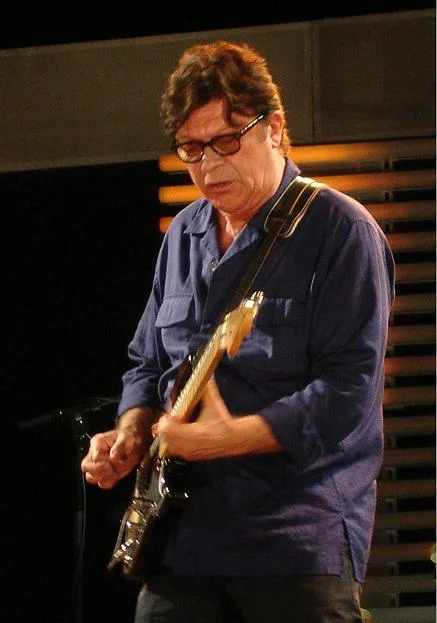
Robbie Robertson
Guitarist, songwriter and film composerRobbie Robertson was a Toronto-born guitarist and songwriter whose work with Ronnie Hawkins, Bob Dylan and the Band preceded solo records and a long filmmaking partnership with Martin Scorsese.Read biographyQuick answers
Common questions
- Was Music from Big Pink recorded entirely in the house?
- No. The house was important to rehearsal, songwriting and informal Dylan sessions. The album’s professional sessions took place in New York and Los Angeles studios.
- Who produced Music from Big Pink?
- John Simon produced it, working with the five members of the Band.
- Did Robbie Robertson write every song?
- No. Other credits include Dylan with Manuel or Danko, Manuel’s own writing, and Long Black Veil by Danny Dill and Marijohn Wilkin.
- Are Music from Big Pink and The Basement Tapes the same album?
- No. They are connected by musicians, songs and the Woodstock-area period, but have different recording and release histories.
Primary and institutional sources
How this history was checked
Label history, selected recording credits and direct interview recollections were compared. The 1967 house sessions, 1968 album and 2018 remix are distinguished; no new complete album listening is claimed. This article was reviewed on 23 October 2026.
- Universal Music CanadaHouse, studios, release date, reception and 2018 remix
- Ray Chelstowski / GoldmineRobertson on John Simon, microphone choices and ensemble recording
- Qobuz / Universal Music GroupPerformers, producer and selected songwriter credits
- NAMM Oral HistoryRobertson’s songwriting and The Weight
- Amanda Petrusich / CriterionThe Weight and the Band’s wider musical context
- Truejustice / Wikimedia CommonsSeparate 2007 performance photograph and CC BY-SA 2.5