In this biography
Quick facts
- Born
- 16 October 1854
- Died
- 30 November 1900
- Birthplace
- Dublin, Ireland, then part of the United Kingdom
- Country
- United Kingdom
- Nationality
- Irish
- Known for
- The Picture of Dorian Gray, The Importance of Being Earnest, fairy tales and The Ballad of Reading Gaol
- Identity
- Irish; born in Dublin in 1854
- Education
- Trinity College Dublin and Magdalen College, Oxford
- Only novel
- The Picture of Dorian Gray: magazine 1890, expanded book 1891
- Major stage comedy
- The Importance of Being Earnest, first performed in 1895
Why this life matters
His writing turns the appeal of elegant language into a question about how people live, while his prosecution remains part of the history of the criminalisation of sex between men.
Timeline
Key moments
Born in Dublin
Oscar was born at 21 Westland Row on 16 October to William and Jane Wilde.
Classical education
He studied at Trinity College Dublin, then Magdalen College, Oxford, and won the Newdigate Prize for Ravenna in 1878.
North American lectures
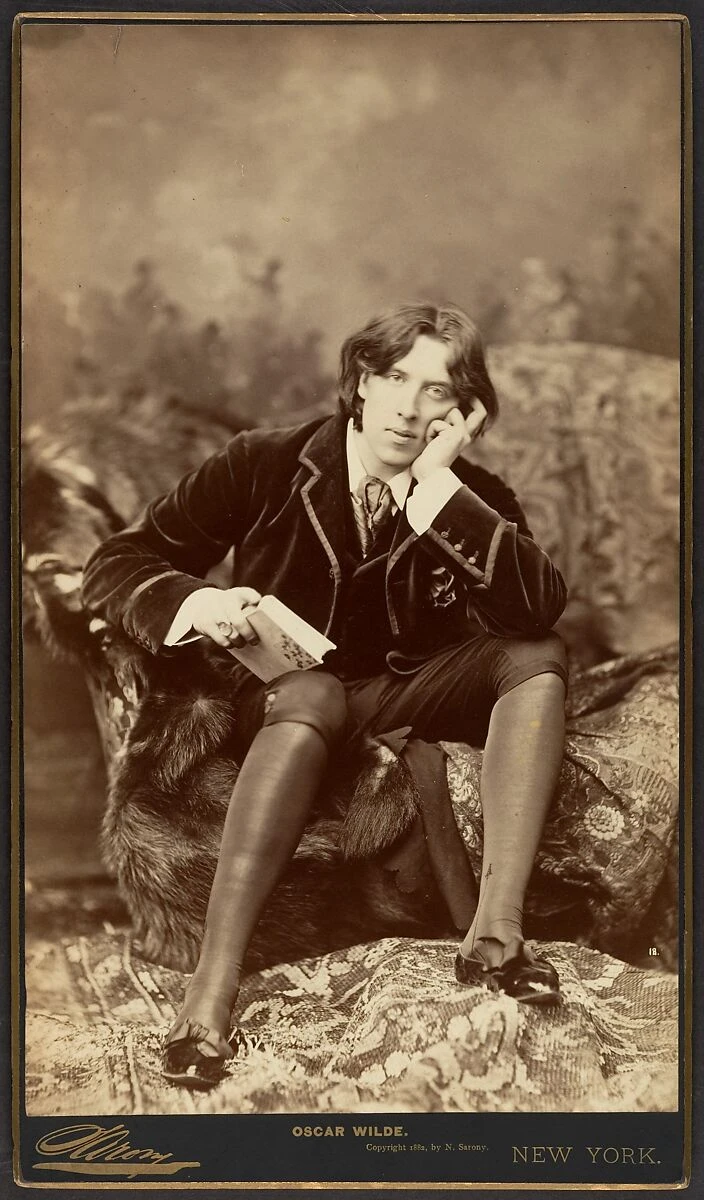
Wilde toured the United States and Canada; Sarony photographed him in New York.
Family and periodical work
He married Constance Lloyd in 1884, became a father of two sons, and edited The Woman’s World from 1887 to 1889.
Dorian Gray in two forms
The novel appeared in Lippincott’s Monthly Magazine, followed by the revised and expanded book with its Preface.
West End success and prosecution
Four major society comedies reached the stage before the 1895 trials and a sentence of two years’ imprisonment with hard labour.
Release, exile and final writing
He left Britain after release, published The Ballad of Reading Gaol in 1898, and died in Paris on 30 November 1900.
An Irish upbringing and a classical education
Oscar Fingal O’Flahertie Wills Wilde was born at 21 Westland Row, Dublin, on 16 October 1854. His father, William, was a surgeon and antiquarian; his mother, Jane, wrote under the name Speranza and hosted a literary salon. Books, argument and public reputation were therefore part of his family environment. He was Irish: the fact that Dublin then lay within the United Kingdom, and that his best-known stage career developed in London, does not make him an English-born writer.
After Portora Royal School in Enniskillen, Wilde studied classics at Trinity College Dublin from 1871 and moved to Magdalen College, Oxford, in 1874. He won Oxford’s Newdigate Prize for Ravenna in 1878. This training supplied more than a decorative vocabulary. Classical literature and the discussion of beauty became materials for a writer who would repeatedly test the relationship between an admired ideal and the conduct of the people invoking it.
The public aesthete and the working journalist
Wilde settled in London and published Poems in 1881. His 1882 lecture tour of the United States and Canada made his public identity as an aesthete widely visible before the novel and comedies appeared. The tour was connected with the promotion of Gilbert and Sullivan’s Patience, which satirised aesthetic fashion. Sarony’s New York photographs belong to this moment: the elaborate clothing and studio setting are evidence of a consciously presented public persona, not casual snapshots of the later successful dramatist.
He married Constance Lloyd in 1884, and their sons Cyril and Vyvyan were born in 1885 and 1886. Alongside reviewing and other periodical writing, he edited The Woman’s World from 1887 to 1889. The Happy Prince and Other Tales appeared in 1888. These activities show a writer working across forms and audiences. The familiar image of the effortless conversational wit can obscure the recurring business of producing copy, editing a magazine and finding publishers.
Fiction, criticism and the work of revision
The Picture of Dorian Gray first appeared in the July 1890 issue of Lippincott’s Monthly Magazine. Wilde revised and expanded it for book publication in 1891, adding the Preface and further narrative material. These are distinct texts. The earlier magazine publication had already passed through editorial intervention, so it should not simply be called the untouched original. The surviving manuscript, typescript and printed versions preserve different stages of the novel’s development.
Dorian’s unchanged appearance conceals the damage registered by his portrait. The story makes beauty, influence and responsibility difficult to separate. Its characters’ striking statements do not all become Wilde’s instructions for living: Lord Henry’s confident talk must be read against what happens to other people. Essays collected in Intentions and the stories of A House of Pomegranates, both published in 1891, broaden this engagement with art and criticism. Wilde’s achievement extends beyond the epigrams detached from their settings in modern quotation collections.
The stage successes and the collapse of 1895
Lady Windermere’s Fan reached the London stage in 1892, followed by A Woman of No Importance in 1893 and An Ideal Husband and The Importance of Being Earnest in 1895. Their polished social worlds make reputation, secrets and the performance of respectability into dramatic machinery. Salome followed another path: written in French, it was refused a British performance licence in 1892 and subsequently staged in Paris. Publication, licensing and first performance are separate events in this theatrical career.
Wilde met Lord Alfred Douglas in 1891. In 1895 he brought a criminal libel action against Douglas’s father, the Marquess of Queensberry. The action collapsed; Wilde was then prosecuted, convicted of gross indecency and sentenced to two years’ imprisonment with hard labour. The proceedings operated within laws criminalising sexual acts between men. His literary texts and the accusations made in court are different kinds of evidence, and neither should be reduced to a convenient paraphrase of the other.
Prison writing, exile and a contested afterlife
Wilde served his sentence at Pentonville, Wandsworth and Reading. In prison he wrote the long letter to Douglas later known as De Profundis. After release in 1897 he left Britain and used the name Sebastian Melmoth. The Ballad of Reading Gaol appeared in 1898, drawing on prison experience while speaking through a deliberately shaped poetic voice. It is a work about punishment and shared vulnerability, rather than a court transcript or a complete factual account of every prisoner it evokes.
He died in Paris on 30 November 1900. Originally buried at Bagneux, his remains were moved to Père Lachaise in 1909. His later fame brings together the comedies, Gothic fiction, critical prose and the history of persecution, but those strands are not interchangeable. Reading the works in their different forms restores something that the legend of a single brilliant personality can hide: Wilde revised his writing, addressed changing audiences and built arguments whose attractions and dangers unfold through an entire scene or story.
Quick answers
Frequently asked questions about Oscar Wilde
- Was Oscar Wilde Irish or English?
- He was Irish, born in Dublin in 1854. Dublin then formed part of the United Kingdom. This UK archive association records the historical and literary context, not an English nationality.
- Was The Picture of Dorian Gray published in 1890 or 1891?
- Both dates matter: the shorter text appeared in Lippincott’s Monthly Magazine in July 1890, and a revised, expanded book with the Preface followed in 1891.
- Why was Oscar Wilde imprisoned?
- In 1895 he was convicted of gross indecency under the law then criminalising sexual acts between men and sentenced to two years’ imprisonment with hard labour.
- Is this a real photograph of Oscar Wilde?
- Yes. It is the complete museum image of a genuine Napoleon Sarony photograph made in 1882, with its card mount and studio imprint retained. The Met marks the exact item Public Domain.
Keep exploring
Lives connected to this story
- Mary Shelley
Compare Gothic fiction that gives competing speakers different accounts of creation, influence and responsibility.
- William Shakespeare
Read another dramatist whose theatrical writing loses meaning when speeches are detached from their characters and scenes.
- Thomas Hardy
Compare a late Victorian writer whose fiction challenged judgements about desire, respectability and unequal social consequences.
- George Bernard Shaw
Compare another Dublin-born dramatist whose career developed in London.
Sources and further reading
Explore the evidence
These references support the biography and offer further reading. Official records, first-person accounts and independent reporting provide different perspectives; image records document attribution and licensing.
- 1. Dublin City Libraries / Dublin UNESCO City of LiteratureOscar Wilde: Dublin family, education and literary career
- 2. University College CorkChronology of Oscar Wilde
- 3. The Oscar Wilde SocietyBiography: chronological life and works
The society chronology distinguishes the French Salome publication (1893), English translation (1894), refused British licence (1892) and Paris production (1896). Its burial chronology also distinguishes Bagneux in 1900 from reinterment at Père Lachaise in 1909.
- 4. Historic EnglandCriminal Desires: gross indecency and Oscar Wilde
Historic England supplies the historical context of the gross-indecency law. The profile does not present fictional characters, poetic speakers or prosecution rhetoric as transparent statements of Wilde’s own life.
- 5. The Morgan Library & Museum / Philip S. PalmerThe Picture of Dorian Gray: surviving manuscript and revision
Philip S. Palmer’s institutional introduction was read through the search service’s complete cached text after direct access returned 403. Selected printed passages were checked separately. No complete manuscript or UCLA typescript collation is claimed.
- 6. British LibraryOscar Wilde’s The Picture of Dorian Gray: art, ethics and double lives
- 7. Oscar Wilde / Project GutenbergThe Picture of Dorian Gray: thirteen-chapter text
- 8. Oscar Wilde / Project GutenbergThe Picture of Dorian Gray: twenty-chapter text and Preface
- 9. The Metropolitan Museum of ArtOscar Wilde, Napoleon Sarony, 1882; accession 2005.100.120
The Met’s exact object record identifies Wilde as Irish, the maker as Sarony and the date as 1882; its commentary specifies January. The Public Domain label and institutional CC0 policy permit commercial reuse. No restored or colourised derivative was used.
- 10. The Metropolitan Museum of ArtOpen Access: public-domain images released under CC0