In this biography
Quick facts
- Born
- 7 February 1812
- Died
- 9 June 1870
- Birthplace
- Portsmouth, Hampshire, England
- Country
- United Kingdom
- Nationality
- English
- Known for
- Oliver Twist, A Christmas Carol, David Copperfield, Bleak House and Great Expectations
- Early pen name
- Boz
- Breakthrough
- The Pickwick Papers, serialised 1836–1837
- Christmas book
- A Christmas Carol, 1843
- Journals
- Household Words and All the Year Round
Why this life matters
His career joined imaginative storytelling to the commercial forms of Victorian print, exposing failures of institutions while revealing the tensions of literary celebrity.
Timeline
Key moments
Born in Portsmouth
Dickens was born on 7 February to John and Elizabeth Dickens.
Disrupted childhood
Factory work and his father’s imprisonment for debt became central to his later account of insecurity. Exact factory dates vary between summaries.
From sketches to Pickwick
Early published sketches led to Sketches by Boz and the serial success of The Pickwick Papers. He married Catherine Hogarth in 1836.
American travel and a Christmas story
He travelled to America, published American Notes and then wrote A Christmas Carol.
Editor and novelist
Household Words began in 1850; All the Year Round followed in 1859, carrying the serial A Tale of Two Cities.
Separation and professional readings
He separated from Catherine and began his paid public-reading career, following earlier charitable readings.
Second American visit
A major public-reading tour brought him back to the United States.
Death and unfinished novel
He died at Gad’s Hill on 9 June, leaving The Mystery of Edwin Drood incomplete; burial followed at Westminster Abbey on 14 June.
A childhood that cannot be reduced to a fictional hero
Charles Dickens was born in Portsmouth, England, on 7 February 1812. His father, John, worked in the Navy Pay Office; his mother was Elizabeth Dickens. Moves to London and Kent shaped the child’s experience of streets, books and performance. The birthplace museum preserves the house associated with his birth, while explaining that its Regency furnishings are a recreation, not an intact collection of the family’s possessions.
Financial difficulty interrupted his schooling. While still a child he pasted labels onto containers at a blacking business, and his father was imprisoned for debt in 1824. Institutional chronologies differ over the exact beginning and duration of factory employment. The secure point is the disruption itself. Dickens later supplied John Forster with an account of its humiliation and isolation. Forster published that testimony in his biography, making the remembered experience accessible without turning every detail of David Copperfield into literal autobiography.
Reporting, Boz and the making of a serial novelist
A legal-office job and shorthand training opened a route into reporting. Dickens covered courts and Parliament, learning to observe speech, movement and social encounters while working to deadlines. His early sketches appeared under the name Boz and were collected in 1836. These concise pieces offered a print career before the long novels, rather than serving merely as abandoned practice for them.
The Pickwick Papers, published in instalments in 1836–1837, made him a celebrated novelist. Its development also involved illustrators and publishers; the popular author did not operate outside the material business of print. He married Catherine Hogarth in 1836. Oliver Twist followed as a serial beginning in 1837, alongside editorial work at Bentley’s Miscellany. Serial publication meant that many first readers encountered a story over time, rather than holding its final complete volume from the outset.
The range behind A Christmas Carol
Dickens’s first American visit in 1842 produced American Notes, a nonfiction account distinct from the novels. A Christmas Carol appeared the following year as an illustrated book, not a monthly novel instalment. Its miser, Ebenezer Scrooge, became one of his best-known characters, but the short Christmas narrative represents only one part of a career that moved between comedy, social observation, mystery and extended family histories.
The novels continued to examine institutions through particular lives. David Copperfield uses retrospective first-person narration; Bleak House moves through a world dominated by Chancery; Hard Times considers an industrial setting and a constricted educational outlook. Great Expectations follows the shaping and unmaking of Pip’s ambitions. Their institutions and characters should not be treated as statistical surveys or direct portraits of every person Dickens knew. The manuscripts, plans and proof sheets preserved at the V&A show composition and revision, not simply effortless transcription from life.
Journals and the public performance of authorship
Household Words began in 1850, with Dickens as editor and part-owner. All the Year Round followed in 1859. These journals carried work by many contributors; his editorial responsibility does not make every unsigned item his own composition. Dickens Journals Online allows readers to inspect issues and attribution information rather than assuming that a familiar name on a journal’s masthead supplies the authorship of every page.
He was also a performer. Charitable readings preceded the professional paid readings that began in 1858. On stage he presented selected and shaped passages from his own books to audiences in Britain and America. His second American visit, in 1867–1868, belonged to that reading career. The writer’s speaking voice, business arrangements and performance schedule formed another aspect of literary work, not a late replacement for all writing. The material record includes both published novels and the papers behind their public presentation.
Family tensions and the limits of the humanitarian image
Dickens’s concern for vulnerable characters does not provide a complete account of his private conduct. He and Catherine separated in 1858, after more than twenty years of marriage and ten children. His relationship with the actress Ellen Ternan complicates the public image of domestic harmony. The Dickens Museum’s exhibition on the women around him also emphasises Catherine’s own published cookbook and the work of relatives, performers and philanthropists, rather than reducing them to supporting characters in his celebrity.
Forster was Dickens’s friend and executor as well as his biographer. His access to letters and memories makes his work indispensable, but friendship is a perspective, not a guarantee of completeness. A responsible life therefore reads it alongside family documents and later archival research. It also resists the temptation to treat Dickens’s sympathy for suffering as proof that every social assumption in his fiction or every action in his household was beyond criticism.
Death, commemoration and unfinished work
Dickens died at Gad’s Hill in Kent on 9 June 1870. The Mystery of Edwin Drood remained unfinished, so later solutions to its mystery cannot be described as the ending he published. His burial in Westminster Abbey on 14 June was the outcome of decisions by people around him and public discussion after his death. It should not be simplistically described as the precise funeral arrangement he had requested.
His surviving papers offer a way beyond the monument and the familiar character names. First editions show how readers originally met the stories; manuscripts and proofs record changes; journals reveal editorial networks; and letters expose relationships that a novel transforms rather than reproduces. Those different kinds of evidence help explain how a reporter and serial novelist became a literary institution, while leaving the work open to critical reading rather than requiring unqualified admiration.
Quick answers
Frequently asked questions about Charles Dickens
- What was Charles Dickens’s pen name?
- He used Boz for early sketches. Sketches by Boz was collected in 1836, before his best-known later novels.
- Did Dickens write A Christmas Carol as a serial?
- No. The 1843 Christmas story appeared as a separate illustrated book. Several of his longer novels first appeared in instalments.
- Is David Copperfield a complete autobiography?
- No. It draws on experiences connected with Dickens’s life, but its narrator, characters and arranged plot belong to fiction. Forster’s biography preserves separate autobiographical testimony.
- Did Dickens finish The Mystery of Edwin Drood?
- No. He died in 1870 before completing it. Later proposed endings are not a finished ending published by Dickens.
Keep exploring
Lives connected to this story
- William Shakespeare
Compare another English writer whose printed texts belong alongside a career in live performance.
- Louisa May Alcott
Compare the distinction between family experience and invented characters in two nineteenth-century writing lives.
Sources and further reading
Explore the evidence
These references support the biography and offer further reading. Official records, first-person accounts and independent reporting provide different perspectives; image records document attribution and licensing.
- 1. Charles Dickens’ Birthplace Museum / Portsmouth MuseumsAbout the museum and major works
- 2. The Dickens FellowshipLife of Charles Dickens
Used for career chronology. Its late-1823 factory start differs from common 1824 summaries; no exact factory employment period or simple cause-and-effect sequence with imprisonment is asserted. Paid readings in 1858 are distinguished from earlier charitable readings.
- 3. John Forster, 1875 edition; Project Gutenberg transcriptionThe Life of Charles Dickens: selected passages
Read selected childhood, reporting, Pickwick, publishing and later-career passages, including Dickens’s reproduced blacking-warehouse recollection. This is a nineteenth-century friend/executor’s account, not an exhaustive modern family history. The complete three-volume text was not reviewed.
- 4. Victoria and Albert MuseumCharles Dickens and the Forster Collection
- 5. Charles Dickens MuseumExtra/Ordinary Women: Catherine Dickens, Ellen Ternan and other participants
- 6. Dickens Journals OnlineDigitised Household Words and All the Year Round
- 7. British LibraryCharles Dickens’s A Christmas Carol
- 8. Westminster AbbeyThe Nation’s Memory: Dickens’s death and burial
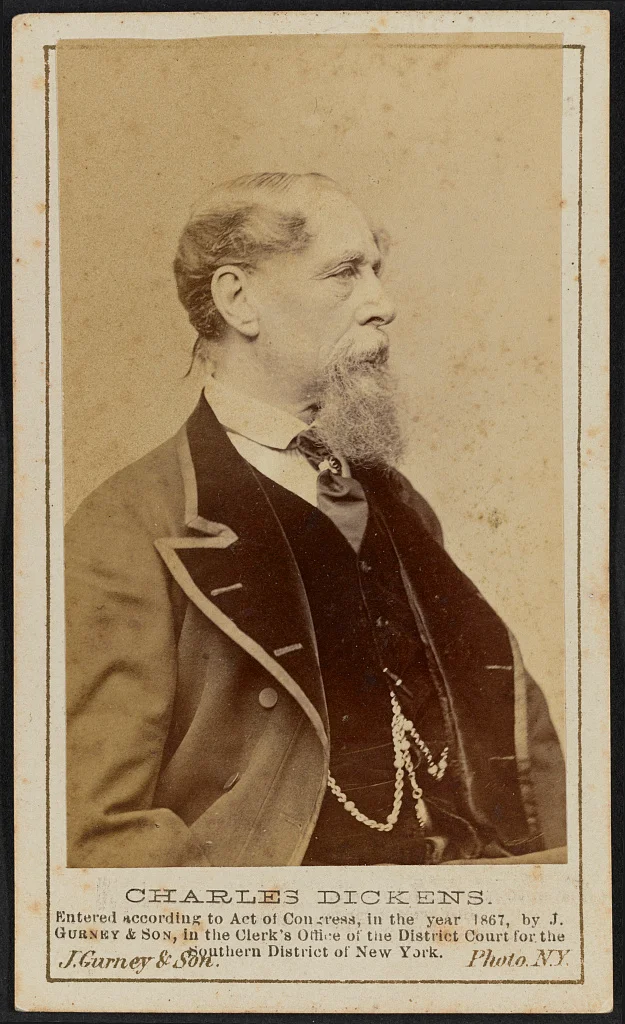
- 9. Library of CongressCharles Dickens, J. Gurney & Son, circa 1867: official Flickr posting
- 10. Wikimedia Commons / Library of CongressExact Gurney portrait file and no-known-restrictions record
Exact 625×1024 mirror of the official LOC Flickr item, transferred without an intervening edit. LOC item 2018645020 identifies Gurney & Son, circa 1867 and no known publication restrictions; the mount visibly records 1867 copyright registration. Full supplied front card retained. No government-authorship inference or universal modern licence is asserted.
- 11. Library of CongressCharles Dickens: LCCN 2018645020, digital item ppmsca.54180
- 12. Wikimedia Commons / Library of CongressSame Gurney image, original TIFF: specific public-domain expiry record