In this biography
Quick facts
- Born
- 27 October 1917
- Died
- 24 April 1993
- Birthplace
- Mbizana area, Eastern Cape, South Africa
- Country
- South Africa
- Nationality
- Not independently established
- Known for
- Sustaining the ANC’s external organisation, international advocacy and leadership through the transition towards negotiations
- Full name
- Oliver Reginald Kaizana Tambo
- Life
- 27 October 1917–24 April 1993
- Earlier occupations
- Science teacher and attorney
- Legal partnership
- Mandela and Tambo, Johannesburg, from 1952
- ANC leadership
- Acting president from 1967; confirmed at Morogoro in 1969
- Return
- December 1990, after three decades abroad
Why this life matters
His career makes the work outside South Africa visible alongside the better-known story of imprisoned leaders. Assessing that leadership also means examining authority over armed operations and civilian harm, not separating diplomatic achievement from the responsibilities of command.
Timeline
Key moments
Education and teaching
Eastern Cape schooling and Fort Hare study lead into teaching in Johannesburg.
Youth League and legal work
ANC organisation develops alongside a legal partnership with Mandela.
Mission abroad
The ANC sends him outside South Africa as repression closes political space.
Leadership and reassessment
Acting presidency is followed by the Morogoro consultative conference.
Exile responsibilities
Diplomacy and organisational leadership coexist with authority over armed struggle.
Homecoming and final years
He returns in ill health, becomes national chairperson and dies before the democratic election.
Education led first to teaching and then legal practice
Tambo was born in the Mbizana area of the Eastern Cape on 27 October 1917. Schooling took him to St Peter’s in Johannesburg and then to Fort Hare, where he earned a science degree. He returned to St Peter’s as a mathematics and science teacher during the 1940s.
Law became a different means of public service. In 1952 he and Mandela established their Johannesburg legal partnership. The practice placed them in contact with people seeking representation within a racially discriminatory system, while their political work developed alongside their professional responsibilities.
The ANC’s external mission became a long-term responsibility
A founding member of the ANC Youth League in 1944, Tambo later held senior ANC positions and faced banning and treason proceedings. In 1960, amid intensified repression and the ANC’s prohibition, the organisation sent him abroad to build support and maintain an external presence.
He became acting ANC president after Albert Luthuli’s death in 1967. Advocacy, fundraising and relationships with foreign governments and solidarity movements helped sustain an organisation whose leaders were dispersed, imprisoned or underground. The external mission did not replace resistance inside South Africa; connecting those settings remained a difficult organisational task.
Morogoro required organisational change rather than personal unity alone
Tambo’s March 1969 directive called for an appraisal of the struggle and more effective organisational machinery. The Morogoro conference followed in Tanzania between 25 April and 1 May. It confirmed his leadership while confronting how an exiled movement could act within South Africa.
The external ANC opened membership to non-Africans, but its National Executive Committee remained restricted to Africans. A Revolutionary Council brought political and military work into a new coordinating structure. These changes qualify any simple account of instant non-racial equality: participation expanded, while an important leadership restriction remained.
Command responsibilities included the consequences of armed operations
Tambo’s record cannot be understood through diplomacy alone. The TRC’s final report discusses the May 1983 Church Street bombing with his stated approval. Its findings identify civilian injury and deaths as gross human-rights violations where the distinction between military and civilian targets was blurred.
SAPA’s report of the ANC’s 1997 submission also records the organisation naming him in connection with that operation. A liberation movement’s political justification and the effects of its methods are separate questions. These are attributed historical findings and accounts, not a claim that Tambo received an individual criminal conviction in those proceedings.
The transition brought a homecoming, but not a state presidency
Tambo contributed to the work leading to the 1989 Harare Declaration, which set out conditions for negotiations towards a non-racial democracy. Severe illness interrupted his work that year. He returned to South Africa in December 1990 after the ANC had been unbanned.
In 1991 Mandela became ANC president and Tambo became national chairperson. Tambo died on 24 April 1993, before the first democratic election. His central place in the liberation movement should therefore not be confused with holding South Africa’s state presidency or personally completing the negotiated settlement.
Quick answers
Frequently asked questions about Oliver Tambo
- Was Tambo President of South Africa?
- No. He led the ANC and later became its national chairperson, but did not hold the state presidency.
- Did he lead the ANC only after Morogoro?
- He was acting president from 1967; his appointment was confirmed at the 1969 conference.
- Did Morogoro open every leadership position on the same basis?
- No. External membership widened, while NEC eligibility remained restricted to Africans.
- Did he live to see the democratic election?
- No. He died in April 1993, before the 1994 election.
Keep exploring
Lives connected to this story
- Nelson Mandela
Their legal partnership preceded different responsibilities in imprisonment and exile.
- Thabo Mbeki
His political formation included work within the external ANC led by Tambo.
- Ahmed Kathrada
Compare exile leadership with a long-term prisoner’s return to public politics.
Sources and further reading
Explore the evidence
These references support the biography and offer further reading. Official records, first-person accounts and independent reporting provide different perspectives; image records document attribution and licensing.
- 1. Apartheid Museum and Oliver and Adelaide Tambo FoundationThe Modest Revolutionary: selected education and teaching exhibition panels
- 2. Padraig O’Malley / Nelson Mandela Foundation archiveOliver Tambo: legal partnership, exile and ANC leadership
- 3. William J. Clinton Presidential LibraryOliver Tambo finding aid: selected biographical note
Biographical note only; the underlying funeral files were not reviewed. No disputed medical cause of death is asserted.
- 4. South African History OnlineOliver Tambo: selected exile, return and final years
Village spellings and some office dates vary across accounts; birthplace is kept at the verified Mbizana-area level.
- 5. Oliver Tambo / SAHO archive1 March 1969 directive on the proposed consultative conference
- 6. African National CongressFirst National Consultative Conference, 25 April–1 May 1969
- 7. Padraig O’Malley / Nelson Mandela Foundation archiveMorogoro: external membership and NEC eligibility
- 8. African National Congress / TRC archive1997 second submission: selected 1969–1976 organisational structures
- 9. Truth and Reconciliation CommissionVolume 5: selected Church Street findings and stated approval, printed pages 240 and 261
Only the identified findings and operation passages were read, not the entire report or amnesty record.
- 10. South African Press Association / TRC archive12 May 1997: ANC submission names Tambo in Church Street operation
- 11. OAU Ad-hoc Committee on Southern Africa / ANC archive21 August 1989 Harare Declaration: selected climate-for-negotiations clauses
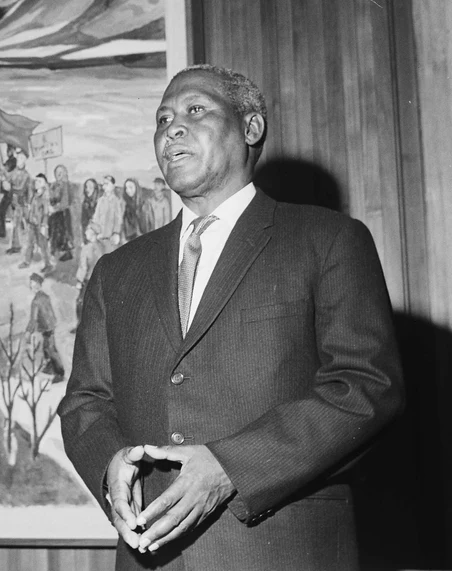
- 12. Rob Bogaerts / Anefo / Nationaal ArchiefOliver Tambo at Schiphol, 17 October 1981, archive 931-7461