In this biography
Quick facts
- Born
- 1898; exact day unconfirmed
- Died
- 21 July 1967
- Birthplace
- Near Bulawayo, present-day Zimbabwe
- Country
- South Africa
- Nationality
- Not independently established
- Known for
- Anti-apartheid leadership, nonviolent resistance and the 1960 Nobel Peace Prize, received in 1961
- Birth year
- 1898 in the Nobel and SAHO records; exact day unconfirmed
- Earlier work
- Teacher and teacher trainer at Adams College
- Local leadership
- Elected chief at Groutville in 1935
- ANC presidency
- December 1952–July 1967
- Nobel distinction
- 1960 Peace Prize, received in December 1961
- Death inquiry
- Accidental-death finding set aside in October 2025
Why this life matters
His career connects local service with a struggle for democratic rights beyond racial categories. It also shows why historical reputation must remain open to scrutiny: neither later armed resistance nor an overturned account of his death can be explained through a simple heroic shorthand.
Timeline
Key moments
Education and teaching
Mission schooling leads into teacher training and work at Adams College.
Elected chief
He returns to Groutville and takes up local leadership.
Campaign and national office
Support for defiance precedes removal as chief and election as ANC president-general.
Restricted political work
Banning orders limit travel and participation in public life.
International recognition
He travels to Oslo to receive the Peace Prize for 1960.
Death and renewed inquiry
His 1967 death is reassessed by a reopened inquest in 2025.
Teaching and an elected chieftainship preceded national leadership
Born near Bulawayo in present-day Zimbabwe, Luthuli grew up connected to Groutville in Natal. Training and employment took him to Adams College. In his interview with Studs Terkel, he recalled teaching future teachers, Zulu and music, presenting education as engagement with a wider world rather than preservation through enforced isolation.
He dated his election as chief to 1935. That office involved service to a particular community, not leadership of all Zulu people. His account challenged the assumption that cultural identity required political separation: learning from other societies need not erase one’s own traditions.
The 1952 campaign brought provincial responsibility into conflict with the state
As Natal ANC president, Luthuli publicly supported the Defiance Campaign. His August statement described joint action with the Indian Congress and invited participation across racial and religious divisions. Natal’s campaign began later than the national launch, allowing time for preparations.
The government removed him as chief that November after he refused to abandon the ANC. National election as president-general followed in December. These were separate changes: losing a state-recognised local position did not prevent his movement from choosing him for a different political responsibility.
Restrictions limited the practical exercise of leadership
Banning orders constrained travel and public activity during his presidency. In 1963, he described successive restrictions to Terkel, including a five-year order confining his movement to a limited radius. The interview’s introduction places their conversation near Durban, despite the archive heading’s reference to Chicago.
Such restrictions mattered beyond personal inconvenience. Organising a national movement required communication and access to colleagues that the state tried to obstruct. International prominence should therefore not be mistaken for freedom to conduct everyday political work. His account remained an argument for democratic participation, not merely a record of the bans imposed on him.
The Peace Prize did not resolve every dispute over political methods
The Nobel record identifies him as Africa’s first Peace Prize laureate and distinguishes the 1960 award from its presentation in 1961. His Oslo lecture located South African freedom within a wider African struggle and described a nonracial democratic future. Recognition amplified an existing political commitment rather than creating it.
The later relationship between that commitment and the ANC’s turn to armed struggle remains contested. SAHO explicitly notes disagreement over his approval. It is therefore misleading either to assign him unquestioned authorship of that transition or to infer every later tactical position solely from the prize’s language.
A reopened inquest changed the official account of his death
Luthuli died on 21 July 1967. An apartheid-era inquest attributed his death to a train accident. In October 2025, the reopened inquiry in Pietermaritzburg set aside that finding. Parliament’s subsequent statement reported a finding of fatal assault injuries and killing by apartheid police; eNCA independently reported the ruling.
This is an inquest finding about a death, not evidence here of a completed criminal prosecution or conviction of named individuals. The distinction matters as of this article’s October 2026 review. Replacing the old account requires attention to what the later process actually established, without inventing a further legal outcome.
Quick answers
Frequently asked questions about Albert Luthuli
- Was his Peace Prize awarded for 1961?
- No. It was the 1960 prize, received in Oslo in December 1961.
- Was he chief of all Zulu people?
- No. His elected chieftainship was associated with Groutville.
- Is his approval of the turn to armed struggle undisputed?
- No. The historical interpretation remains contested.
- Does the old accidental-death finding still stand?
- No. A reopened inquest set it aside in October 2025; that finding is distinct from a criminal conviction.
Keep exploring
Lives connected to this story
- Nelson Mandela
Compare the Defiance Campaign and the later debate over armed resistance.
- Oliver Tambo
Follow the ANC leadership that continued abroad after Luthuli’s death.
- Helen Suzman
Compare mass-movement leadership with opposition inside the restricted Parliament.
- Charlotte Maxeke
Continue with a different organising career and its linked address study.
- Sol Plaatje
Compare another working life and its selected historical-document study.
Sources and further reading
Explore the evidence
These references support the biography and offer further reading. Official records, first-person accounts and independent reporting provide different perspectives; image records document attribution and licensing.
- 1. South African History OnlineAlbert Luthuli: selected education, leadership and disputed armed-struggle passages
- 2. Albert Luthuli / Studs Terkel / SAHO archive1963 interview: teaching, elected chieftainship, bans and democratic principles
Selected interview passages only. The introduction places the interview near Durban; the Chicago heading is not used as its physical location.
- 3. Albert Luthuli / SAHO archiveWe Go To Action: Natal campaign statement, 30 August 1952
- 4. University of South AfricaLeading through the most difficult times: 2019 Luthuli research lecture report
- 5. Nobel Prize OutreachAlbert Lutuli: award-year and biographical facts
- 6. Albert Lutuli / Nobel FoundationAfrica and Freedom: selected 11 December 1961 lecture passages
Selected search-returned lecture text was available; direct page access returned 403. No full lecture reading is claimed.
- 7. Parliament of South Africa31 October 2025 statement on the reopened Luthuli inquest finding
Official statement checked against reporting, not a claim to have read the complete inquest record.
- 8. eNCA30 October 2025: court overturns accidental-death finding
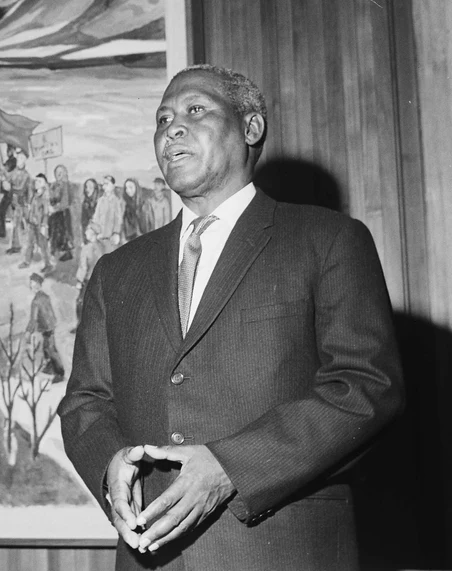
- 9. Leif Ørnelund / Oslo Museum / Wikimedia CommonsAlbert Lutuli in Oslo, 11 December 1961, OB.Ø61/4753