In this biography
Quick facts
- Born
- 31 January 1925
- Died
- 2 July 1994
- Birthplace
- Mandalay, British Burma
- Country
- Myanmar
- Nationality
- Burmese
- Known for
- Serving as the last president of the BSPP state during the final month of the 1988 uprising
- Profession
- Lawyer, jurist, writer and historian
- Advanced law degrees
- Utrecht and Yale
- President
- 19 August–18 September 1988
- Time in office
- One month
Why this life matters
Maung Maung personified the legal architecture of Ne Win’s state and its failed attempt to promise elections without surrendering power.
Timeline
Key moments
Born in Mandalay
Born on 31 January to U Sint and Daw Aye Tin.
Moved from journalism to law
Worked as a writer and pursued legal education in London and Utrecht.
Joined Ne Win’s governing project
Became a central civilian legal adviser after the military coup.
Helped construct the socialist legal order
Contributed to the constitutional and judicial system of the one-party state.
Elected president
Succeeded acting president Aye Ko and promised multiparty elections.
Removed by the SLORC coup
Saw Maung’s military council suspended the Constitution and abolished the presidency.
A lawyer and writer drawn into state power
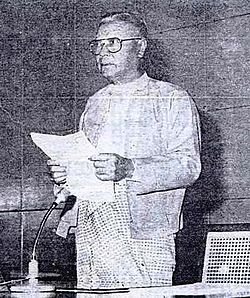
Maung Maung was born in Mandalay in 1925 and worked as a journalist and writer before developing a distinguished legal career. He studied law in London and at Utrecht University and later earned a doctorate at Yale. His scholarship ranged across constitutional law, nationalism and modern Burmese history, giving him an international academic profile unusual among senior figures in Ne Win’s government.
After the 1962 coup, he became one of the military regime’s most important civilian intellectuals. He served in senior legal posts, including attorney-general and chief justice, and helped translate revolutionary government into lasting institutions. His published biography of Ne Win and later defence of the regime made him not merely a technician but also an interpreter and advocate of the system.
Legal architect of the one-party order
The 1974 Constitution replaced the Revolutionary Council with a formally constitutional socialist republic while recognising the BSPP as the sole political organisation. Maung Maung played a major role in the legal thinking and judicial restructuring surrounding that order. Courts lost the institutional independence associated with the 1947 Constitution as power was reorganised through people’s councils and party-controlled state organs.
This background shaped his selection during the 1988 crisis. He was a civilian, but not an opposition figure or outsider to military rule. When the Pyithu Hluttaw elected him president and the BSPP made him chairman on 19 August, the leadership presented a lawyer as a more conciliatory successor to Sein Lwin without abandoning the state Maung Maung had helped design.
One month of promises before another coup
Maung Maung announced that multiparty elections would be held, but protesters demanded immediate political change and doubted that the BSPP could supervise a credible transition. Demonstrations, strikes and administrative breakdown continued. On 18 September General Saw Maung created the State Law and Order Restoration Council, suspended the 1974 Constitution and removed Maung Maung after exactly one month.
He withdrew from public office and continued writing until his death in Yangon on 2 July 1994. His short presidency cannot be understood as a civilian democratic interval between two military regimes. It was the final constitutional phase of Ne Win’s one-party state, led by the jurist who had helped give that state legal form and who could not save it with a late promise of elections.
Quick answers
Frequently asked questions about Maung Maung
- Who was Maung Maung?
- Maung Maung was a jurist, writer and seventh president of Burma. Maung Maung personified the legal architecture of Ne Win’s state and its failed attempt to promise elections without surrendering power.
- What is Maung Maung best known for?
- Maung Maung is best known for serving as the last president of the BSPP state during the final month of the 1988 uprising.
- When and where was Maung Maung born?
- Maung Maung was born on 31 January 1925 in Mandalay, British Burma.
- When did Maung Maung die?
- Maung Maung died on 2 July 1994.
Sources and further reading
Explore the evidence
These references support the biography and offer further reading. Official records, first-person accounts and independent reporting provide different perspectives; image records document attribution and licensing.
- 1. The IndependentObituary: Maung Maung
- 2. ISEAS–Yusof Ishak Institute / Cambridge CoreDr Maung Maung · legal scholarship and public career
- 3. UPI ArchivesDr Maung Maung, last BSPP president, dies
- 4. Myanmar Ministry of Natural Resources and Environmental ConservationConstitution of the Socialist Republic of the Union of Burma
- 5. Human Rights WatchChronology of political events in Burma, 1962–2008