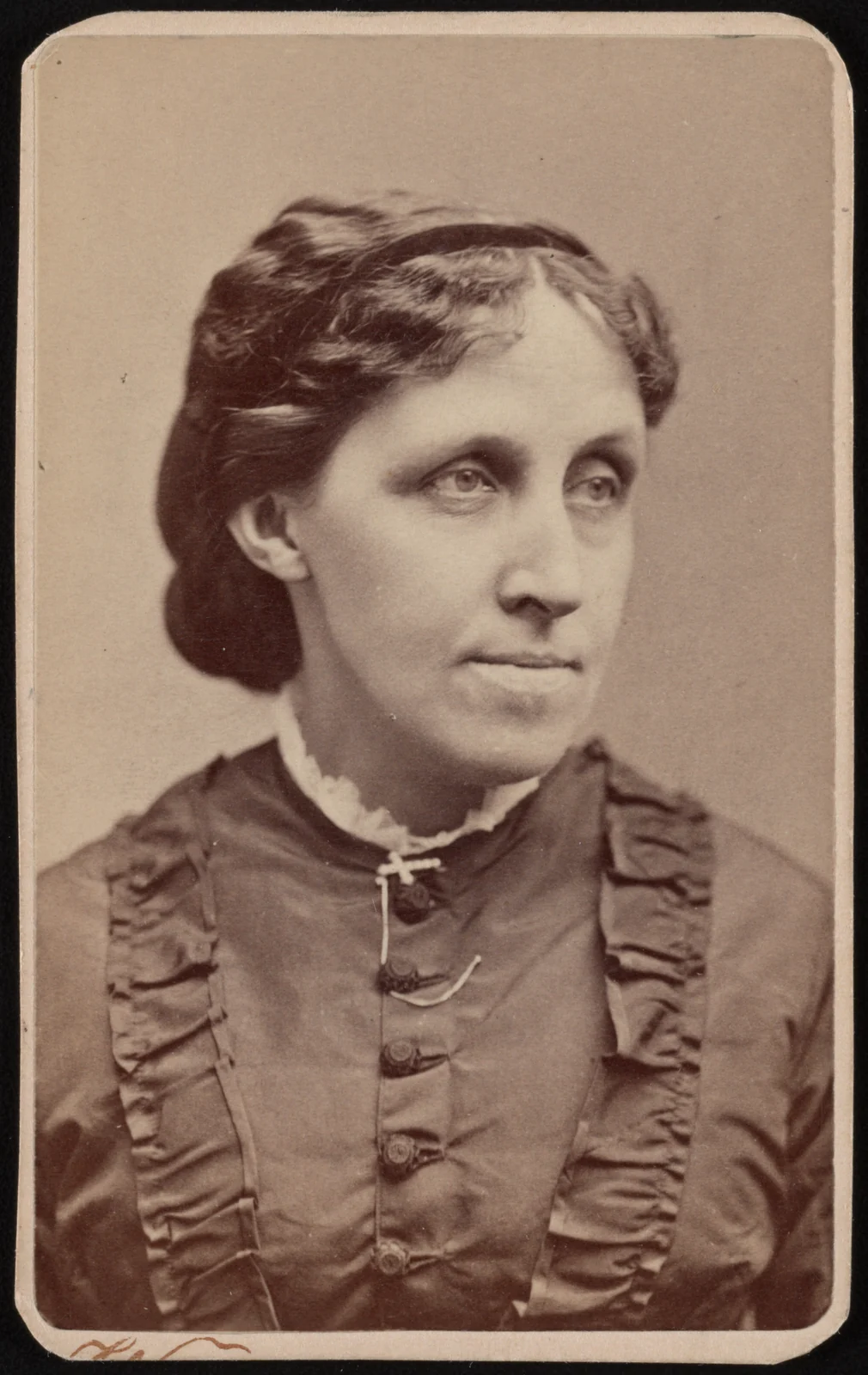
In this biography
Quick facts
- Born
- 29 November 1832
- Died
- 6 March 1888
- Birthplace
- Germantown, Pennsylvania, United States
- Country
- United States
- Nationality
- American
- Known for
- Little Women, Hospital Sketches, adult fiction and stories published as A. M. Barnard
- First book
- Flower Fables, 1854
- War writing
- Hospital Sketches, 1863
- Little Women
- Original first part, 1868; Part Second, 1869
- Adult novel
- Work: A Story of Experience, 1873
Why this life matters
Her writing makes work, education, family obligation and women’s independence central literary subjects, and her career shows the range concealed by a single famous title.
Timeline
Key moments
Born in Germantown
Alcott was born on 29 November to Abigail May and Amos Bronson Alcott.
Life at Hillside
The family moved to the Concord house now known as The Wayside; the sisters’ playacting and experiences later informed her fiction.
First book
Flower Fables established her in print before the novels for which she became famous.
Union nursing and Hospital Sketches
Brief service in a Georgetown military hospital supplied material for Hospital Sketches, published in 1863.
Behind a Mask
The sensational novella appeared under the established pen name A. M. Barnard.
Little Women in two parts
Roberts Brothers published the first part in 1868 and Part Second in 1869; later editions often combine them.
Work and the Rose novels
Work: A Story of Experience was followed by Eight Cousins and its sequel Rose in Bloom.
Suffrage and later work
Alcott registered for Concord school-committee voting after the limited franchise expanded in 1879. Jo’s Boys appeared in 1886; she died on 6 March 1888.
A literary household with practical pressures
Louisa May Alcott was born in Germantown, Pennsylvania, on 29 November 1832. Her parents, Abigail May and the educator Amos Bronson Alcott, raised four daughters: Anna, Louisa, Elizabeth and May. Family life brought her into the orbit of New England intellectuals, but it also required practical work. Teaching, sewing and domestic employment formed part of the world from which her writing career emerged.
In Concord she knew Ralph Waldo Emerson’s library and the natural world explored with Henry David Thoreau. At Hillside, the house now called The Wayside, the sisters staged plays and invented dramatic entertainments. These activities helped make storytelling a shared practice before it became a profession. The National Park Service also records the family’s sheltering of a freedom seeker there. Their home life included the political reality of slavery alongside books, performances and philosophical discussion.
Writing for publication and serving during the Civil War
Flower Fables, published in 1854, was Alcott’s first book. It preceded Little Women by more than a decade. Magazine work, experiments with different audiences and the need to earn income are important to that early career. It is misleading to imagine that the familiar March family story was her first attempt at writing or the only kind of writing that interested her.
During the Civil War she served briefly as a nurse at the Union Hotel hospital in Georgetown, Washington, D.C. Typhoid ended that service. Hospital Sketches (1863) drew on letters sent home, turning nursing experience into a shaped literary account. The work belongs close to the events, but it uses the narrator Tribulation Periwinkle and narrative invention. It is neither a hospital’s administrative record nor a transcript of unaltered correspondence. The surviving service documentation and the published sketches answer different questions about the same period.
Little Women was fiction published in two original parts
At the request of publisher Thomas Niles, Alcott wrote a story for girls that became Little Women. She worked at a small desk in her Orchard House bedroom. The first part appeared from Roberts Brothers in 1868, illustrated by her sister May. Part Second followed in 1869. A later volume that contains both parts should not be mistaken for the physical form of the first 1868 publication.
Meg, Jo, Beth and Amy draw on the Alcott sisters, but resemblance does not make the novel a family documentary. Its arrangement, characterization and resolutions belong to fiction. Jo’s writing ambition makes the relationship especially inviting to readers, while also making the distinction necessary. The March sisters’ growing responsibilities let the book examine earning, education and family attachment together. Little Men (1871) and Jo’s Boys (1886) continue the March-family story beyond the original two parts.
Adult fiction and the established A. M. Barnard stories
Alcott’s bibliography extends well beyond domestic books for young readers. Moods appeared in 1864. Behind a Mask (1866), published as A. M. Barnard, follows an actress who enters a wealthy household disguised as a governess. Its manipulation, performance and class ambitions reveal a writer comfortable with sensational plotting. A. M. Barnard is an established attribution; it does not justify treating every proposed discovery under another name as settled fact.
Work: A Story of Experience (1873) follows Christie Devon’s search for a livelihood and a meaningful independent life. Its occupations and Civil War setting draw on experiences Alcott knew, while remaining the story of an invented protagonist. Eight Cousins (1875) and Rose in Bloom (1876) explore education, wealth and women’s choices through a different fictional family. Rose in Bloom continues Eight Cousins, rather than continuing the March sisters’ adventures. These distinctions give readers several routes into Alcott instead of reducing her career to a single heroine.
Reform, later life and the surviving record
Women’s independence was also a public concern for Alcott. When Massachusetts extended a limited school-committee franchise to women in 1879, she became the first woman to register in Concord. This was a specific local voting opportunity, not universal voting rights. The connection with the writing is worth considering without treating every character’s speech as a direct statement of the author’s politics.
Alcott died on 6 March 1888, two days after her father. Her later reputation depends on more than successive adaptations of Little Women. The Library of Congress points readers toward books, letters, suffrage records and photographs, while institutional bibliographies distinguish works published during her life from manuscripts first printed much later. Reading across those forms makes room for the working author, nurse and reform advocate alongside the familiar family storyteller. No single fictional counterpart can contain all of those activities.
Quick answers
Frequently asked questions about Louisa May Alcott
- Was Little Women first published as one complete volume?
- No. Roberts Brothers published its first part in 1868 and Part Second in 1869. Many later editions combine the two; check the contents when comparing editions.
- Is Jo March exactly the same person as Louisa May Alcott?
- No. Alcott drew on herself, her sisters and family experiences, but Jo is a fictional character. The novel’s plot is not a literal biography of its author.
- Did Alcott write for adult readers?
- Yes. Her broader work includes Moods, Work: A Story of Experience and sensational fiction such as Behind a Mask, published under the established pen name A. M. Barnard.
- What was Alcott’s connection to Civil War nursing?
- She served briefly at the Union Hotel military hospital in Georgetown before illness ended the work. Hospital Sketches, published in 1863, is a literary account drawn from that experience and her letters home.
Keep exploring
Lives connected to this story
- Mark Twain
Compare two nineteenth-century American writers whose famous books about young people sit within wider careers involving adult audiences, publishing markets and public identities.
- Emily Dickinson
Compare another nineteenth-century New England writing life, paying attention to the different roles of manuscripts, publication during life and later editorial presentation.
Sources and further reading
Explore the evidence
These references support the biography and offer further reading. Official records, first-person accounts and independent reporting provide different perspectives; image records document attribution and licensing.
- 1. Louisa May Alcott’s Orchard HouseLouisa May Alcott
- 2. National Park Service, Minute Man National Historical ParkThe Wayside: Little Women Happened Here!
Used for Hillside, the sisters’ performances and the documented freedom seeker. This NPS page gives Flower Fables as 1855; Orchard House explicitly identifies December 1854, and Kansas State’s works list also gives 1854, which is used here.
- 3. National ArchivesLouisa May Alcott’s Civil War Service
Read the service-record discussion. Its muster-roll period is not treated as a complete chronology of every day of nursing; no exact six-week start/end dates are asserted. The article’s definitive claim of lifelong mercury poisoning is not repeated. Hospital Sketches is described as a shaped account, rather than assumed to be verbatim letters.
- 4. James Redpath, 1863; digitized by Project GutenbergHospital Sketches: original work in transcription
- 5. Library of CongressBooks That Shaped America, 1850–1900: Little Women and The Mysterious Key entries
- 6. Christie’sLittle Women, 1868; Part Second, 1869; Little Men, 1871: first-edition catalogue
Read the catalogue’s physically described first-edition set for the separate 1868 and 1869 Little Women parts. Its illustration-credit wording is not adopted: the LOC exhibition specifically credits the first part to May Alcott. Later reprints are not dated as first editions.
- 7. Kansas State University, Louisa May Alcott ArchiveWorks by Louisa May Alcott
- 8. Cita PressBehind a Mask: publication and A. M. Barnard attribution
Publisher record establishes Behind a Mask’s 1866 publication as A. M. Barnard. Unresolved claims of newly discovered pseudonyms are omitted; no complete Alcott attribution catalogue is claimed.
- 9. Library of AmericaWork, Eight Cousins, Rose in Bloom, Stories & Other Writings
- 10. National Park ServiceMassachusetts and the 19th Amendment: limited school voting and Alcott’s registration
- 11. Library of CongressLouisa May Alcott: Digital Resources
- 12. Library of CongressGeorge Kendall Warren’s Alcott portrait, LCCN 2017660625
- 13. Wikimedia CommonsWarren’s Alcott portrait: unrestored original TIFF and item-specific public-domain statement
Exact original TIFF page read directly after browser access failed. It explicitly distinguishes the unrestored original from Adam Cuerden’s restored JPEG/PNG and records PD-old-100-expired, Warren’s death in 1884 and pre-1931 U.S. publication. The corresponding LOC item identifies Alcott and states no known publication restrictions. The whole supplied card scan is retained.