In this biography
Quick facts
- Born
- 10 December 1830
- Died
- 15 May 1886
- Birthplace
- Amherst, Massachusetts, United States
- Country
- United States
- Nationality
- American
- Known for
- Innovative lyric poetry and a substantial manuscript body published largely after her death
- Schooling
- Amherst Academy; Mount Holyoke Female Seminary, 1847–1848
- Manuscripts
- Almost 1,800 poems survive in her poetic legacy
- First posthumous collection
- Poems, edited by Mabel Loomis Todd and Thomas Wentworth Higginson, 1890
- Later scholarly editions
- Thomas H. Johnson, 1955; R. W. Franklin, 1998
Why this life matters
Her manuscripts, correspondence and complex publication history make her achievement both a history of poetic invention and a continuing question of how editors present a writer's work.
Timeline
Key moments
Born in Amherst
Emily Dickinson was born at the family Homestead on 10 December.
Mount Holyoke studies
After years at Amherst Academy, she spent one year at Mount Holyoke Female Seminary.
Intensive poetic work
She composed, revised and preserved hundreds of poems, including manuscripts assembled in handmade booklets.
Death in Amherst
Dickinson died on 15 May, leaving most of her poetry unpublished.
First collection
Todd and Higginson published Poems, introducing a wider audience to her work through an edited text.
New scholarly presentations
Johnson's 1955 edition and Franklin's 1998 edition changed how readers could study the poems and their manuscript evidence.
Education and a life rooted in Amherst
Emily Dickinson was born in Amherst, Massachusetts, on 10 December 1830. Her education included about seven years at Amherst Academy and one year at Mount Holyoke Female Seminary beginning in 1847. These were substantial educational opportunities for a young woman of her period, but they were not a university degree. Reading, music, natural observation and correspondence also shaped her intellectual life.
The familiar image of a permanently isolated poet can obscure the social energy of her youth. She attended gatherings, formed close friendships and participated in the activities of a connected family. Her brother Austin married her friend Susan Gilbert, who lived next door at The Evergreens. Amherst remained the setting of her work, but the world reached her through people, books, letters and the events that occupied nineteenth-century American life.
Sources for this section: [1]
Making and circulating manuscripts
The years around 1858–1865 were especially productive. Dickinson composed, revised and saved hundreds of poems, assembling many into small handmade booklets now known as fascicles. The physical manuscripts matter because her choices included not only words but also lineation, punctuation and alternative readings. A tidy printed page can conceal some of that working process.
Although most of the poems did not reach a broad public during her lifetime, writing was not always solitary circulation. She sent poems to selected readers, including Susan Dickinson and Thomas Wentworth Higginson. Those exchanges were different from commercial publication, but they were still relationships between writer and reader. The small contemporary audience should not be mistaken for an absence of ambition, craft or sustained engagement with what language could do.
Sources for this section: [2]
A compact form with unsettled questions
Dickinson's poems often draw on the rhythm of hymns while disturbing expectations about syntax, rhyme and closure. Their short scale can hold complicated shifts of perspective. Nature, death, belief, love and the identity of the self recur, but a shared subject does not mean that every poem offers the same answer. Humor and intellectual play belong beside grief and spiritual uncertainty.
The speaking voice is not automatically a transparent record of the author's daily circumstances. A useful reading attends to a poem's argument, image and movement before turning it into biography. Her condensed vocabulary and surprising comparisons can make familiar experiences strange again. Many poems are known by first lines or editorial numbers rather than author-supplied titles, a practical reminder that the form in which readers encounter her work has its own history.
Publication after death changed the text readers saw
Dickinson died on 15 May 1886, leaving almost 1,800 poems and no clear instructions for their publication. Her sister Lavinia worked to bring them into print. Mabel Loomis Todd and Higginson edited the first collection, Poems, in 1890. They regularized punctuation, sometimes supplied titles and changed some wording. Their work created a public readership while also changing the presentation of the poems.
The publication story continued through other editors, including Martha Dickinson Bianchi and Millicent Todd Bingham. Thomas H. Johnson's 1955 edition returned to manuscript evidence and presented a much more comprehensive body of work. R. W. Franklin's 1998 edition offered another major scholarly treatment. These editions are not interchangeable windows onto a single finished typescript. Their numbering, ordering and textual decisions affect how readers study Dickinson, and should be identified when quoting or comparing a poem.
Later life and a legacy beyond the recluse legend
In later years Dickinson withdrew increasingly from public life, while continuing to write and maintaining significant relationships. Higginson visited her in 1870 after years of correspondence. Family responsibilities, illness and bereavement formed part of these decades, but no single explanation securely accounts for her choices. Her privacy should not become permission to invent a diagnosis or reduce the poems to one secret cause.
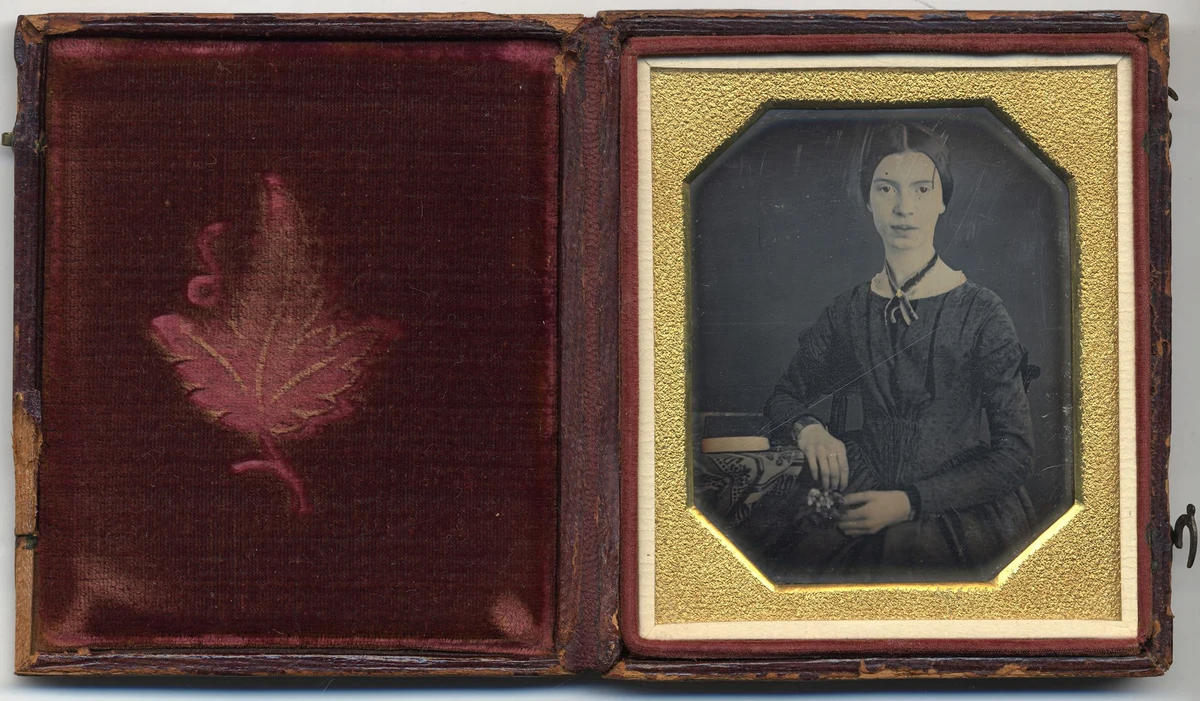
The surviving papers are now held chiefly at Amherst College and Harvard, with related collections elsewhere. They allow readers to consider her as a working poet as well as a cultural legend. The photograph here is the complete institutional reproduction of an early daguerreotype, still within its case, not a later imagined portrait in white. Dickinson's achievement remains in the demanding, inventive writing, whose apparent smallness of scale opens onto unusually large questions.
Quick answers
Frequently asked questions about Emily Dickinson
- Did Emily Dickinson publish no writing during her lifetime?
- A small amount appeared, often anonymously, but the great majority of her poetry remained unpublished until after her death.
- Who edited the first collection of her poems?
- Mabel Loomis Todd and Thomas Wentworth Higginson edited Poems in 1890, after Lavinia Dickinson helped initiate the publication effort.
- Why do editions of Dickinson differ?
- Early editors altered punctuation, supplied some titles and changed wording. Later editors returned to manuscripts and made different decisions about readings, chronology and numbering.
- Did Dickinson earn a college degree?
- No degree is claimed here. She attended Amherst Academy and spent one year at Mount Holyoke Female Seminary in 1847–1848.
Keep exploring
Lives connected to this story
- Walt Whitman
Compare another major nineteenth-century American poet with a very different public career and poetic scale.
- Langston Hughes
Explore another poet's relationship with lyric voice, rhythm and a wider reading public.
Sources and further reading
Explore the evidence
These references support the biography and offer further reading. Official records, first-person accounts and independent reporting provide different perspectives; image records document attribution and licensing.
- 1. Emily Dickinson Museum1830–1855: Childhood and Youth
- 2. Emily Dickinson Museum1855–1865: The Writing Years
- 3. Emily Dickinson MuseumMajor Characteristics of Dickinson's Poetry
- 4. Emily Dickinson MuseumThe Posthumous Discovery of Dickinson's Poems
Used for the first editors' interventions and later publication history. No complete edition or entire manuscript archive was read for this biography; no poem passages are reproduced.
- 5. Emily Dickinson Museum1865–1886: The Later Years
- 6. Emily Dickinson MuseumFrequently Asked Questions
Distinguishes known facts from uncertain explanations of reclusiveness and publication choices. Poetic speakers are not assumed to be literal autobiographical testimony.
- 7. Emily Dickinson MuseumResources and Bibliography
Identifies repositories and scholarly editions. The image uses a separate institutional item-specific public-domain determination, not a capture-year-only or unverified 1894-publication claim.