In this biography
Quick facts
- Born
- 2 August 1924
- Died
- 1 December 1987
- Birthplace
- Harlem, New York City, United States
- Country
- United States
- Nationality
- American
- Known for
- Go Tell It on the Mountain, Giovanni’s Room and essays confronting race, sexuality and American identity
- Full name
- James Arthur Baldwin
- Birth
- 2 August 1924 in Harlem, New York City
- First novel
- Go Tell It on the Mountain, published in 1953
- Major essay collections
- Notes of a Native Son (1955), Nobody Knows My Name (1961) and The Fire Next Time (1963)
- Life abroad
- First moved to Paris in 1948; settled in Saint-Paul-de-Vence in 1971 while continuing transatlantic connections
- Death
- 1 December 1987 in Saint-Paul-de-Vence, France
Why this life matters
Baldwin made personal experience a powerful instrument of social criticism, examining how racial and sexual oppression shaped both private lives and America’s account of itself.
Timeline
Key moments
Born in Harlem
James Arthur Baldwin was born at Harlem Hospital in New York City.
School and literary beginnings
Graduated from DeWitt Clinton High School, where he had edited the literary magazine The Magpie.
First move to France
Left for Paris, beginning a life of writing and travel across national borders.
First books
Published Go Tell It on the Mountain in 1953, Notes of a Native Son in 1955 and Giovanni’s Room in 1956.
The Fire Next Time
Published his influential account of race in America and interviewed Black young people in San Francisco for the documentary Take This Hammer.
Home in southern France
Settled in Saint-Paul-de-Vence, where his house became a gathering place for family, writers and artists.
If Beale Street Could Talk
Published a novel linking a young couple’s love and family life to an unjust criminal prosecution.
Death in France
Died at his home in Saint-Paul-de-Vence, aged 63.
Harlem, reading and the church
James Arthur Baldwin was born in Harlem on 2 August 1924 and grew up as the eldest child in a large family. His mother, Emma Berdis Jones, and his stepfather, the preacher David Baldwin, shaped a childhood marked by economic hardship and demanding family responsibilities. Reading and performance offered another world. Teachers encouraged his interest in literature, and the poet Countee Cullen taught him at Frederick Douglass Junior High School.
Baldwin preached as a teenager before turning away from the ministry. At DeWitt Clinton High School he developed his writing and edited The Magpie. The language, emotional intensity and moral questions of the church remained important resources for his later literary work.
Writing America from abroad
Baldwin began publishing reviews and short fiction in the 1940s. In 1948 he left for Paris, seeking room to develop beyond the racial pressures he experienced in the United States. Distance did not dissolve his connection to America: it helped him examine it. He completed his first novel in Paris and Switzerland, and Go Tell It on the Mountain appeared in 1953.
His life abroad involved movement rather than a single permanent departure. He returned to the United States, spent time in other places including Istanbul, and maintained close family and literary relationships. The result was a perspective shaped by crossing borders while continuing to confront the society that had formed him.
Novels and essays on belonging
Go Tell It on the Mountain transformed a Harlem religious upbringing into fiction. Notes of a Native Son followed in 1955, establishing the essay as a central form in Baldwin’s work. He moved between personal recollection, literary criticism and an examination of the racial assumptions embedded in everyday life. His subjects demanded attention to the inner lives of people whom public debate often reduced to categories.
Giovanni’s Room, first published in 1956, explored a young man’s struggle with sexual identity. Another Country appeared in 1962. Baldwin’s surviving draft of a speech about the novel shows his concern with how American writers could describe their country honestly. Fiction and criticism were complementary ways of pursuing that problem.
A public voice for civil rights
Baldwin became an influential participant in the civil rights struggle through his writing, speeches and encounters with activists. He knew Medgar Evers, Martin Luther King Jr. and Malcolm X; the violence that killed movement figures entered his reflections on America. His essays pressed readers to consider the history and human costs behind claims of national innocence.
The Fire Next Time appeared in 1963. That May, while protests unfolded in Birmingham, he interviewed Black young people in San Francisco. Those encounters became part of Take This Hammer, broadcast in January 1964. The project brought his national argument into conversation with people describing their own lives, frustrations and expectations.
Later fiction and a transatlantic legacy
In 1971 Baldwin settled in Saint-Paul-de-Vence in southern France. His home became a place for family, artists and intellectuals to gather. He continued writing about American life: If Beale Street Could Talk, published in 1974, follows a young couple and their families as love and an unjust prosecution collide. Its attention to intimate relationships carried forward concerns that public fame had never displaced.
Baldwin died there on 1 December 1987, aged 63. His manuscripts, letters and working drafts now support study of both the public figure and the patient reviser. They reveal a career sustained across fiction, essays, drama and other forms, with the act of writing itself central to his demand for honesty.
Quick answers
Frequently asked questions about James Baldwin
- What is James Baldwin best known for?
- His novels include Go Tell It on the Mountain and Giovanni’s Room. His best-known nonfiction includes Notes of a Native Son and The Fire Next Time, which connect personal experience with questions of race, identity and American history.
- Did James Baldwin leave the United States permanently in 1948?
- No. His first move to Paris began a life of travel and repeated returns. He maintained American family and public connections, later settling in Saint-Paul-de-Vence in 1971 while continuing his transatlantic life.
- How did Baldwin participate in the civil rights movement?
- He wrote, spoke publicly and engaged with activists including Medgar Evers and Martin Luther King Jr. In 1963 he also interviewed Black young people in San Francisco for Take This Hammer, connecting national debates with local experience.
- When were Giovanni’s Room and If Beale Street Could Talk first published?
- Giovanni’s Room first appeared in 1956, and If Beale Street Could Talk in 1974. Dates attached to modern paperback, ebook or film tie-in editions refer to those editions, rather than the novels’ original publication.
Keep exploring
Lives connected to this story
- Amy Tan
Read another American novelist whose fiction explores family, cultural inheritance and belonging, from a different historical and personal starting point.
- Duke Ellington
Compare a musician who also used artistic work and a public career to bring African American experience before wider audiences.
Sources and further reading
Explore the evidence
These references support the biography and offer further reading. Official records, first-person accounts and independent reporting provide different perspectives; image records document attribution and licensing.
- 1. Smithsonian National Museum of African American History and CultureJames A. Baldwin Collection — finding aid
- 2. Smithsonian National Museum of African American History and CultureThe Makings of a Man
- 3. New York Public Library, Schomburg Center for Research in Black CultureJames Baldwin Papers — finding aid and chronology
Chronology checked for full name, birth, school, travel and first publication years. The 1948 departure is not described as a permanent end to American residence.
- 4. Smithsonian National Museum of African American History and CultureJames Baldwin
- 5. Library of CongressJames Baldwin — biography
- 6. Library of CongressGiovanni’s Room — MacDowell exhibition first edition
First-edition exhibit establishes Giovanni’s Room in 1956; later reissue dates are not used as original publication dates.
- 7. New York Public LibraryPage from James Baldwin’s draft of The Novel
- 8. Library of CongressJames Baldwin in San Francisco
Read the exhibition caption: San Francisco interviews were filmed in May 1963, with the documentary broadcast in January 1964.
- 9. Smithsonian National Museum of African American History and CulturePassport to Baldwin
The exhibition documents a United States passport and the Saint-Paul-de-Vence home from 1971 to 1987; American nationality is retained despite residence abroad.
- 10. Penguin Random HouseIf Beale Street Could Talk — reader’s guide
- 11. New York Public LibraryJames Baldwin papers — collection description
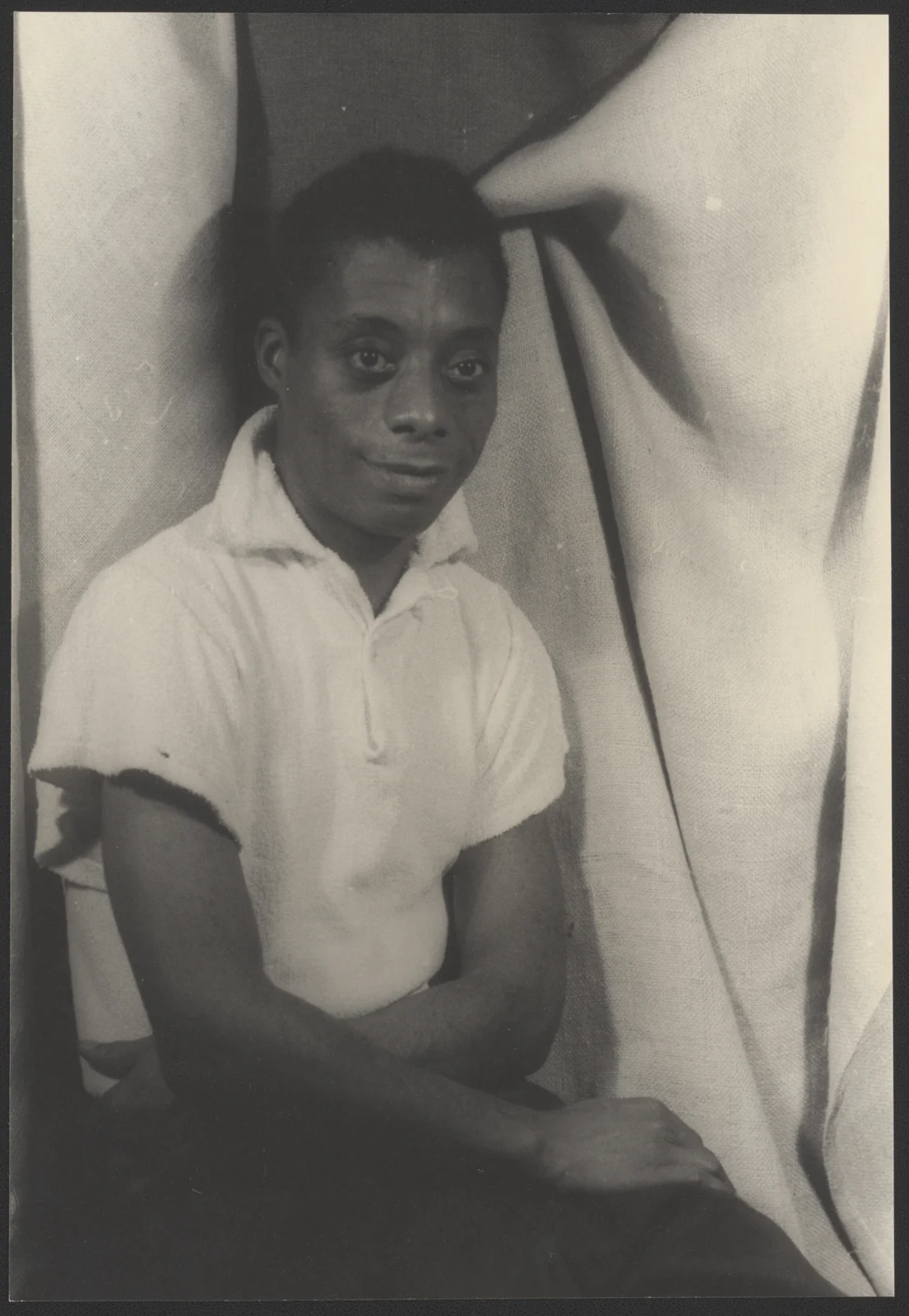
- 12. Library of Congress, Prints and Photographs DivisionPortrait of James Baldwin, Carl Van Vechten, 13 September 1955
- 13. Library of Congress, Prints and Photographs DivisionCarl Van Vechten Photographs — rights and restrictions
Complete advisory read at the Library’s wwws.loc.gov mirror. Donor restrictions expired in 1986. Bruce Kellner disputed Saul Mauriber’s authority in 1998; LOC reviewed the materials and continued to regard the photographs as public domain. Advisory requests photographer credit and no cropping or colorization, and notes possible privacy/publicity rights. The choice relies on this collection-specific position, not government hosting.
- 14. Wikimedia CommonsJamesbaldwin.jpg — original file and upload history
Exact original Commons JPEG downloaded and visually checked at 3712×5376. Current upload says higher resolution from the same source; no separate restoration credit appears. Entire supplied print and borders retained. Creator and 13 September 1955 date match LOC item 2004662552; Commons also identifies the copy-negative digital ID cph.3a42800. No byte identity with a LOC TIFF is claimed.