In this biography
Quick facts
- Born
- Probably 9 September 1911
- Died
- 19 May 2002
- Birthplace
- Uncertain: Melbourne or Wellington reported
- Country
- Australia
- Nationality
- Not independently established
- Known for
- Wartime flying, national cultural policy and a turbulent Liberal leadership
- Birth details
- 1911; exact birthplace uncertain
- Education
- Brasenose College, Oxford
- Wartime service
- Royal Australian Air Force
- Federal representation
- Victorian senator, then member for Higgins
- Prime minister
- 10 January 1968–10 March 1971
- Died
- 19 May 2002, Sydney
Why this life matters
His career joins personal independence to the practical demands of party government. The tied confidence vote of 1971 did not end his public life: ministerial conflict, an independent candidacy and eventual reconciliation with the Liberals followed.
Timeline
Key moments
Uncertain beginnings and Oxford
Australian schooling and Oxford study precede marriage and work on the family orchard.
Wartime flying
RAAF service includes serious facial injury and survival after a ship is torpedoed.
Senate and ministry
Election as a Victorian senator is followed by Navy and education responsibilities.
Prime minister and national initiatives
He moves from the Senate to Higgins while promoting a stronger federal role.
Confidence vote and departure
He treats a tied party-room vote as insufficient confidence and steps aside.
Independent contest and later life
An unsuccessful ACT Senate bid follows his party resignation; reconciliation comes before his death.
Uncertain birth records preceded study, farming and war
Gorton is generally dated to 9 September 1911, but the National Archives describes unresolved birth records and conflicting Melbourne and Wellington accounts. Certainty about a particular city would therefore overstate the evidence.
He attended Australian schools, studied at Brasenose College, Oxford, and returned to orchard work. During the Second World War he served as an RAAF pilot, suffering severe facial injury in a forced landing and surviving the torpedoing of a ship carrying him from Singapore. These experiences became prominent in public accounts of his life, without explaining every later political judgment.
Local government and the Senate supplied a ministerial apprenticeship
After the war, Gorton entered local government in northern Victoria and then national politics. He won a Victorian Senate seat in 1949. His ministerial career began under Robert Menzies and developed through Navy, works and education responsibilities.
The education portfolio enlarged his experience of Commonwealth involvement in fields closely associated with the states. That interest continued as prime minister, when his preference for national action generated conflict with state Liberal leaders. His later reputation for independence had institutional roots as well as a personal style: he was willing to contest where governmental responsibility should lie.
An unusual succession led to a move between chambers
Following Harold Holt’s disappearance, Gorton won the Liberal leadership and was sworn in on 10 January 1968 while still a senator. He then resigned from the Senate and won the Higgins by-election in February.
The transition made him exceptional among Australian prime ministers, but did not give him freedom from parliamentary or party constraints. His government supported national cultural initiatives, including the film-development corporation. Gorton’s willingness to strengthen federal activity also attracted resistance. After electoral reversals, colleagues disputed both policy direction and his handling of Cabinet relationships. National ambition and political management were not the same achievement.
Fraser’s resignation sharpened a wider leadership conflict
In March 1971 defence minister Malcolm Fraser resigned and accused Gorton of failing to support him over a dispute involving Army leadership. Their disagreement became the immediate occasion for a party-room confidence vote, against a background of broader dissatisfaction.
The result on 10 March was a 33–33 tie. Gorton treated that as insufficient confidence and stepped down; a subsequent leadership election chose William McMahon. This was not a general-election defeat or a constitutional rule that every tied party ballot must remove its leader. Gorton then won the deputy leadership and briefly served as defence minister in McMahon’s government.
Parliamentary dissent outlasted the premiership
Relations with McMahon deteriorated and Gorton left the ministry in August 1971. He remained in Parliament through the 1972 and 1974 elections. Later support for law reform and criticism of Liberal leadership reinforced his distance from party orthodoxy.
He resigned from the Liberals in 1975, opposed the supply strategy against Whitlam and unsuccessfully contested an ACT Senate seat as an independent. Media work and public interventions followed. Readmission to the Liberal Party in 1999 marked a later reconciliation, not uninterrupted party membership. Gorton died in Sydney on 19 May 2002, leaving a record of reforming ambitions, internal conflict and a notably unconventional route to office.
Quick answers
Frequently asked questions about John Gorton
- Is Gorton’s birthplace certain?
- No. Melbourne is considered probable, but Wellington appears in records and the Archives explains unresolved evidence.
- Was he a senator when appointed prime minister?
- Yes. He subsequently moved to the House by winning Higgins in February 1968.
- Did he lose a general election in March 1971?
- No. A tied Liberal confidence vote led him to step aside; the replacement leadership election followed.
- Did he leave Parliament in 1972?
- No. He retained Higgins in 1972 and 1974, then unsuccessfully contested the ACT Senate election in 1975.
Keep exploring
Lives connected to this story
- Malcolm Fraser
Read the defence minister whose resignation triggered the final leadership confrontation.
- John Howard
Compare another Liberal prime minister’s approach to party continuity and government.
- Paul Keating
Compare a later programme of national cultural and economic policy without treating the periods as identical.
Sources and further reading
Explore the evidence
These references support the biography and offer further reading. Official records, first-person accounts and independent reporting provide different perspectives; image records document attribution and licensing.
- 1. National Archives of AustraliaJohn Gorton before office: selected birth uncertainty, education, war and ministerial passages
Selected early-life and career passages only. Birthplace intentionally unverified; no nationality inferred. The listed books and full service file were not read.
- 2. National Archives of AustraliaJohn Gorton during office: selected national policy and March 1971 confidence vote
Selected policy and departure passages. References to training-school initiatives are not substituted for the separate school’s statutory establishment in 1973.
- 3. National Archives of AustraliaJohn Gorton after office: selected party rupture, 1975 candidacy and later life
- 4. National Museum of AustraliaJohn Gorton: selected Senate-to-House transition and parliamentary elections
- 5. ABC AMSir John Gorton dies, 20 May 2002: selected obituary transcript and recollections
Transcript read directly after browser extraction failed. It incorrectly says he did not recontest in 1972 and simplifies the leadership ballot; institutional election and confidence-vote records supply those distinctions.
- 6. Federal Register of LegislationAustralian Film Development Corporation Act 1970: selected original provisions
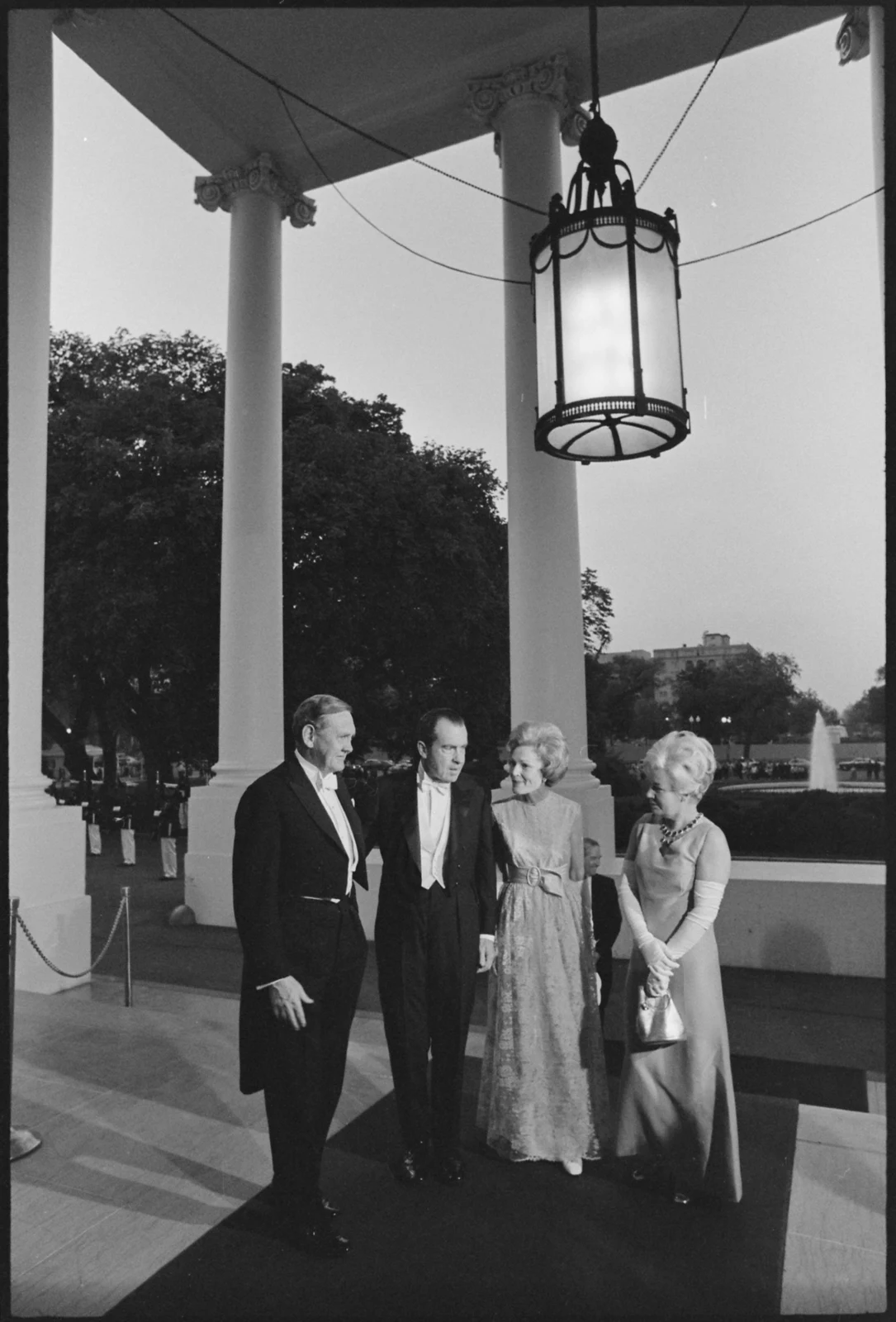
- 7. Jack E. Kightlinger / US National ArchivesWHPO-0981-11A, NARA 194627: complete original White House photograph