In this biography
Quick facts
- Born
- 15 November 1932
- Died
- 8 June 2015
- Birthplace
- Romeas Hek district, Svay Rieng province, Cambodia
- Country
- Cambodia
- Nationality
- Not independently established
- Known for
- Post-1979 political leadership, the CPP presidency and a disputed legacy involving untried Khmer Rouge-era allegations
- Birth
- 15 November 1932; Romeas Hek, Svay Rieng
- Political rupture
- Fled the Khmer Rouge to Vietnam in 1978
- Interior ministry
- Minister in the post-1979 government until 1981
- CPP leadership
- Party president from 1991 until his death
- Senate
- President from 1999 to 2015
- Death
- 8 June 2015, Phnom Penh; aged 82
Why this life matters
His career reveals the connections and tensions between post-war institution building, ruling-party patronage, formal parliamentary rank and accountability for Cambodia’s violent past.
Timeline
Key moments
Birth in Svay Rieng
Born on 15 November in Romeas Hek district, according to a contemporary diplomatic-condolence account.
Flight to Vietnam and an opposition front
Left amid Khmer Rouge purges and became a founding leader of the Vietnam-backed United Front for the National Salvation of Kampuchea.
Interior ministry
Became interior minister after the overthrow of the Khmer Rouge government.
CPP presidency
Became president when the ruling party reorganised as the Cambodian People’s Party.
Senate presidency
Took the presidency of the newly established Senate, separate from his party office.
A disputed departure
Left for Thailand amid a constitutional-signing controversy; official medical explanations and opposition speculation differed.
Japanese recognition
Received a Japanese decoration for contributions to bilateral relations, as Japan’s later official condolence statement records.
Death and disputed legacy
Died in Phnom Penh without prosecution of the Khmer Rouge-era allegations raised by Human Rights Watch.
Eastern Cambodia and a break with the Khmer Rouge
Chea Sim was born on 15 November 1932 in Romeas Hek district, Svay Rieng province. He studied ethics and Pali at a Buddhist pagoda and entered anti-colonial and communist movements. His political career developed in eastern Cambodia, where he held local responsibilities before and during the Khmer Rouge’s rule.
As purges spread through the regime’s Eastern Zone, he fled to Vietnam in 1978. He became a founding leader of the United Front for the National Salvation of Kampuchea, serving beneath Heng Samrin. The Vietnam-backed movement returned as the Khmer Rouge government was overthrown in January 1979, placing former cadres in a new governing coalition.
State institutions and a separate party presidency
Chea Sim became interior minister in 1979 and held that office through 1981. He subsequently occupied parliamentary leadership positions during the 1980s and 1990s. In 1991 he became president of the reorganised Cambodian People’s Party; in 1999 he became Senate president. Party leadership and the upper-house presidency were separate offices, neither equivalent to being prime minister.
His parliamentary position also involved international relations. Japan’s 2015 condolence statement recalled six visits to Japan, exchanges between parliamentarians and the promotion of economic ties. It noted a Japanese decoration awarded in 2013. This records a diplomatic assessment of his bilateral contributions, distinct from an independent judgment about his earlier security responsibilities.
Formal seniority and declining political leverage
Chea Sim’s senior party rank coexisted with Hun Sen’s growing executive power. Historical reporting describes competing patronage networks and a gradual shift in influence toward the prime minister. Worsening health, including a stroke in 2000, reduced Chea Sim’s public activity even as he retained the CPP and Senate titles.
A visible dispute occurred in July 2004. While acting as head of state during King Norodom Sihanouk’s absence, he left for Thailand under police escort before signing constitutional arrangements intended to end a government-formation deadlock. Medical treatment was the stated explanation; opposition figures suspected resistance to the deal. The departure was documented, but those competing explanations do not establish a proven personal motive.
Untried allegations and a contested legacy
Human Rights Watch alleged that Chea Sim bore responsibility for arbitrary arrests, torture and executions through Khmer Rouge district-level authority in 1975–1978. It also criticised his role in the post-1979 security apparatus. These were serious, documented rights-group allegations, not a criminal judgment: he was never prosecuted for them before his death.
Cambodia’s Interior Ministry rejected the accusations, arguing that he had been a lower-level official and denying responsibility for Khmer Rouge crimes. Its spokesman also threatened to blacklist HRW’s Brad Adams unless he apologised. Chea Sim died in Phnom Penh on 8 June 2015, aged 82. Official commemorations and unresolved accountability claims therefore remain distinct parts of his historical record.
Quick answers
Frequently asked questions about Chea Sim
- Was Chea Sim Cambodia’s prime minister?
- No. His main documented offices included interior minister, parliamentary leader, CPP president and Senate president. Those were separate from Hun Sen’s premiership.
- When did he become Senate president?
- In 1999, when the new Senate was established. He retained that title until his death in June 2015, despite declining public activity.
- Was he convicted over his Khmer Rouge-era role?
- No. Human Rights Watch raised serious allegations and criticised the failure to investigate him; the Interior Ministry rejected its claims. He died without prosecution, which is neither a conviction nor exoneration.
- Why did he leave Cambodia in July 2004?
- Medical treatment was the stated reason. Opposition figures and observers suspected a dispute over signing constitutional arrangements, but the selected reporting does not establish his motive as proven fact.
Keep exploring
Lives connected to this story
- Heng Samrin
Read about the other founding front leader, distinguishing his state and parliamentary offices from Chea Sim’s party and Senate positions.
- Hun Sen
Place Chea Sim’s formal party seniority and shifting influence alongside the separate executive career of the long-serving prime minister.
Sources and further reading
Explore the evidence
These references support the biography and offer further reading. Official records, first-person accounts and independent reporting provide different perspectives; image records document attribution and licensing.
- 1. Pelita Brunei · Haniza Abdul Latif · June 2015Menandatangani buku takziah: diplomatic condolence account and biographical details
Complete contemporary official condolence article read. Explicitly gives 15 November 1932 and Romeas Hek, Svay Rieng, corroborating the month/province in independent obituaries and an indexed historical-dictionary entry. Its age 83 conflicts with its dates and independent age 82 reports; age 83 is not carried forward. Its broad 1981–1998 parliamentary summary is not treated as uninterrupted presidency through the 1993 constitutional transition.
- 2. The Cambodia Daily · Alex Willemyns · 9 June 2015Chea Sim, Long-Serving CPP President, Dead at 82
Complete substantial obituary read. Covers pagoda schooling, eastern cadre background,1978 defection, front leadership, party reorganisation,1999 Senate and declining influence. Interpretive claims and rivalries are identified as historical reporting; opposition speculation about the 2004 trip is not converted into a proven motive or an adjudicated coup allegation.
- 3. The Cambodia Daily · Saing Soenthrith · 8 June 2015CPP President Chea Sim Dead
Complete contemporary death report read. Establishes 8 June 2015 death at 82,1991 party presidency and 1932 Svay Rieng origins. His party rank is not a premiership, and a pre-death succession announcement is not used as the exact date of Hun Sen’s subsequent election to party president.
- 4. Ministry of Foreign Affairs of Japan · 9 June 2015Foreign Minister Kishida’s statement on Chea Sim’s passing
Complete official condolence statement read. Supports international parliamentary exchanges, six visits and a 2013 Japanese decoration. Ceremonial praise does not disprove separate rights allegations, nor does the statement identify the exact order/class, so no more specific award name is invented.
- 5. The Cambodia Daily · Yun Samean · 23 July 2004CPP President Returns Home From Bangkok
Complete indexed contemporary dispatch read. Documents a 13 Julydeparture and 22 Julyreturn under police escort amid a constitutional-signing dispute. Medical explanations and political speculation are kept separate; no forced-exile motive is asserted as established fact.
- 6. Human Rights Watch · 8 June 2015Chea Sim Death Shows Failings of Khmer Rouge Court
Complete original rights-group release read. Its research alleges district/sector responsibility for serious abuses and political interference in accountability; these are attributed claims, not court findings. It states he had not been investigated/prosecuted. Genocide or crimes-against-humanity conviction is not invented, and lack of prosecution is not described as exoneration.
- 7. The Cambodia Daily · Chris Mueller · 15 June 2015Interior Ministry Wants HRW Director Barred From Cambodia
Complete report read. Contains the Interior Ministry’s substantive lower-level-official defence as well as the threatened blacklist of Brad Adams. The denial is attributed rather than adopted as an adjudicated finding; the threatened exclusion is not asserted to have been implemented.
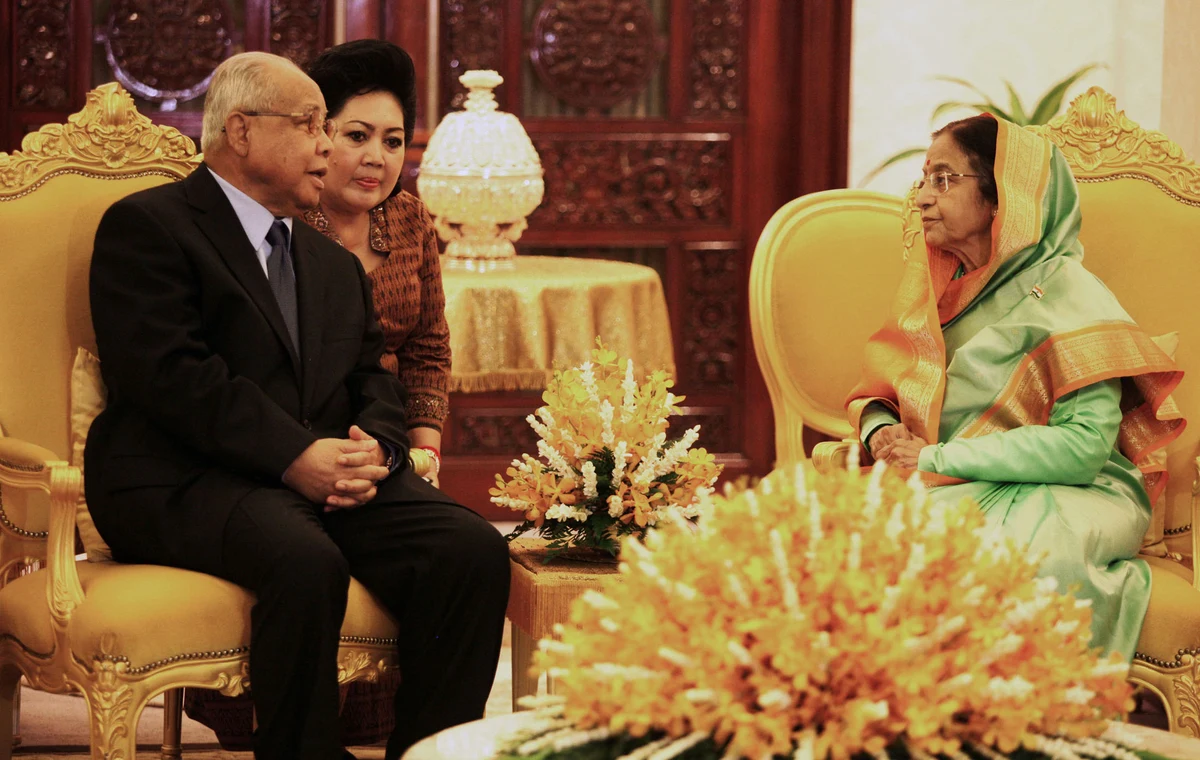
- 8. Wikimedia Commons · President’s Secretariat / PIBChea Sim meets President Pratibha Patil, Phnom Penh, 14 September 2010: PIB ID 30364
Complete wikitext revision 480901653 and all EXIF/IPTC read. Exact President’s Secretariat work, PIB ID 30364/CNR 33397; confirmed GODL-India source review by GazothBot 17 August 2018. No embedded third-party photographer reservation; writer initials are not invented as a photographer’s full name. Original PIB archive cannot be reread live; that limit is explicit. Editorial review visually checked the complete supplied source and retained its whole frame in the WebP; the captioned subject and source documentation agree.
- 9. Government of India · Open Government Data PlatformGovernment Open Data License – India
Complete indexed official GODL text read. Covers images and lawful commercial/non-commercial adaptation with attribution and non-endorsement conditions; third-party, sensitive and other exempt material is excluded. Applied here through the exact producer/source/review record, not a claim that every government upload is free or that personality/third-party rights are universally cleared.
- 10. Press Information Bureau · Government of IndiaCopyright Policy
Complete short indexed current PIB policy read. Permits reproduction without prior approval but excludes third-party material and requires accurate, non-misleading use with source acknowledgment. It is corroborating publisher policy, not a claim of having reread the original photo page today.
- 11. Ministry of Electronics and Information Technology · Gazette of India · 13 February 2017Government Open Data License–India: official notification and complete terms
The official Gazette notification’s complete English licence was read, including the definition of images, lawful commercial reuse, attribution and non-endorsement requirements, exemptions and termination. The exact President’s Secretariat/PIB source and confirmed historical asset review supply the grant route; this is not a claim that every government-hosted photograph or every personality/third-party right is cleared. The present web extraction of the OGD portal is incomplete, so the official notification is also linked.