In this biography
Quick facts
- Born
- 21 May 1930
- Died
- 20 March 2015
- Birthplace
- Melbourne, Victoria, Australia
- Country
- Australia
- Nationality
- Not independently established
- Known for
- The 1975 constitutional crisis, refugee resettlement and later human-rights advocacy
- Born
- 21 May 1930, Melbourne
- Education
- Magdalen College, Oxford
- Federal seat
- Wannon, won in 1955
- Prime minister
- 11 November 1975–11 March 1983
- Parliamentary retirement
- 31 March 1983
- Died
- 20 March 2015, Melbourne
Why this life matters
His record resists a simple conversion story from conservative leader to humanitarian critic. Longstanding concerns about race and international affairs existed alongside a deeply divisive route to office, economic disappointments and later estrangement from the party he had led.
Timeline
Key moments
Pastoral family and Oxford
Schooling in Australia precedes university study and a return to the family’s Victorian property.
Wannon and ministerial office
A decade on the backbench precedes Army, education and defence responsibilities.
Leadership and constitutional crisis
He becomes opposition leader and then caretaker prime minister following Whitlam’s dismissal.
Three election victories
The Coalition wins in 1975, 1977 and 1980 while pursuing a mixed conservative and reform record.
Electoral defeat and retirement
Hawke wins the March election; Fraser leaves office and subsequently Parliament.
Humanitarian public life
CARE work and criticism of later Liberal policies continue before his death in 2015.
A pastoral background led to a long parliamentary apprenticeship
Born in Melbourne in 1930, Fraser grew up in a prosperous pastoral family. Australian schooling was followed by study at Magdalen College, Oxford. He returned to work at Nareen in western Victoria and entered local Liberal politics.
He lost his first Wannon contest in 1954 but won the seat the following year, aged 25. Ten years as a backbencher preceded ministerial promotion. Army, education and defence responsibilities gave him experience under several prime ministers. In 1971 his resignation as defence minister and attack on John Gorton intensified the conflict that ended Gorton’s leadership, an important rupture before Fraser’s own rise.
The route to the premiership remained deeply contested
Fraser defeated Billy Snedden for the Liberal leadership in March 1975. Later that year the Coalition used its Senate position to delay supply, seeking an election. Fraser argued extraordinary circumstances justified that course; Whitlam resisted the demand.
Governor-General John Kerr dismissed Whitlam on 11 November and commissioned Fraser as caretaker prime minister. The Coalition’s decisive December election victory supplied an electoral mandate, but did not end argument about the earlier use of vice-regal power or Fraser’s role. Appointment, electoral victory and continuing disagreement over legitimacy were separate parts of the episode, rather than interchangeable explanations of how government changed.
Conservative government also built reform institutions
Fraser sought expenditure restraint and tighter administration. His government was not, however, simply an early version of later market deregulation. National Archives analysis describes selective economic liberalisation alongside more traditional management and stronger central coordination of Cabinet.
Refugee resettlement, multiculturalism and opposition to apartheid were also substantial commitments. His government established the first Human Rights Commission in 1981. These initiatives do not erase criticism of economic performance or make every decision progressive. They show why a record combining conservative administration with rights-related reform is more accurate than assigning all humanitarian concerns to his retirement.
Economic pressures and electoral losses ended his government
The Coalition won further elections in 1977 and 1980, but its position weakened. The early 1980s brought recession, drought and rising political pressure. Fraser also faced internal leadership discontent.
He obtained a double dissolution in February 1983 as Labor replaced Bill Hayden with Bob Hawke. Labor won the election on 5 March. Hawke’s swearing-in on 11 March ended Fraser’s prime ministership; Fraser resigned his parliamentary seat on 31 March. The sequence distinguishes losing government from immediately losing an electorate: he had retained Wannon at the election before choosing retirement.
Later advocacy brought new roles and a break with his party
After office, Fraser worked on international efforts against apartheid and helped establish CARE Australia in 1987, chairing it until 2002. Humanitarian diplomacy and criticism of discrimination became major elements of his public life.
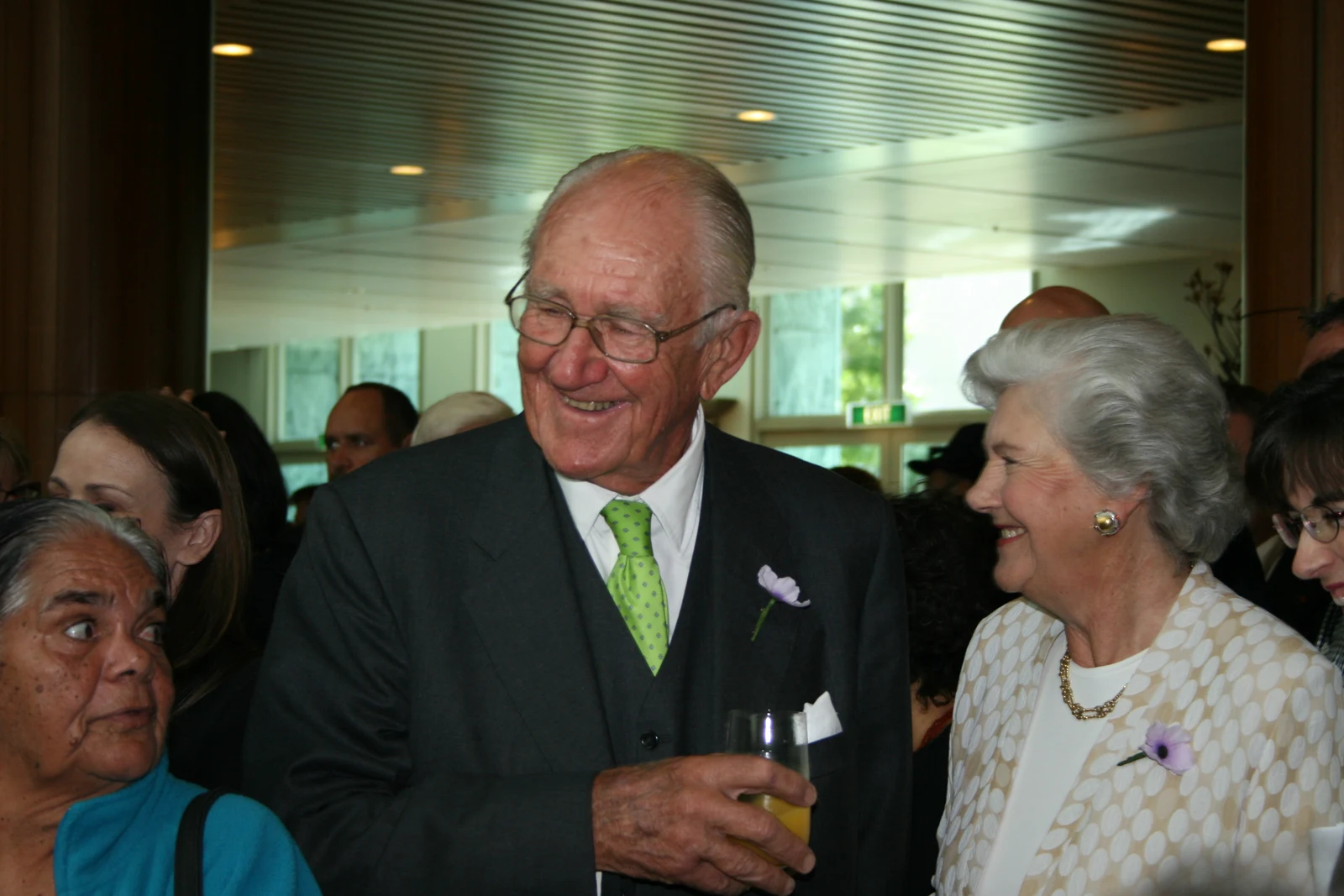
He opposed later Liberal policies on asylum seekers and Indigenous affairs, and resigned from the party after Tony Abbott became leader in 2009. His appearance at the 2008 Parliamentary Apology, pictured here, was part of that continuing engagement. He died in Melbourne on 20 March 2015. Tributes acknowledged humanitarian work while the constitutional crisis remained central to public assessments of his career.
Quick answers
Frequently asked questions about Malcolm Fraser
- Did Fraser first become prime minister by winning an election?
- No. Kerr appointed him caretaker after Whitlam’s dismissal; the Coalition won the subsequent December 1975 election.
- Did the 1983 election remove him from Wannon?
- No. He retained the seat and later resigned from Parliament on 31 March.
- Did his humanitarian work begin only after office?
- No. Refugee resettlement and opposition to apartheid were also parts of his government’s record.
- Did he remain a Liberal Party member for life?
- No. He resigned after Tony Abbott became leader in 2009.
Keep exploring
Lives connected to this story
- John Gorton
Read the prime minister whose 1971 leadership crisis followed Fraser’s resignation.
- Bob Hawke
Place Fraser’s electoral defeat beside the career of the Labor leader who succeeded him.
- John Howard
Compare the former Fraser treasurer with the later policies Fraser publicly criticised.
Sources and further reading
Explore the evidence
These references support the biography and offer further reading. Official records, first-person accounts and independent reporting provide different perspectives; image records document attribution and licensing.
- 1. National Archives of AustraliaMalcolm Fraser before office: selected upbringing, education and ministerial history
The Archives and Museum disagree on the marriage year. No precise marriage date is adopted. Full-name alias and Melbourne birth agree.
- 2. National Archives of AustraliaMalcolm Fraser during office: selected economic, Cabinet and foreign-policy passages
- 3. National Archives of AustraliaMalcolm Fraser after office: selected retirement and humanitarian work
Selected retirement and humanitarian passages. Its apology reference says February 2007; the originating photograph and established event date support February 2008 instead.
- 4. National Museum of AustraliaMalcolm Fraser: selected leadership, supply crisis and term dates
Selected leadership and term passages, not every list of achievements. Its later parliamentary-exit sentence conflates 11 March with 31 March; the Archives retirement record is used.
- 5. National Archives of AustraliaMalcolm Fraser elections: selected 1980 and 1983 results
- 6. ABC NewsFraser’s death and political record, 20 March 2015: selected obituary passages
- 7. Australian Human Rights CommissionRosalind Croucher, 23 November 2018: selected founding, conciliation and enforcement discussion
- 8. Australian Human Rights Commission / FlickrIMG_1210: Malcolm Fraser and others after the Parliamentary Apology, 13 February 2008