In this biography
Quick facts
- Born
- 26 July 1939
- Birthplace
- Earlwood, Sydney, New South Wales
- Country
- Australia
- Nationality
- Australian
- Known for
- Four Coalition election victories, firearms reform, the GST and national-security policy
- Education
- Law degree, University of Sydney, 1961
- Federal electorate
- Bennelong, New South Wales, 1974–2007
- Treasurer
- 1977–1983, in Malcolm Fraser’s government
- Prime minister
- 11 March 1996–3 December 2007
Why this life matters
Howard’s long career links economic liberalisation and social conservatism with contested decisions about industrial relations, asylum policy and Australia’s military alliances.
Timeline
Key moments
Sydney law and party organisation
Grows up in Earlwood, qualifies as a solicitor and wins Bennelong in 1974.
Minister and treasurer
Joins Fraser’s ministry and becomes treasurer in November 1977.
Opposition leadership and a return
Leads the Liberals, loses the position to Andrew Peacock, then returns in January 1995.
Government and major changes
Defeats Keating, negotiates firearms reforms and governs through the introduction of the GST.
Security, industrial relations and a fourth term
Governs during regional and international conflicts and contentious WorkChoices reforms.
Defeat and public life after office
Loses government and Bennelong, writes books and continues speaking on public affairs.
A legal career grew alongside Liberal organisation
John Winston Howard was born on 26 July 1939 in Earlwood, Sydney. He attended Earlwood Primary School and Canterbury Boys’ High School before studying law at the University of Sydney. He graduated in 1961 and was admitted as a solicitor in 1962.
His family’s service-station business influenced his interest in small enterprise and economic policy. He joined the Young Liberals, organised campaigns and held positions in the New South Wales party. An unsuccessful state contest in Drummoyne preceded his election to the federal seat of Bennelong in May 1974.
Treasury experience did not prevent leadership setbacks
Howard became minister for business and consumer affairs in Malcolm Fraser’s government in December 1975. After further ministerial responsibilities, he became treasurer in November 1977 and served until Labor’s return to office in 1983.
He led the Liberal Party from 1985 to 1989, losing the 1987 election and later the leadership to Andrew Peacock. Shadow portfolios followed under successive leaders. He returned as opposition leader in January 1995, then led the Coalition to victory over Paul Keating on 2 March 1996. His path to the premiership involved a substantial political recovery rather than uninterrupted promotion.
Firearms reform required agreement across governments
Howard was sworn in as prime minister on 11 March 1996. The Port Arthur massacre on 28 April, in which 35 people were killed, brought gun regulation to the centre of his first months in office. He pressed for a national response and supported a Commonwealth-funded compensation scheme.
On 10 May police ministers agreed to the National Firearms Agreement. State and territory governments then had to enact and administer changes within their jurisdictions. Howard’s national leadership was important, but the agreement did not give him sole authority to rewrite every firearms law. Restrictions, licensing, registration and the buyback formed different parts of the response.
Tax and workplace changes became defining domestic disputes
Howard won re-election in 1998, 2001 and 2004. His government progressively sold shares in Telstra and introduced a goods and services tax in July 2000, following negotiation over the legislation in the Senate. Treasurer Peter Costello and other ministers carried major responsibilities within that programme.
Industrial relations reform developed over several terms, culminating in WorkChoices in 2006. The 1998 waterfront dispute had already made workplace power a national issue when a stevedoring company locked out unionists and brought in non-union labour. Economic reform therefore involved contested relationships among employers, workers, unions and government as well as the passage of legislation.
Regional intervention and US alliances shaped foreign policy
Howard’s government supported the international intervention in East Timor in 1999 and committed Australian forces to Afghanistan and Iraq after the September 2001 attacks. These deployments involved different events and decisions, rather than a single unchanging military operation.
The August 2001 Tampa dispute also made border control an election issue. The government refused to permit the rescued asylum seekers to land and developed offshore-processing arrangements, attracting international criticism. Howard later defended his broader security choices. His retrospective explanations, the arguments of critics and the consequences for those affected require separate assessment rather than a single verdict on the whole foreign-policy record.
The 2007 result ended both his government and parliamentary career
At the election of 24 November 2007, Kevin Rudd’s Labor Party defeated the Coalition and Maxine McKew won Bennelong. Howard became the second serving Australian prime minister to lose his own seat. His government’s resignation took effect on 3 December, when the new ministry was commissioned.
He subsequently published Lazarus Rising and The Menzies Era and continued public speaking. An ANU report dated 8 September 2026 records his participation in a discussion of national-security decision-making and alliances. That confirms continuing public engagement at review; it does not imply a current ministerial role or treat his recollections as a complete independent account of disputed policies.
Quick answers
Frequently asked questions about John Howard
- How long was John Howard prime minister?
- He served from 11 March 1996 to 3 December 2007.
- Was he a treasurer before becoming prime minister?
- Yes. He was treasurer in Malcolm Fraser’s government from 1977 to 1983.
- How many elections did the Coalition win under his leadership?
- Four: in 1996, 1998, 2001 and 2004.
- Did Howard personally pass a single national firearms law?
- No. His government helped secure the 1996 agreement and funded the buyback, while state and territory parliaments enacted and administered their laws.
- Did he lose only the premiership in 2007?
- No. The Coalition lost government and he also lost Bennelong to Maxine McKew.
Keep exploring
Lives connected to this story
- Paul Keating
Follow the Labor prime minister whom Howard defeated at the 1996 election.
- Bob Hawke
Read about the Labor prime minister whom Howard opposed during his first period as Liberal leader.
- Julia Gillard
Continue to a later prime minister whose parliamentary career began during Howard’s government.
Sources and further reading
Explore the evidence
These references support the biography and offer further reading. Official records, first-person accounts and independent reporting provide different perspectives; image records document attribution and licensing.
- 1. National Archives of AustraliaJohn Howard: prime ministerial and parliamentary overview
- 2. National Archives of AustraliaJohn Howard: before office, law, Treasury and opposition leadership
The detailed chronology gives November 1977 for the Treasury appointment; the overview’s December summary is not used as the exact start month.
- 3. National Archives of AustraliaJohn Howard: during office, taxation, industrial relations and international affairs
- 4. National Archives of AustraliaJohn Howard: after office, December 2007 transition and later writing
- 5. National Museum of AustraliaJohn Howard: Australia’s 25th prime minister
The precise Port Arthur date is controlled by the firearms records. The Museum’s “three weeks” timing and November 2004 election date are not repeated.
- 6. Charles Sturt UniversityJohn Winston Howard: honorary doctorate citation and biographical summary
- 7. Australian National UniversityJohn Howard on 9/11, geopolitics and Australia’s security, 8 September 2026
The 2026 event confirms public activity. His explanations of alliance and immigration policy remain attributed political assessments.
- 8. ABC NewsFormer prime minister John Howard evaluates his time in office, 2 March 2021
- 9. National Museum of AustraliaTampa affair: the 2001 dispute, legislation and offshore processing
- 10. Australasian Police Ministers’ Council / Australian Criminal Intelligence CommissionSpecial Firearms Meeting, Canberra, 10 May 1996: original resolutions and action plans
- 11. Parliamentary Education OfficeNational Firearms Agreement: 10 May 1996 and intergovernmental cooperation
- 12. National Archives of AustraliaLetters to John Howard supporting gun control: the massacre, political response and legislation
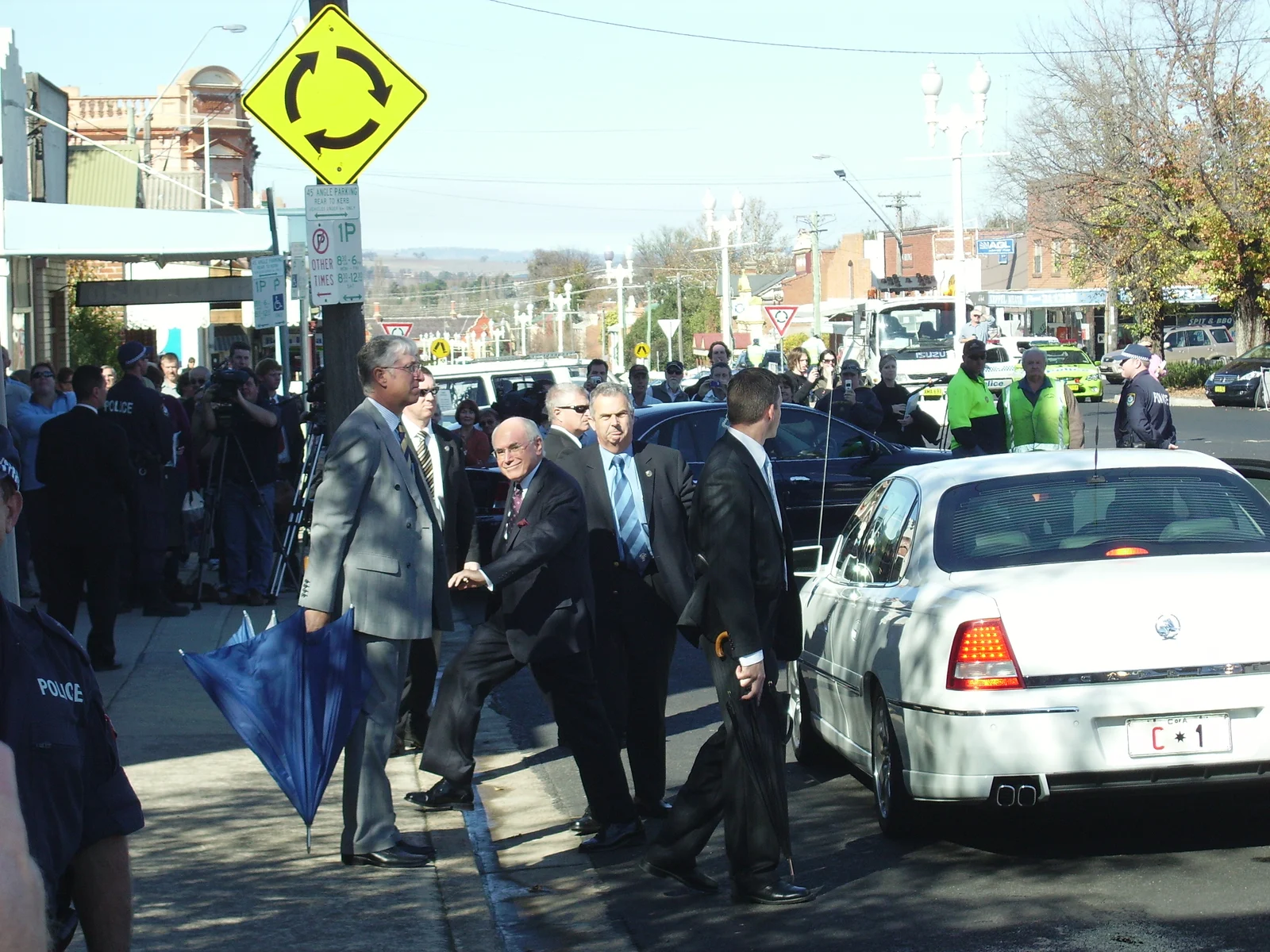
- 13. Wikimedia Commons / Cartman02auHoward gets out of car.JPG: complete original and copyright-holder licence choices