
In this biography
Quick facts
- Born
- 23 August 1954
- Birthplace
- Singapore
- Country
- Singapore
- Nationality
- Singaporean
- Known for
- Becoming Singapore’s first woman president after a career in the labour movement and Parliament
- Office
- President, 2017–2023
- Earlier office
- Speaker of Parliament, 2013–2017
- Profession
- Lawyer and labour leader
- Historic first
- First woman president of Singapore
Why this life matters
Halimah’s career links organised labour, parliamentary leadership, representation and the constitutional role of Singapore’s elected presidency.
Timeline
Key moments
Joined the labour movement
Began work with the National Trades Union Congress.
Entered Parliament
Was elected as a member of Jurong GRC.
Became speaker
Became the first woman to serve as Speaker of Parliament.
Became president
Was sworn in as Singapore’s eighth president and first woman head of state.
Completed her term
Left office after one six-year presidential term.
A career built in the labour movement
Halimah Yacob studied law at the University of Singapore and joined the National Trades Union Congress (NTUC) in 1978 as an industrial relations officer. The organisation’s own career record dates her appointment as director of its Legal Services Department to 1995 and its labour-studies institute to 1999. These posts were not merely honorary: they placed her within the structures that advised unions and trained representatives during Singapore’s economic change.
She also worked on women’s development and represented Singapore in the International Labour Organization. The Istana describes her as the first Singaporean elected to the ILO Governing Body. The institutional biographies differ slightly in how they count that service, so the important, well-supported point is her international labour role rather than an exact tenure total. Her labour experience preceded her elected office and remained a recurring subject of her public career.
From Parliament to Speaker
Halimah entered Parliament in 2001 as a member for Jurong Group Representation Constituency. She later served as a minister of state before Parliament elected her Speaker on 14 January 2013. Its recorded proceedings show there was one nomination for the office; the parliamentary account also identifies her as the first woman Speaker. This was a distinct constitutional role, presiding over debates and the work of the House, rather than an extension of her union position.
She continued as an MP until stepping down as Speaker in August 2017 to seek the presidency. The change matters to her biography because it moved her from an elected legislative seat into a non-partisan head-of-state office. Her earlier record in worker representation and community issues helps explain the public themes she carried into that office, but the legal powers of a president are different from those of a legislator or union official.
The reserved, uncontested 2017 election
The 2017 presidential election was reserved for candidates from Singapore’s Malay community. The Elections Department recorded five applications for eligibility, three applicants seeking Malay community certificates, and only one person issued both certificates required to stand. Its results list the election as uncontested. Halimah was declared elected on 13 September and sworn in on 14 September. She became Singapore’s eighth president and its first woman head of state; describing her as having won a popular vote in 2017 would be inaccurate.
The eligibility rules and the absence of a poll form part of the history of her accession, rather than a footnote to omit or a judgment on her subsequent work. Her official biography identifies women’s causes, disability organisations and disadvantaged families among her long-running interests. A careful account can recognise the representational first while also explaining precisely how the office was filled.
The presidency during the pandemic
Singapore’s elected president has custodial responsibilities over the nation’s past reserves. In a message to Parliament on 26 March 2020, Halimah described giving in-principle support to a proposed draw to finance extraordinary COVID-19 measures after consultation with the Council of Presidential Advisers. She explicitly said Parliament still needed to debate and pass the spending legislation before she would consider presidential assent. That sequence shows why it is misleading to say the president personally created the relief package or unilaterally released the reserves.
At a farewell reception in September 2023, she described the pandemic-era decisions as a test of the two-key system: the government initiated requests, while she assessed them in her custodial role. That is her own retrospective account, not an independent evaluation of every fiscal outcome. Her six-year term ended on 13 September 2023, and the next president was sworn in the following day. Her career thus spans three different institutions—NTUC, Parliament and the presidency—each with a different source of authority and responsibility.
Quick answers
Frequently asked questions about Halimah Yacob
- Who is Halimah Yacob?
- Halimah Yacob is an eighth President of Singapore. Halimah’s career links organised labour, parliamentary leadership, representation and the constitutional role of Singapore’s elected presidency.
- What is Halimah Yacob best known for?
- Halimah Yacob is best known for becoming Singapore’s first woman president after a career in the labour movement and Parliament.
- When and where was Halimah Yacob born?
- Halimah Yacob was born on 23 August 1954 in Singapore.
Keep exploring
Lives connected to this story
- Tharman Shanmugaratnam
Continue to the ninth president and distinguish the 2023 election result from the inauguration date.
- Yusof Ishak
Compare Singapore’s first president with the eighth president and the later elected-presidency system.
- Lee Hsien Loong
Read about the prime minister whose government worked with Halimah during the pandemic response.
Sources and further reading
Explore the evidence
These references support the biography and offer further reading. Official records, first-person accounts and independent reporting provide different perspectives; image records document attribution and licensing.
- 1. The IstanaMdm Halimah Yacob
- 2. Singapore Council of Women’s OrganisationsHalimah Yacob in the Singapore Women’s Hall of Fame
- 3. National Trades Union CongressKey Labour Movement contributors
- 4. Parliament of SingaporeParliament’s election of Speaker, 14 January 2013
- 5. Elections Department Singapore2017 presidential eligibility certificates
The Elections Department records the reserved-election and certificate process; its results page separately confirms that the election was uncontested.
- 6. Elections Department SingaporePresidential election results
- 7. Elections Department SingaporeDeclaration of elected president, 2017
- 8. The IstanaPresident’s message on proposed past-reserves draw
The March 2020 message documents in-principle support for a proposed reserves draw, not unilateral enactment of a relief package.
- 9. The IstanaHalimah Yacob’s farewell remarks
The 2023 account is Halimah’s own retrospective description of her constitutional role and is not an independent audit of policy effects.
- 10. Presidential Communications Office of the Philippines2019 Philippine state-visit photo archive
- 11. Wikimedia CommonsPresident Halimah Yacob in 2019 — image and licence record
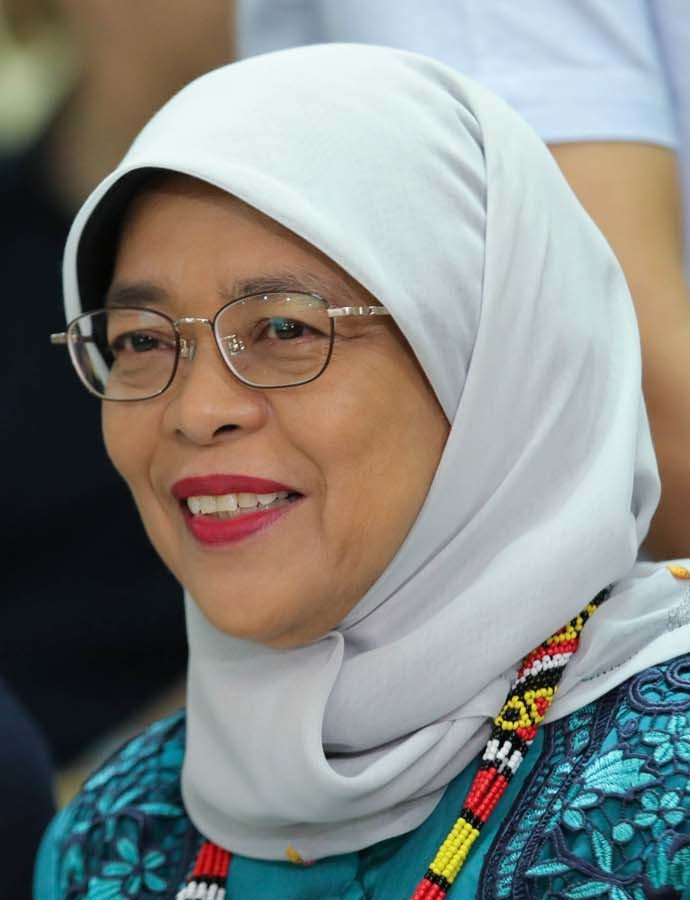
The local image is byte-identical to the complete 690-by-900 Commons crop of a 2019 Philippine Presidential Photo by Robinson Niñal Jr; the government photo archive lists the visit and Commons records the reuse basis.


