In this biography
Quick facts
- Born
- 1773
- Died
- 1857
- Birthplace
- Scarborough, England
- Country
- United Kingdom
- Nationality
- Not independently established
- Known for
- Distinguishing lift, propulsion and control in fixed-wing flight
Why this life matters
He treated lift, resistance, propulsion and control as problems that an aircraft design had to address together.
Timeline
Key moments
Design disc
An engraved design records an early heavier-than-air concept.
On Aerial Navigation
Publishes the first part of his account of flight principles.
Glider work
A later glider is associated with a human-carrying flight.
Scarborough and a broad engineering curiosity
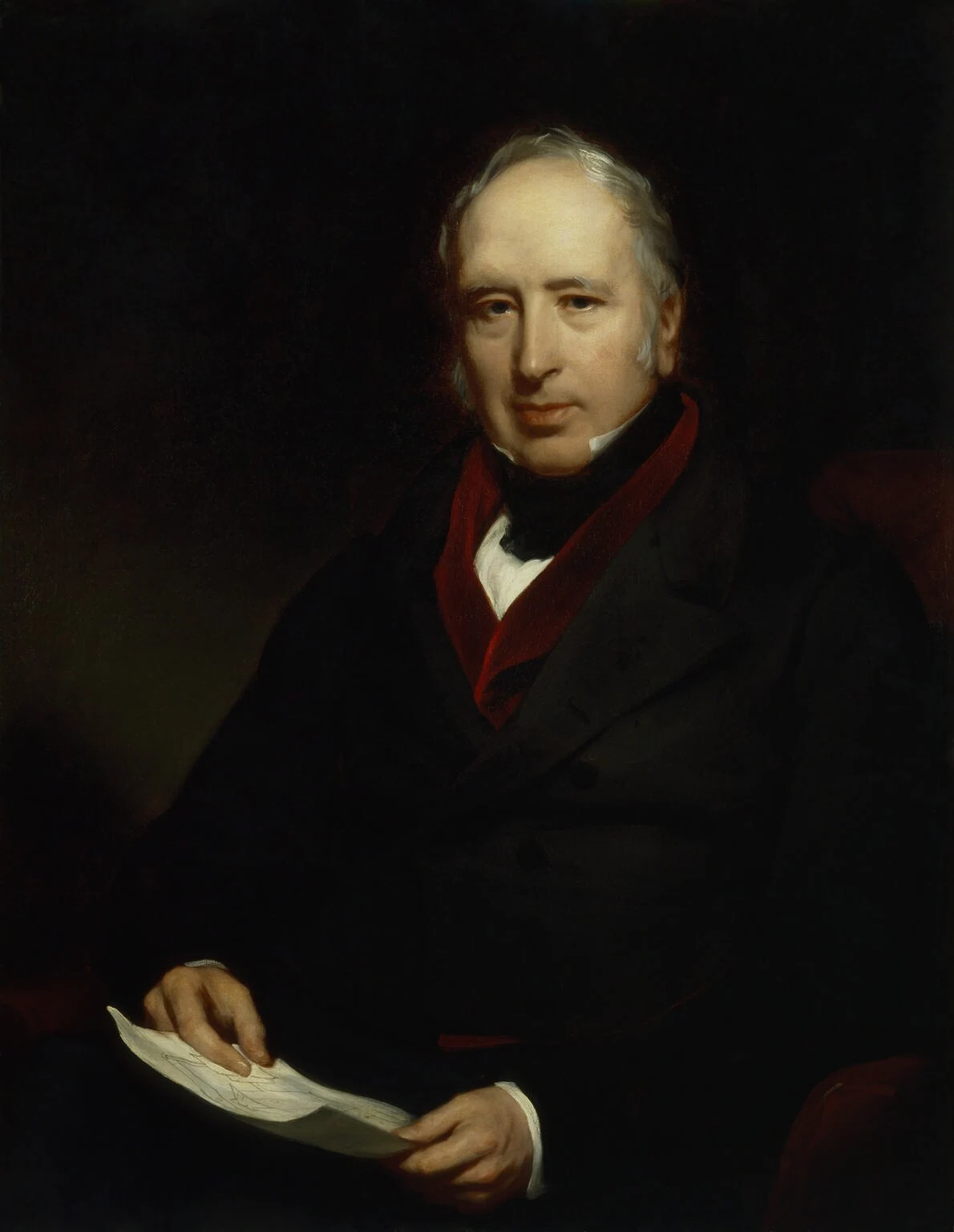
Cayley was born in Scarborough in 1773 and succeeded to his family’s baronetcy while young. His interests reached beyond flight, and his life included work in public institutions and a period in Parliament. Aviation was a problem to which he returned through drawings and experiments rather than a single commercial invention.
A silver disc in the Science Museum collection carries a design dated 1799. It offers evidence that he was thinking about a heavier-than-air machine, and it can be read beside later records that develop the argument. The date belongs to the design on the object, not to a flight by a full-size aircraft.
Breaking flight into problems
A wing can provide support while the craft moves through air. The craft must also overcome resistance and remain controllable. In his aerial navigation essay Cayley considered how the relationship between supporting surfaces, motion and resistance shaped practical design. The separation of problems mattered because an aircraft need not use a single moving part for every function.
Models gave him ways to test aspects of the idea. A gliding model could explore support and stability without carrying the entire means of sustained propulsion. A drawing could describe an intended arrangement without establishing its flight performance.
Gliders and later interpretation
The museum’s account connects Cayley’s long research programme to a human-carrying glider in 1853. This belongs at a different stage from a model or essay. His strongest historical contribution is the way he framed flight as an engineering problem with separable functions, which made it possible for later experimenters to ask narrower questions of an actual machine.
Sources for this section: [1]
Quick answers
Frequently asked questions about George Cayley
- Did Cayley’s 1799 disc show that an aircraft flew that year?
- No. It records a design. Evidence of a model or flight must be dated and identified separately.
Keep exploring
Lives connected to this story
- Frank Whittle
Compare a later test programme in which propulsion was a separate engineering task.
- Isambard Kingdom Brunel
Compare a British engineering career spanning multiple systems and forms of public work.
Sources and further reading
Explore the evidence
These references support the biography and offer further reading. Official records, first-person accounts and independent reporting provide different perspectives; image records document attribution and licensing.
- 1. Science Museum GroupGeorge Cayley
- 2. Science Museum GroupSmall silver disc engraved with an early design of Sir George Cayley
The date identifies the engraved design. It does not document construction or a flight.
- 3. George Cayley, 1809, Mississippi State University transcriptionOn Aerial Navigation, Part 1
First part of the historical essay in a university transcription; selected discussion of support and resistance.