
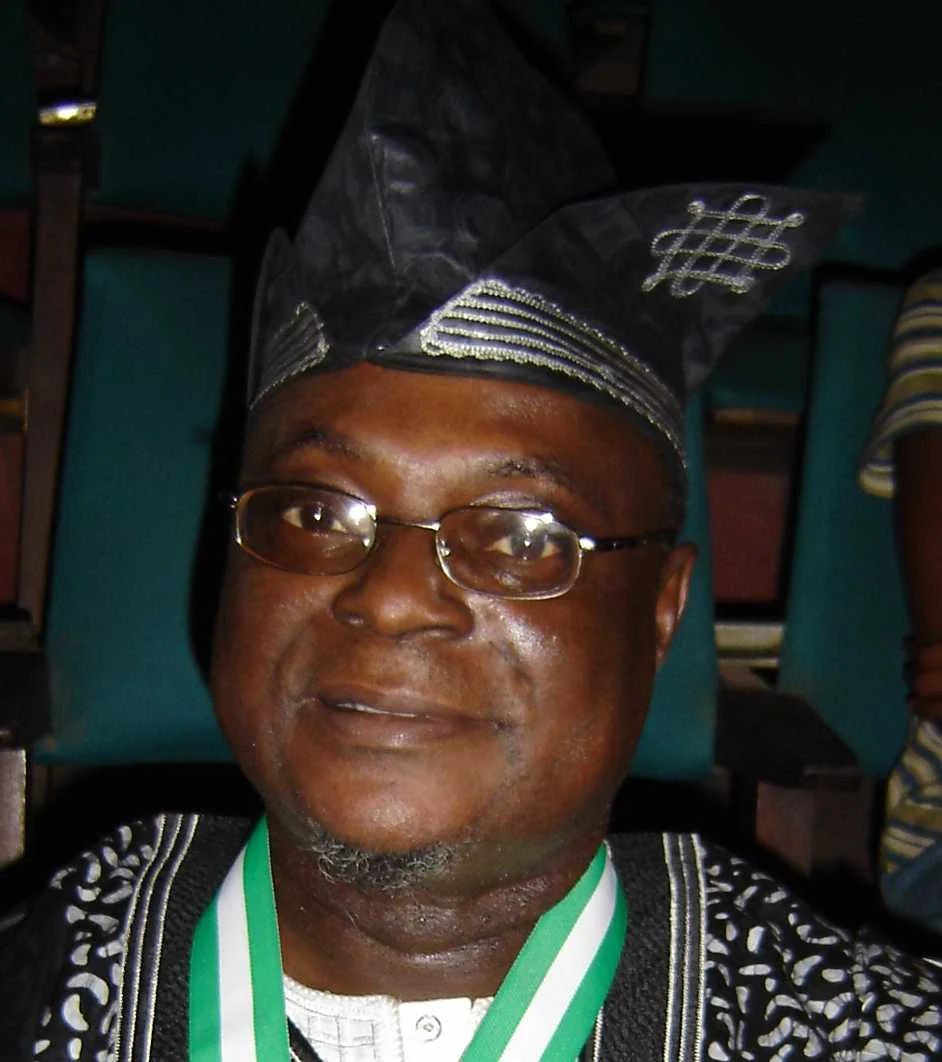
In this biography
Quick facts
- Born
- 1946
- Birthplace
- Not independently established
- Country
- Nigeria
- Nationality
- Not independently established
- Known for
- Women of Owu, politically engaged drama and poetry as Okinba Launko
- Birth
- 1946; exact date and locality not established here
- French degree
- University of Ibadan, 1969
- Poetry name
- Okinba Launko
- Thalia Prize
- 2016
Why this life matters
His participant accounts show adaptation as an active search for local histories and contemporary questions, supported by a career in teaching, criticism and theatre making.
Timeline
Key moments
Birth
Born in 1946 according to the IATC account.
French studies
Studied at Ibadan, including a year in Dakar.
Further study
Sorbonne study preceded a doctorate completed at Ibadan.
Newspaper work
Joined the pioneer editorial board of The Guardian in Lagos.
National recognition
Received the Nigerian National Order of Merit.
Thalia Prize
IATC recognised his contribution to understanding theatre.
Retrospective interviews
Discussed education, adaptation and theatre in participant accounts.
Schooling provided an early theatre vocabulary
The International Association of Theatre Critics dates Osofisan’s birth to 1946. In later interviews he describes losing his father in infancy, a mother who worked as a teacher and a childhood spent among relatives. Government College, Ibadan became a turning point. His account emphasises its library, facilities and opportunities for performance. In the Ohio State transcript he recalls encountering simplified Yoruba Shakespeare before studying English texts at secondary school. These recollections explain a route into drama through several languages and forms; they do not make his education a story of European texts arriving in an otherwise empty cultural setting.
French study led back to African drama
Osofisan entered the University of Ibadan in 1966, studied French and spent a year at Dakar before graduating in 1969. The IATC biography records a scholarship to the Sorbonne but states that he did not complete the degree there after disagreement over an African-drama thesis. He subsequently completed his doctorate at Ibadan. Distinguishing study from a completed qualification matters: an international itinerary is not a list of degrees. The same account places teaching and directing beside scholarship, showing how questions about dramatic traditions became part of practical and critical work.
Sources for this section: [1]
Several writing roles addressed different publics
The Ohio State interview introduces Osofisan as a playwright, director, scholar and poet who uses the name Okinba Launko. IATC also records his newspaper work, including membership of The Guardian’s pioneer editorial board in 1982. These roles offered different ways of engaging an audience: a play requires performance, a poem can circulate in print, and criticism argues about other people’s work. They should not be collapsed into a single count of books or productions. His career is more usefully understood through the interaction of making theatre, teaching its possibilities and debating its public responsibilities.
Women of Owu began with a comparative problem
In the 2023 PUNCH interview, Osofisan explains that a Chipping Norton commission to adapt Euripides’ Women of Troy prompted him to seek a comparable African history. The resulting Women of Owu joined that inquiry to contemporary concern about the invasion of Iraq, especially the suffering of women and children. This is his account of the work’s motivation, not a claim that the three historical situations are identical. It shows adaptation operating through choices about whose experience occupies the centre, and why an older dramatic structure might matter to a new public.
Sources for this section: [3]
An award recognised a contribution to theatre criticism
The Nigerian National Order of Merit in 2004 and IATC’s Thalia Prize in 2016 are useful fixed milestones. The Thalia announcement explains the prize’s interest in people who help critics understand new ways of seeing the performing arts. Its biographical introduction describes Osofisan’s writing, directing and international theatre connections. The award is therefore relevant to his work across artistic and critical practice, rather than proof of a particular audience’s response to every play. The association was marking the prize’s tenth anniversary in 2016; that does not make him its tenth recipient.
Later interviews preserve both conviction and perspective
Osofisan’s 2023 interview expresses concern about the conditions facing live theatre, while the 2024 Ohio State conversation returns to education and early encounters with drama. Such participant evidence is valuable precisely because it preserves perspective. His explanation of changing audiences is an artist’s judgment, not a national attendance survey, and a remembered commission is not the whole production archive. Taken together with IATC’s career account, the interviews make a substantial record of an artist who continually connects imaginative work to institutions, political choices and the question of how a public comes together.
Quick answers
Frequently asked questions about Femi Osofisan
- Is Okinba Launko a different person?
- It is the poetry name associated with Femi Osofisan in the Ohio State interview introduction.
- Did he complete a Sorbonne degree?
- The selected IATC biography explicitly says he did not; it records a later doctorate at Ibadan.
Keep exploring
Lives connected to this story
- Ola Rotimi
Compare a different playwright’s account of historical imagination and English/Yoruba expression.
- Wole Soyinka
Read another theatre career with a distinct dramatic and political vocabulary.
- Niyi Osundare
Explore the relation between poetry, public argument and recurring newspaper publication.
Sources and further reading
Explore the evidence
These references support the biography and offer further reading. Official records, first-person accounts and independent reporting provide different perspectives; image records document attribution and licensing.
- 1. International Association of Theatre Critics; introduction by Don RubinThalia Prize awarded to Femi Osofisan
Actual award announcement and selected biographical paragraphs read: 2016 award, born 1946, French study 1966–1969 including Dakar, incomplete Sorbonne study, Ibadan doctorate and theatre/critical work. Not a full play. The prize’s tenth anniversary is not a claim that he was its tenth recipient.
- 2. Amrita Dhar and Adélékè Adéẹ̀kọ́; Shakespeare in the Postcolonies, Ohio State University, 9 August 2024Femi Osofisan: interview and transcript
Actual published transcript introduction and opening schooling dialogue read (approximately first 6,000 characters), including the Okinba Launko pseudonym, Yoruba Shakespeare introductions and school performance/libraries. The remaining transcript, embedded audio and complete plays were not consumed. Host biographical statements are distinguished from Osofisan’s replies.
- 3. Fatteh Hamid; PUNCH, 17 June 2023Challenges caused by political leaders tempting me to japa — Prof Osofisan
Actual selected first-person interview paragraphs read, approximately first 8,500 characters: upbringing, Government College, writing, Women of Owu commission, Euripides/Owu/Iraq connection, theatre opinions and awards. Not the complete play, original commission file or performance; opinions about theatre decline are attributed, not treated as survey findings.
